
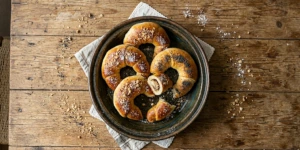
Bratislavské rožky - Bratislava Sweet Rolls with Poppy or Walnut Filling
If you walk through the historic streets of Bratislava, the aroma of sweet yeast and toasted nuts is almost guaranteed to lead you to a tray of Bratislavské rožky. Known in German as Pressburger Kipfel and in Hungarian as Pozsonyi kifli, these crescent-shaped rolls are more than just a pastry-they are a protected culinary treasure with centuries of tradition.
What sets them apart is their incredibly high filling-to-dough ratio and their distinctive "marbled" surface. To be called a true Bratislava Roll, the pastry must follow strict rules, earning it the Traditional Speciality Guaranteed (TSG) status in the European Union.
A Bite of History: From Royal Bakeries to Your Table
The story of these rolls dates back to the late 18th century. History suggests that they were first sold at the city’s St. Nicholas Fair in 1785. However, their global fame was cemented by the bakery of Wilhelm Scheuermann in the 1830s, who perfected the recipe that was later enjoyed by the Habsburg royalty in Vienna.
For centuries, Bratislava (then Pressburg) was a melting pot of Slovak, German, and Hungarian cultures. This pastry is the perfect reflection of that "Danubian" heritage-refined, elegant, and uncompromising on quality.
The "Secret Code" of Shapes
A true connoisseur knows that you don't need to bite into a Bratislava roll to know what’s inside. The bakers of old developed a visual "code" so that customers could identify the filling at a glance:
| Feature | Poppy Seed Filling (Makový) | Walnut Filling (Orechový) |
|---|---|---|
| Shape | Horseshoe / U-shape (sharper curve) | C-shape (shallower curve) |
| Dough Texture | Thin and elastic | Thin and elastic |
| Surface | Shiny, marbled golden-brown | Shiny, marbled golden-brown |
| Filling Ratio | Minimum 30% (usually 40-50%) | Minimum 30% (usually 40-50%) |
Why the "Marble" Crust?
The hallmark of a perfect Bratislavské rožok is its marbled, cracked surface. This isn't an accident-it’s the result of a specific, patient technique.
After the rolls are formed, they are brushed with egg yolk and placed in a cool, drafty spot to dry. Once the first layer dries and cracks slightly, they are brushed again (sometimes with egg white or a second yolk) and moved to a warm area to rise. This "shock" between cold and warm, combined with the drying layers, creates the beautiful mosaic pattern during baking.
Key Ingredients for Authenticity
To recreate this at home, you need to step away from "fluffy" bread rolls. These are rich and dense.
- The Dough: It must contain at least 30% fat (butter or lard) relative to the flour weight. This creates a shortcrust-like texture that is tender yet firm. No chemical leaveners-only natural yeast.
- The Filling: The poppy seeds must be finely ground and cooked with sugar, milk, and lemon zest. The walnuts are typically scalded with hot sugar syrup and flavored with vanilla or a hint of rum.
- No Artificial Preservatives: Traditionally, the rolls stay fresh for days thanks to the high fat and sugar content, making them the perfect travel snack for 19th-century aristocrats (and 21st-century foodies).
Serving and Pairing Suggestions
Bratislavské rožky are traditionally served at room temperature. They are a staple of the "Kaffee und Kuchen" (Coffee and Cake) culture.
- Best with: A strong dark espresso or a glass of cold milk.
- When to eat: They are excellent as a sophisticated breakfast or a late-afternoon treat.
Pro Tip: If you’re visiting Bratislava, look for the "official" bakeries that carry the TSG seal to ensure you’re tasting the original, centuries-old recipe.