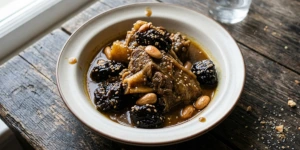
Tagine Lahm bil Barkouk Recipe (Moroccan Lamb Tagine with Prunes)
- Preparation time
- 25 mins
- Total time
- 2 hours 40 mins
- Yield
- 4-6 servings

Region: Maghreb

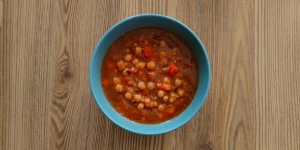
Moroccan cuisine combines Amazigh, Arab-Andalusian, Jewish, Saharan and Mediterranean traditions. Couscous, tagines, breads, pulses, vegetables, olive oil, preserved foods, meat, poultry and fish form the foundation of everyday cooking. Spices are used with care rather than simply in large quantities: cumin, ginger, turmeric, cinnamon, paprika, saffron and black pepper appear in different combinations, alongside fresh coriander and parsley.
The Moroccan National Tourist Office describes the cuisine as particularly shaped by Amazigh, Arab-Andalusian and Jewish culinary traditions. These influences developed differently from region to region, which is why there is no single formula for Moroccan tagine, couscous or even bread.
Amazigh food traditions form one of the oldest layers of Moroccan cooking, especially in grain dishes, breads, couscous and slow-cooked foods. Islamic-era trade and migration strengthened connections with the wider Arab world and Mediterranean, while Andalusian Muslims and Jews arriving from Iberia contributed to the urban cuisines of cities such as Fez and Tetouan.
Jewish Moroccan cooking developed alongside Muslim traditions for centuries and contributed its own preserved foods, breads, festive dishes and spice combinations. Trans-Saharan trade linked Morocco with West Africa, while Mediterranean and Atlantic trade connected it with southern Europe and the wider Islamic world.
Unlike several neighboring territories, Morocco was not incorporated into the Ottoman Empire, so it is misleading to describe Ottoman cuisine as a dominant historical foundation of Moroccan food. French and Spanish protectorate rule in the twentieth century later influenced cafés, baking and urban eating habits without replacing older Moroccan traditions.
Fez is famous for an elaborate urban cuisine in which sweet and savory flavors can appear together. Pastilla, traditionally made in warka pastry with poultry or other fillings, is one of its most recognizable dishes. Slow-cooked meat dishes, couscous and carefully balanced spice mixtures are also important.
Fish and seafood become much more prominent along the coast. Sardines are particularly important and may be grilled, fried, stuffed or seasoned with chermoula, a mixture commonly made with herbs, garlic, spices, lemon and oil.
Mountain and rural cooking relies heavily on grains, bread, legumes, vegetables and slow-cooked meat. The Souss region is especially associated with argan oil and amlou, a spread traditionally made with argan oil, almonds and honey. Dates and preserved foods become increasingly important toward the oases and pre-Saharan south.
Mint tea, bread and shared dishes are central to Moroccan hospitality, but the country's cuisine is best understood through this regional diversity rather than through a short list of tagines and spices.