
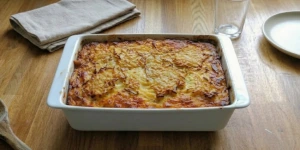
Kugelis (Baked Potato Pudding)
Achieving the perfect Kugelis is an exercise in starch management and temperature control. This traditional Lithuanian baked potato pudding relies on a delicate, custard-like crumb contrasted by a deeply caramelized, savory crust. Unlike standard potato casseroles, authentic Kugelis uses finely puréed potatoes rather than shreds, resulting in a cohesive, uniform texture. By understanding how to scald the dairy and retain the natural potato starches, you can prevent the dish from becoming dense, watery, or grey.
What is Kugelis & Its Origins
Kugelis (also known in some regions as plokštainis) is the national dish of Lithuania. Historically, its roots are shared with the Jewish kugel, a dish that migrated throughout Eastern Europe during the era of the Polish-Lithuanian Commonwealth. As potato cultivation became dominant in Lithuania during the late 18th and 19th centuries, local cooks adapted the concept, enriching it with pork fat, bacon (spirgai), and milk or cream. Today, it remains a centerpiece of Lithuanian celebratory meals and Sunday family dinners.
What Does It Taste Like?
Kugelis offers a rich, comforting flavor profile dominated by smoky bacon, sweet caramelized onions, and earthy, savory potato. Texture-wise, it is uniquely dualistic: the interior is silky, moist, and custard-like - almost melting on the tongue - while the top and edges bake to a deeply browned, crispy, and slightly chewy crust.
Popular Variations
While the classic bacon-and-onion version is the most revered, regional variations exist across Lithuania. In some households, raw chicken pieces or chicken wings are baked directly inside the pudding, infusing the potato mixture with rich poultry fat. In modern variations, heavy cream is substituted for milk to yield an even denser, richer texture, while vegetarian versions substitute butter or vegetable oils for the traditional rendered pork fat.
What To Serve With Kugelis
To balance the rich, fatty profile of the potato pudding, serve it with traditional high-acid or cool accompaniments. A generous dollop of sour cream (grietinė) is mandatory. It is traditionally topped with spirgai - crispy fried bacon bits and onions sautéed in bacon fat. To cut through the richness, accompany the dish with a crisp dill cucumber salad, pickled beets, or a tart cranberry or lingonberry preserve.
Expert tips:
The Starch Retention Technique
Never discard the liquid from squeezed potatoes without reclaiming the starch. The white sediment at the bottom of the liquid bowl is pure potato starch. Reincorporating it acts as a natural binder, ensuring a rich, cohesive, velvety interior without needing flour.
Preventing Discoloration
Potatoes oxidize quickly once their cell walls are ruptured. Grating quickly, adding lemon juice or a crushed vitamin C tablet, and immediately pouring the scalded milk over the grated pulp will keep your Kugelis a beautiful light cream color inside rather than an unappetizing slate grey.
Selecting the Right Potato
High-starch Russet (Idaho) potatoes are mandatory. Their high amylose content provides the necessary structure to absorb the liquid fats and dairy. Waxy potatoes, such as Yukon Gold or red potatoes, contain too much sugar and moisture, resulting in a gummy, dense pudding.
Slicing and Serving Cleanly
Like a lasagna, Kugelis requires a cooling phase. Cutting into it directly out of the oven will cause the slices to slump. A 15-to-20-minute rest allows the starch and egg proteins to cool slightly and firm up, ensuring clean, defined slices.
Storage:
How to store
Allow the Kugelis to cool completely to room temperature. Cover the baking dish tightly with aluminum foil or transfer individual slices to an airtight container.
Shelf life
Kugelis stores exceptionally well in the refrigerator for up to 4 days. In fact, many argue it tastes even better the next day when sliced and pan-fried in butter.
Freezing instructions
Freezing is not recommended. The cellular structure of cooked potatoes degrades significantly when frozen and thawed, causing the pudding to release water and develop a spongy, dry texture.
Recipe information:
Core Ingredients
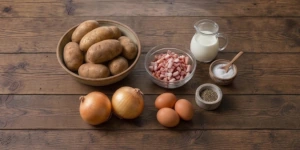
Substitutions for ingredients:
- Smoked Slab Bacon - Pancetta or salt pork can be used. For a vegetarian alternative, substitute with 1/2 cup (115g) of unsalted butter melted and browned to coat the onions.
- Whole Milk - Half-and-half or heavy cream can be used for an even richer custard. For dairy-free versions, unsweetened, unflavored cashew milk is a viable alternative.
- Lemon Juice - A pinch (1/4 teaspoon) of powdered ascorbic acid (Vitamin C) dissolved in a tablespoon of water works perfectly without altering the flavor profile.
Preparation
1. Render the Bacon and Onions
2. Scald the Milk
3. Grate the Potatoes
4. Extract and Retain Potato Starch
5. Temper and Combine
6. Bake to Golden Perfection
Frequently Asked Questions (FAQ):
What is the best way to reheat leftover Kugelis?
The absolute best method is slicing cold Kugelis into 1/2-inch thick slabs and pan-frying them in a hot skillet with a tablespoon of butter over medium heat. Fry until both sides are exceptionally crispy and the center is piping hot.
Can I use a food processor instead of grating manually?
Yes. Use the finest grating disc or the metal S-blade to process the potatoes into a very fine, watery pulp. Avoid leaving any large chunks, as they will not cook at the same rate and will ruin the uniform texture.
Is Kugelis gluten-free?
Yes, this authentic recipe is naturally gluten-free. It relies entirely on potato starch and eggs to bind the pudding together, requiring no flour additions.
How does Kugelis differ from Jewish Potato Kugel?
While historically linked, Lithuanian Kugelis traditionally utilizes rendered pork fat, bacon, and scalded milk. Jewish Kugel complies with kosher dietary laws, meaning it does not combine meat and dairy, and never uses pork products.