
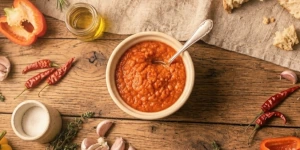
Mojo Rojo - Traditional Red Sauce from the Canary Islands
Mojo Rojo is one of the best-known sauces of the Canary Islands. It is a strong, garlicky red sauce built around peppers, cumin, vinegar and olive oil. You will see it on tables across the islands, most famously next to papas arrugadas, the small potatoes boiled in heavily salted water until their skins wrinkle.
The name mojo rojo simply means red mojo. The hotter version is often called mojo picón. The distinction is not always strict because recipes vary from island to island and from one household to another. Some cooks use hot local peppers, others make a milder red mojo with sweet peppers. There is no single recipe that every Canarian kitchen follows.
A sauce with many local versions
The basic family of Canary Islands mojos is built around a few familiar ingredients: garlic, oil, vinegar and salt. What changes is the main ingredient. Green mojos can contain coriander, parsley or green peppers, while red mojos get their colour from red peppers and paprika.
For a traditional red mojo, dried peppers are especially common. Local Canarian peppers such as pimienta palmera or pimienta picona are used when available. Outside the Canary Islands they can be difficult to find, so dried ñora or choricero peppers are practical substitutes. They are soaked until soft and then crushed into the sauce.
Mojo Rojo and Mojo Picón
Mojo Rojo can be mild or hot. Mojo Picón is generally the hotter version, made with spicy peppers or additional dried chilli. The other ingredients remain broadly similar: garlic, cumin, paprika, vinegar, olive oil and salt.
This recipe sits between the two styles. It uses sweet dried red peppers for colour and body, with one small dried chilli that can be increased or omitted depending on how hot you want the sauce.
Why cumin matters
Cumin is one of the flavours that immediately makes Mojo Rojo taste like a Canarian sauce rather than an ordinary red pepper dip. Traditionally, the cumin is often crushed together with garlic and coarse salt in a mortar before the peppers are added.
Grinding the ingredients in a mortar gives the sauce a slightly rougher texture. A blender is faster and works perfectly well at home, but do not blend the sauce longer than necessary. Mojo Rojo does not need to be completely silky smooth.
How the sauce is traditionally made
The old-fashioned method starts with garlic, salt and cumin in a mortar. The ingredients are crushed into a paste, followed by the softened peppers and paprika. Olive oil and vinegar are then worked in gradually until the sauce becomes thick and glossy.
A blender or immersion blender is a modern shortcut. The flavour remains recognisably Canarian as long as the basic ingredients are right. The important thing is to add the olive oil gradually rather than dumping everything together at the beginning.
What to serve with Mojo Rojo
The most traditional partner for Mojo Rojo is papas arrugadas. The salty potatoes and sharp sauce belong together. The sauce is also commonly served with grilled meat, fish and vegetables.
Keep a bowl of Mojo Rojo on the table and let people add as much as they want. It is strong enough that a little goes a long way, especially when the garlic and chilli have had time to sit in the sauce.
Making it ahead
Mojo Rojo is one of those sauces that often tastes better after resting. The garlic, cumin, peppers and vinegar have time to come together, and the flavour becomes more rounded after several hours in the refrigerator.
Store it in a clean jar and stir it before serving if the olive oil separates. Depending on the recipe and storage conditions, Canarian sources describe keeping mojo refrigerated from several weeks to even several months, but for a homemade sauce made with fresh ingredients, keeping it refrigerated and using it within a few weeks is the safer and more practical approach.
Expert tips:
Use dried peppers for a more traditional result
Fresh red bell pepper makes a perfectly good sauce, but dried peppers give Mojo Rojo a more concentrated flavour and are closer to many traditional Canarian versions. Ñora and choricero peppers are useful substitutes when Canarian peppers are unavailable.
Crush the cumin seeds
Whole cumin seeds are traditionally crushed with the garlic and salt. Pre-ground cumin works in a pinch, but freshly crushed seeds give the sauce a stronger and cleaner flavour.
Add the oil gradually
Pouring the olive oil in slowly gives you a thicker and more even sauce. If the sauce separates later, simply stir it again before serving.
Do not make it completely bland
Mojo Rojo is supposed to taste sharp and assertive. If it tastes like an ordinary red pepper spread, it probably needs more garlic, cumin, vinegar or salt.
Let it sit before judging the flavour
Freshly made mojo can taste aggressively garlicky. Give it at least 30 minutes before making major adjustments. The flavours settle noticeably after resting.
Storage:
How to store
Transfer the sauce to a clean glass jar with a tight lid and keep it in the refrigerator. Use a clean spoon each time you serve it.
Shelf life
For a homemade version, use the sauce within 2 weeks and keep it refrigerated. Some traditional Canarian versions are kept much longer, but storage time depends heavily on the ingredients, preparation and cleanliness of the container.
Freezing instructions
Freezing is possible, but not ideal. The texture can change and the oil may separate after thawing. If you freeze it, thaw it in the refrigerator and blend or stir it again before serving.
Recipe information:
For the Mojo Rojo
Substitutions for ingredients:
- Canarian dried peppers - Use dried ñora or choricero peppers. These are the closest widely available substitutes for traditional dried red peppers used in many versions of Mojo Rojo.
- Dried red chilli - Use cayenne or another dried hot chilli. Leave it out completely for a mild Mojo Rojo.
- Cumin seeds - Use ground cumin if necessary. Use slightly less because pre-ground cumin can be more concentrated.
- Wine vinegar - Sherry vinegar works very well. White wine vinegar is another good choice. Avoid strongly flavoured sweet vinegars because they change the character of the sauce.
- Olive oil - Extra virgin olive oil is the traditional choice. A milder olive oil can be used if your extra virgin oil is particularly bitter.
Prepare the Peppers
1. Soak the dried peppers
2. Prepare the pepper flesh
Make the Sauce
1. Crush the garlic and cumin
2. Add the peppers and paprika
3. Add the vinegar
4. Work in the olive oil
5. Adjust the consistency
6. Let the sauce rest
Frequently Asked Questions (FAQ):
Is Mojo Rojo the same as Mojo Picón?
They are closely related. Mojo Rojo refers to the red Canarian sauce, while Mojo Picón usually refers to a hotter version made with spicy peppers. The names and recipes can overlap depending on the island and household.
What is Mojo Rojo traditionally served with?
The classic accompaniment is papas arrugadas, small Canary Islands potatoes boiled in heavily salted water. Mojo Rojo is also served with grilled meat, fish and vegetables.
Can I use fresh red bell peppers?
Yes, and many modern recipes do. Roasted fresh red peppers make a softer and sweeter sauce. Dried peppers, however, give a more concentrated flavour and are closer to many traditional versions.
Should Mojo Rojo be smooth or coarse?
Both are acceptable. A mortar produces a rougher texture, while a blender gives a smoother sauce. Traditional preparation does not require the sauce to be perfectly smooth.
Can I make Mojo Rojo without chilli?
Yes. Use only sweet dried red peppers and paprika for a mild version. The result is still Mojo Rojo, just without the stronger heat associated with Mojo Picón.
Why does my Mojo Rojo taste better the next day?
The ingredients have more time to sit together. The garlic, cumin, peppers and vinegar become less separate and the overall flavour becomes more even after resting.