
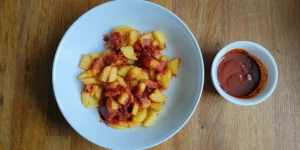
Patatas Bravas - Spanish Potatoes with Spicy Brava Sauce
What are Patatas Bravas?
Patatas bravas are one of the most recognizable tapas in Spain: pieces of potato fried until golden and served with a spicy sauce known as salsa brava. They are particularly associated with Madrid, where the dish became a bar and tavern classic during the twentieth century.
The potatoes are usually cut into irregular bite-sized pieces rather than thin French fries. They should be soft and creamy inside with a browned exterior, then served immediately with enough brava sauce to season them without completely soaking the crisp potatoes.
Origins of Patatas Bravas in Madrid
The exact origin of Patatas Bravas is not known, but the dish is strongly associated with Madrid. It is sometimes claimed that its history reaches back to the late nineteenth century, but the surviving evidence does not support identifying those early potato dishes with modern Patatas Bravas.
In 1893, Spanish writer and gastronome Ángel Muro wrote in El Practicón about potatoes being eaten with a wide variety of sauces and seasonings. Potatoes were inexpensive and widely consumed, including among the poorer population of Madrid. This provides useful historical context for the popularity of potatoes with sauces, but Muro did not describe the modern dish known as patatas bravas.
The recognizable tapa is much more safely associated with Madrid in the middle of the twentieth century. Two establishments often mentioned in connection with its early popularity are Casa Pellico and La Casona, both remembered for serving spicy potatoes during the 1950s. However, the Academia Madrileña de Gastronomía notes that these origin stories are difficult to document conclusively.
Another important name is Las Bravas, a Madrid bar whose distinctive spicy sauce became famous during the 1950s. The Las Bravas name was registered as a trademark in 1959, providing much firmer evidence that potatoes served with a characteristic spicy brava sauce had become an established part of Madrid bar culture by that period.
For this reason, rather than claiming that Patatas Bravas originated in the nineteenth century, it is more accurate to say that potatoes served with sauces had older precedents in Madrid, while the modern dish called Patatas Bravas became clearly established around the middle of the twentieth century.
What is authentic Salsa Brava?
There is no single universally accepted brava sauce. Madrid bars have historically guarded their recipes closely, and several distinct styles developed.
One of the most strongly documented traditional Madrid styles contains no tomato. Instead, its red color and spicy character come from pimentón, combined with olive oil, flour and broth. Onion, garlic, vinegar or cayenne may also be included.
The Academia Madrileña de Gastronomía describes genuine Madrid brava sauce as based on olive oil, onion and hot paprika, with flour sometimes used to thicken it and broth added in many versions. Madrid's official restaurant guide likewise notes that the original sauce is said to have contained oil, flour, broth and paprika rather than tomato.
Does Salsa Brava contain tomato?
It can. Tomato-based brava sauces are now widespread across Spain, and some historic Madrid establishments also use tomato in their own proprietary sauces. Las Bravas in Madrid, for example, uses tomato together with sweet and hot paprika, olive oil, flour, garlic and other seasonings.
For that reason, it would be incorrect to say that tomato sauce is not authentic at all. It is simply not required, and the tomato-free paprika-and-broth style has particularly strong associations with classic Madrid bravas.
Pimentón and heat
The defining flavor of the sauce is pimentón, Spanish ground red pepper. Combining sweet and hot varieties gives both depth and heat without turning the sauce into an extremely hot chili sauce.
Not every Spanish paprika is necessarily smoked. Pimentón de la Vera has a characteristic smoky flavor because of its production method, while other Spanish paprika can taste different. Use good Spanish sweet and hot paprika rather than assuming all pimentón must taste strongly smoked.
Preparing the potatoes
Use a floury or all-purpose potato suitable for frying. In Spain, varieties such as Agria are particularly popular for fried potatoes because they develop a crisp surface while remaining soft inside.
Cut the potatoes into irregular chunks about 3 to 4 cm across. A two-stage frying method works particularly well: first cook them gently in moderately hot oil until tender, then fry them at a higher temperature until golden.
This produces the contrast associated with good Patatas Bravas: a soft center and a lightly crisp exterior.
Preparing the Brava Sauce
Cook the onion and garlic gently in olive oil until soft. Add flour to provide body, followed by sweet and hot paprika. The paprika should only cook briefly because excessive heat can make it bitter.
Gradually add the broth while stirring until the sauce becomes smooth and lightly thickened. Finish with a little wine or sherry vinegar to balance the richness and paprika.
The sauce can be blended for a completely smooth texture or left slightly rustic. It should be fluid enough to spoon over the potatoes rather than as thick as tomato ketchup.
What about Aioli?
Patatas Bravas are sometimes served with aioli or garlic mayonnaise, particularly outside the traditional Madrid style and in many modern tapas bars. The combination of brava sauce and aioli is now very popular.
However, aioli is not required for classic Madrid-style Patatas Bravas. This recipe therefore serves the potatoes with brava sauce alone, while aioli can be offered separately as an optional variation.
How to serve Patatas Bravas
Serve the potatoes immediately after the final frying. Season them with salt and spoon the warm brava sauce over the top just before serving.
Patatas Bravas are normally eaten as a tapa or shared portion, often alongside other dishes such as tortilla española, croquetas, olives or fried seafood. They are strongly associated with Spanish bar culture and are commonly served with beer, wine or vermouth.
Regional and modern variations
As Patatas Bravas spread across Spain, many different interpretations developed. Madrid is particularly associated with a paprika-based brava sauce, while other areas frequently use tomato-based sauces.
In Catalonia and many modern tapas bars, the potatoes are commonly served with both a spicy red sauce and aioli. Other cooks roast the potatoes instead of frying them, while contemporary restaurants may use confit potatoes, elaborate sauces or individual presentation.
These are legitimate variations of a dish that has never had one completely standardized sauce, but the combination of fried potatoes and a distinctly spicy salsa brava remains its defining feature.
Expert tips:
Do not burn the paprika
Ground paprika can become bitter when exposed to high heat for too long. Lower the heat or briefly remove the pan from the stove before adding it.
Use both sweet and hot Pimentón
Combining sweet and hot Spanish paprika gives the sauce depth as well as heat. Adjust the proportion rather than relying only on cayenne or generic chili flakes.
Tomato is optional, not mandatory
Many Spanish brava sauces contain tomato, but traditional Madrid-style versions are well documented without it. The red color can come almost entirely from paprika.
Fry the potatoes twice
The first lower-temperature fry cooks the center gently. A short second fry at higher temperature produces a browned exterior without drying the interior.
Sauce immediately before serving
Do not leave the potatoes sitting under the sauce for a long time. Spoon it over shortly before serving so the outside remains crisp.
Aioli is optional
Aioli or garlic mayonnaise is common in many modern and regional versions, but classic Madrid bravas do not require it.
Storage:
Brava Sauce
Cool leftover sauce promptly and refrigerate it in a covered container for up to 3 to 4 days. Reheat gently and add a little water or broth if it has thickened.
Cooked Potatoes
Fried potatoes are best eaten immediately. Refrigerate leftovers in a covered container and use them within 2 to 3 days.
Reheating
Reheat the potatoes in a hot oven or air fryer until crisp and hot. Reheat the sauce separately and combine only when serving.
Freezing
Freezing finished Patatas Bravas is not recommended because the fried potatoes lose much of their crisp texture after thawing.
Recipe information:
Potatoes
Madrid-Style Brava Sauce
Substitutions for ingredients:
- Vegetable Broth - For a non-vegetarian Madrid-style version, use chicken, ham or cocido broth. Meat-based broths are common in traditional and modern Madrid brava sauces.
- Hot Spanish Paprika - Use sweet Spanish paprika with a small amount of cayenne if pimentón picante is unavailable.
- Wine Vinegar - Use sherry vinegar for a particularly Spanish character or another mild wine vinegar.
- Plain Flour - Cornstarch can be used to make a gluten-free adaptation, but the method changes: dissolve it in a little cold broth and add it toward the end rather than frying it in the oil.
- Frying - The potatoes can be roasted with olive oil as a modern variation, although frying is more characteristic of traditional Patatas Bravas.
Prepare the Brava Sauce
1. Cook the onion and garlic
2. Add the flour
3. Add the paprika
4. Add the broth
5. Finish the sauce
Prepare the Potatoes
1. Cut the potatoes
2. First fry
3. Second fry
4. Drain and season
5. Serve
Frequently Asked Questions (FAQ):
Where do Patatas Bravas come from?
They are strongly associated with Madrid. The exact inventor is disputed, but the modern dish became clearly established in Madrid bar culture around the middle of the twentieth century.
Were Patatas Bravas invented in the nineteenth century?
There is no strong evidence for that. Ángel Muro wrote in 1893 about potatoes being eaten with many different sauces and seasonings, but he did not describe the modern dish called Patatas Bravas. These nineteenth-century references are better treated as background to the later dish.
Did Casa Pellico or La Casona invent Patatas Bravas?
Both Madrid establishments are often mentioned in stories about the early popularity of spicy potatoes during the 1950s, but the Academia Madrileña de Gastronomía notes that these accounts are difficult to document conclusively. They should therefore be treated as plausible parts of the dish's history rather than proven invention stories.
Why is Las Bravas important to the history of the dish?
The Madrid bar Las Bravas became famous for its spicy potato sauce during the 1950s, and the Las Bravas name was registered as a trademark in 1959. This provides strong evidence that Patatas Bravas were already firmly established in Madrid by that period.
Does authentic Salsa Brava contain tomato?
Not necessarily. A classic Madrid style uses olive oil, paprika, flour and broth without tomato. Other authentic Spanish versions do contain tomato, including the proprietary sauce used by Madrid's Las Bravas.
Does authentic Patatas Bravas include aioli?
Aioli is not required in traditional Madrid-style Patatas Bravas. Serving both brava sauce and aioli is common in other parts of Spain and in modern tapas bars.
Why are Patatas Bravas spicy?
The heat traditionally comes from hot Spanish paprika and sometimes cayenne or another chili. The word brava suggests the bold or fierce character of the sauce.
Is Pimentón the same as smoked paprika?
Not always. Pimentón means Spanish ground red pepper. Some varieties, especially Pimentón de la Vera, are smoked, but Spanish paprika is not universally smoky.
What potatoes are best for Patatas Bravas?
Use potatoes suitable for frying that become tender inside while holding their shape. Agria is a particularly popular Spanish frying variety, but another floury or all-purpose potato can be used.
Why fry the potatoes twice?
The lower-temperature first fry cooks the center without excessive browning. The hotter second fry crisps and colors the exterior shortly before serving.
Can Patatas Bravas be baked?
Yes, roasted versions are common modern alternatives, but traditional bar-style Patatas Bravas are normally fried.
Are Patatas Bravas vegetarian?
This recipe is vegetarian because it uses vegetable broth. Some traditional Madrid brava sauces use chicken, ham or cocido broth, so restaurant versions should not automatically be assumed to be vegetarian.
Are Patatas Bravas gluten-free?
Not always. Traditional-style brava sauce can contain wheat flour as a thickener. A gluten-free version can be made with a suitable starch, but this recipe as written contains wheat flour.