
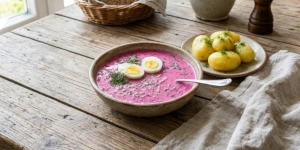
Lithuanian Cold Beet Soup (Šaltibarščiai) Recipe
What is Šaltibarščiai?
Šaltibarščiai is the bright pink cold beet soup that shows up everywhere in Lithuania once the weather gets warm. The modern version is simple: beets, kefir, cucumber, dill, spring onions and hard-boiled eggs. It is served properly cold, usually with hot boiled potatoes on a separate plate.
The color comes naturally from the beetroot mixing with the pale kefir. The flavor is tangy, fresh and slightly earthy, with cucumber and herbs keeping the soup light. The hot potatoes make it much more substantial and provide the familiar contrast between hot and cold that is part of the way the dish is eaten in Lithuania.
The history is older than the pink soup we know today
The history of Šaltibarščiai is more complicated than simply saying that the modern kefir soup has been eaten unchanged for centuries. Cold soups and borscht-like dishes have a much longer history in Lithuania and the wider region. One important predecessor was batviniai, a soup associated with beet leaves and stalks.
According to Lithuanian food historian Rimvydas Laužikas, versions of these soups were eaten between the sixteenth and eighteenth centuries by people from very different social groups, from peasants to nobles and rulers. That means the story is not simply one of an aristocratic dish gradually being copied by poorer households.
An interesting nineteenth-century description appears in Łukasz Gołębiowski's Domy i dwory, published in 1830. It mentions a cold batviniai soup whitened with sour cream and served with ingredients such as crayfish tails, veal, capon or turkey, fresh cucumber and hard-boiled egg. It was clearly much more elaborate than the everyday pink kefir soup familiar in Lithuania today.
The modern combination of beetroot and kefir developed later. Today, beets, cucumber, dill, spring onions, kefir and egg form the familiar Lithuanian version, while individual households adjust the proportions or add their own extras.
Fresh beets or cooked beets?
You can make Šaltibarščiai with freshly cooked beets or with good pre-cooked beets. If you start with raw beets, they need to be cooked until tender and then cooled completely before they are mixed with the kefir. Adding hot beets to cold fermented dairy is not a shortcut worth taking.
Young beets work particularly well because they are tender and naturally sweet, but ordinary mature beets are perfectly fine too. What matters is cooking them until tender without turning them to mush.
The kefir base
Kefir gives Šaltibarščiai its characteristic tart flavor and pale pink color. Lithuanian recipes also sometimes use buttermilk. Sour cream is not necessary for the soup to count as Šaltibarščiai, but a small amount is a common way to make the texture richer.
If your kefir is especially thick, loosen the finished soup with a little cold water or buttermilk. It should be creamy but still easy to eat with a spoon rather than having the consistency of a dip.
Cucumber, herbs and eggs
Fresh cucumber, dill and spring onions are central to the modern Lithuanian version. They give the cold soup its fresh summer character. Hard-boiled eggs add richness and make it more filling.
Radishes can also be added for extra crunch, but they are not essential to the standard Lithuanian recipe. If you use them, think of them as a household variation rather than one of the ingredients that defines the soup.
Why it needs time to cool
This is not really a 50-minute recipe if you start with raw beets. The beets first need to cook and cool completely. Once everything is mixed, the soup also benefits from time in the refrigerator.
Two hours of chilling gives the soup time to become properly cold and lets the flavors settle. You can leave it overnight if you want to prepare it in advance, although a long overnight rest is convenient rather than essential.
Serve it with hot potatoes
Hot boiled potatoes are one of the most recognizable parts of a Lithuanian Šaltibarščiai meal. They are usually served separately rather than dropped into the cold soup.
Take a spoonful of cold beet soup and a bite of hot potato. The combination of tangy kefir, fresh cucumber, beetroot and warm potato is part of what makes the dish work so well.
Šaltibarščiai today
Šaltibarščiai remains one of Lithuania's most recognizable foods. Its bright pink color has even become the theme of Vilnius Pink Soup Fest, an annual celebration built around the dish.
Recipes still vary from household to household. Some are thinner, others use more beetroot, some include radishes or extra sour cream, and some add a little vinegar for more acidity. The basic idea remains straightforward: a cold beet and cultured-milk soup with cucumber and fresh herbs, usually finished with egg and served with hot potatoes.
Expert tips:
Cool the beets completely
Do not rush this step. The beets should be cold before they are mixed with kefir. If you want to work ahead, cook them the day before and refrigerate them.
Taste before adding acid
Kefir varies in sourness. Some batches need a little vinegar or lemon juice and others do not. Add acid only after tasting the finished soup.
Sour cream is optional
Kefir is enough to make a traditional modern Šaltibarščiai. Sour cream makes this particular version richer, but it is not required.
Radishes are optional
Radishes add crunch and a mild peppery taste, but cucumber, dill, spring onion, beetroot, kefir and egg are closer to the standard Lithuanian combination.
Serve the potatoes hot
Do not chill the potatoes with the soup. The contrast between cold Šaltibarščiai and freshly cooked hot potatoes is part of the traditional serving style.
Storage:
How to store
Keep Šaltibarščiai covered in the refrigerator. Return it to the fridge promptly after serving rather than leaving the dairy-based soup at room temperature.
Shelf life
For the best quality, eat the soup within 2 to 3 days. Keep the potatoes separately and cook or reheat them when needed.
Do not freeze
Freezing is not recommended because kefir and sour cream can separate after thawing and the cucumber loses its crisp texture.
Stir before serving
Some liquid may separate slightly during refrigeration. Stir the soup thoroughly before serving and adjust the consistency with a little cold kefir or water if needed.
Recipe information:
Šaltibarščiai
For Serving
Substitutions for ingredients:
- Kefir - Use buttermilk or plain unsweetened yogurt thinned with cold water. The flavor and thickness will differ slightly, but both are practical alternatives.
- Sour Cream - Leave it out entirely or use plain yogurt or crème fraîche. Sour cream is optional in this recipe.
- Fresh Beets - Use plain pre-cooked vacuum-packed beets to save time. Avoid strongly pickled beets unless you deliberately want the vinegar flavor in the soup.
- Radishes - Simply leave them out or use a little extra cucumber. Radishes are optional rather than essential to Šaltibarščiai.
- Dill - There is no close substitute that gives exactly the same Lithuanian flavor. If dill is unavailable, use more spring onion or chives rather than replacing it with a strongly flavored herb.
- Eggs - For an egg-free version, simply omit the eggs. This does not make the soup vegan because the recipe still contains dairy kefir and optional sour cream.
- Kefir, Sour Cream and Eggs - For a vegan adaptation, use unsweetened plant-based kefir or plain plant-based yogurt diluted to a drinkable consistency, omit the sour cream or use a plant-based alternative, and leave out the eggs. This is a vegan adaptation rather than the traditional Lithuanian version.
Preparation
1. Cook the beets
2. Cool the beets completely
3. Prepare the eggs
4. Prepare the vegetables and herbs
5. Mix the soup
6. Adjust the consistency
7. Chill the soup
8. Cook the potatoes
9. Serve
Frequently Asked Questions (FAQ):
What is Šaltibarščiai?
Šaltibarščiai is a Lithuanian cold beet soup. The familiar modern version combines beetroot, kefir, cucumber, dill, spring onions and hard-boiled egg and is served with hot boiled potatoes.
How old is Šaltibarščiai?
Cold borscht-like soups have a long history in Lithuania. Historical batviniai soups were eaten by different social classes between the sixteenth and eighteenth centuries, while the modern bright pink kefir version developed later.
Did historical Šaltibarščiai contain meat or crayfish?
Some elaborate historical cold soups did. An 1830 description of cold batviniai mentions sour cream, crayfish tails, veal, capon or turkey, cucumber and hard-boiled egg. This should not be confused with the much simpler modern kefir-based Šaltibarščiai.
Can I make Šaltibarščiai without sour cream?
Yes. Sour cream is optional. Kefir alone can form the base of the soup and is closer to many standard modern Lithuanian recipes.
Can I make Šaltibarščiai without kefir?
Buttermilk is a common practical alternative. Plain yogurt diluted with cold water can also be used, although it changes the texture and flavor slightly.
Are radishes traditional in Šaltibarščiai?
They appear in some household and neighboring regional versions, but they are not essential to the standard Lithuanian combination. Cucumber, beetroot, kefir, dill, spring onion and egg are more typical core ingredients.
Why is Šaltibarščiai served with hot potatoes?
Hot boiled potatoes are a standard Lithuanian accompaniment. They make the meal more filling and provide the familiar contrast with the cold, tangy soup.
How long should Šaltibarščiai chill?
Chill the finished soup for at least 2 hours if you want it thoroughly cold and the flavors well combined. A shorter chill is possible if every ingredient is already cold, but this recipe allows a full 2-hour rest.
Can I make Šaltibarščiai in advance?
Yes. You can cook the beets a day ahead, and the finished soup can also be refrigerated overnight. Stir it well before serving.
Can Šaltibarščiai be vegan?
Traditional modern Šaltibarščiai is not vegan because it contains dairy kefir and usually eggs. A vegan adaptation needs both dairy and eggs to be replaced or omitted.
Why is Šaltibarščiai pink?
The color comes naturally from red beetroot mixing with the pale kefir. No food coloring is needed.