
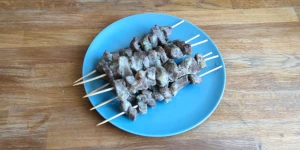
Souvlaki - Traditional Greek Pork Skewers
Traditional Greek Souvlaki
Souvlaki is one of the simplest and most familiar forms of grilled meat in Greek cooking. Small pieces of meat are threaded onto a skewer and cooked quickly over charcoal or another strong heat source until browned on the outside and tender inside.
Pork is one of the most characteristic choices for souvlaki in Greece. Chicken is also widespread today, while other meats can be found depending on the region and establishment. The basic pork skewer does not require a complicated mixture of vegetables or a heavy marinade. Meat, olive oil, lemon, oregano, salt and pepper are enough to produce the familiar Greek flavour.
What does Souvlaki mean?
The Greek word souvlaki (σουβλάκι) refers to a small skewer and, by extension, to food cooked on one. The word is related to souvla (σούβλα), meaning a spit or skewer, with the diminutive form referring to the smaller skewer used for individual portions.
The plural is souvlakia (σουβλάκια). In everyday Greek food culture, however, terminology can vary by place. What is ordered as souvlaki in one part of Greece may be described differently elsewhere, particularly when distinguishing meat on a skewer from meat wrapped in pita.
Souvlaki and the Greek tradition of cooking meat over fire
Cooking meat over an open fire has a very long history in Greece and throughout the Mediterranean. Ancient Greek sources and archaeological evidence show that roasting meat on spits was already known in antiquity. This provides historical context for Greek spit-roasting traditions, but it does not mean that the modern street food called souvlaki has remained unchanged since ancient times.
Modern souvlaki belongs to a continuing Greek tradition of cooking meat directly over fire. Similar techniques remain important in Greek regional cooking, from small skewers grilled quickly over charcoal to much larger cuts of meat roasted on a souvla.
Pork Souvlaki
Pork is particularly well suited to souvlaki because it cooks quickly while retaining enough fat to remain juicy over high heat. Pork shoulder or neck works especially well. Very lean cuts can dry before enough colour develops on the surface.
The meat should be cut into fairly even pieces, roughly 2 to 3 cm across. Uniform pieces cook at approximately the same rate and make it easier to brown the outside without leaving the centre undercooked.
Seasoning the meat
Souvlaki does not need a complicated marinade. Olive oil, lemon, dried oregano, salt and black pepper provide a simple combination closely associated with Greek grilled meat.
The meat can be seasoned shortly before cooking or left in the refrigerator for several hours. Long marination is not necessary. If a large quantity of lemon juice is used, there is little benefit in leaving the pork in it overnight.
Grilling Souvlaki
Charcoal grilling gives souvlaki its most characteristic flavour, but a gas grill, grill pan or very hot cast-iron pan can also be used. The important point is to cook the small pieces quickly over strong heat rather than slowly stewing them.
The pieces should sit close together on the skewer but should not be compressed into a solid block. Turn the skewers several times while grilling so that the meat browns on different sides.
Pork souvlaki is ready when the pieces are browned outside and completely cooked through while remaining juicy. Serve it immediately rather than leaving the cooked skewers on the grill, where the small pieces can dry quickly.
Souvlaki on a skewer and Souvlaki in pita
Souvlaki can be served directly on the skewer as a portion of grilled meat. Lemon, bread or pita and simple accompaniments can be served alongside.
Another familiar form is meat served with or inside pita. Depending on the shop and region, pita may be combined with tomato, onion, tzatziki or another sauce and sometimes fried potatoes. These accompaniments belong to the assembled pita meal rather than to the definition of the grilled skewer itself.
Souvlaki and Gyros are not the same
Souvlaki and gyros are often confused outside Greece, particularly because both can be served in pita with similar accompaniments. The cooking methods are different.
Souvlaki consists of separate pieces of meat threaded onto small skewers and grilled. Gyros is made from meat stacked on a large vertical rotating spit, with cooked pieces sliced from the outside as the spit turns.
Regional terminology
Greek terminology for grilled meat is not completely uniform. In Athens and parts of southern Greece, the word kalamaki, literally referring to the small stick or skewer, is commonly used for meat on a skewer. Elsewhere, souvlaki itself is commonly used for the skewer.
This regional difference explains why descriptions of souvlaki sometimes appear contradictory. The food itself remains straightforward: small pieces of meat cooked quickly on a skewer and served hot.
Expert tips:
Use pork with some fat
Pork shoulder or neck stays juicier during grilling than very lean meat. A small amount of fat also helps the surface brown over high heat.
Cut even pieces
Keep the pork pieces approximately the same size so that they finish cooking at roughly the same time.
Do not overcrowd the skewer
The pieces can sit close together, but compressing them tightly makes it more difficult for the heat to reach their sides.
Use strong heat
Souvlaki is best grilled relatively quickly over strong heat. This browns the outside while helping the pork remain juicy.
Do not overcomplicate the seasoning
Good pork, olive oil, lemon, oregano, salt and pepper are enough. A long list of spices is not necessary for a traditional-style pork souvlaki.
Serve directly from the grill
Small pieces of pork lose moisture quickly after cooking. Serve the skewers as soon as they are ready.
Storage:
Raw marinated pork
Keep the seasoned pork covered in the refrigerator and cook it within 24 hours.
Cooked souvlaki
Cool leftover cooked pork promptly, transfer it to a covered container and refrigerate for up to 3 days.
Reheating
Reheat the pork briefly in a hot pan or oven until heated through. Avoid prolonged reheating because the small pieces can become dry.
Freezing
Cooked souvlaki can be frozen, although freshly grilled pork has a better texture. Cool the meat completely before freezing in an airtight container.
Recipe information:
Pork Souvlaki
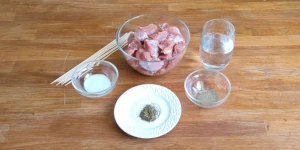
Substitutions for ingredients:
- Pork shoulder or neck - Chicken thigh can be used for chicken souvlaki. Adjust the cooking time and make sure the chicken is completely cooked through.
- Dried Greek oregano - Regular dried oregano can be used when Greek oregano is unavailable.
- Charcoal grill - A gas grill or very hot grill pan can be used, although charcoal provides a more characteristic grilled flavour.
- Wooden skewers - Metal skewers can be used and do not need to be soaked before grilling.
Prepare the Souvlaki
1. Cut the pork
2. Season the meat
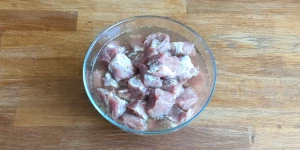
3. Rest the pork
4. Prepare wooden skewers
5. Assemble the skewers
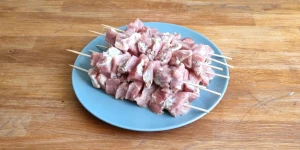
6. Grill the souvlaki
7. Serve immediately
Frequently Asked Questions (FAQ):
What is souvlaki?
Souvlaki is a Greek dish of small pieces of meat threaded onto a skewer and grilled. Pork is one of the most characteristic versions in Greece.
What does the word souvlaki mean?
Souvlaki is the diminutive form related to the Greek word souvla, meaning a spit or skewer. The name therefore refers to the small skewer used to cook the meat.
Is souvlaki an ancient Greek dish?
Cooking meat on spits was known in ancient Greece, but the modern dish called souvlaki should not simply be described as an unchanged ancient recipe. It belongs to a much longer Greek and Mediterranean tradition of cooking meat over fire.
What meat is traditionally used for Greek souvlaki?
Pork is one of the most characteristic meats used for souvlaki in Greece. Chicken is also very common today, while other meats appear in different versions.
What is the difference between souvlaki and gyros?
Souvlaki is made from individual pieces of meat threaded onto small skewers. Gyros is made from layers of meat cooked on a large vertical rotating spit and sliced from the outside.
What is kalamaki?
Kalamaki literally refers to the small stick or skewer and is commonly used in Athens and some other areas for meat served on a skewer. Greek terminology varies regionally.
Does traditional souvlaki contain vegetables on the skewer?
The basic Greek meat souvlaki does not require vegetables between the pieces of meat. Peppers, onions and other vegetables can be added, but they are variations rather than necessary components of the traditional pork skewer.
Is tzatziki part of souvlaki?
Tzatziki is a common accompaniment, especially when souvlaki is served with or inside pita, but it is not an ingredient required for the grilled meat skewer itself.
How long should pork souvlaki be marinated?
One to two hours is enough for this simple seasoning, although the pork can also be grilled shortly after it is seasoned. A long overnight marinade is not necessary.
Can souvlaki be cooked without a charcoal grill?
Yes. A gas grill or hot grill pan can be used. Charcoal gives the meat a characteristic grilled aroma, but it is not essential for preparing souvlaki at home.
What is traditionally served with souvlaki?
Souvlaki can be eaten directly from the skewer or served with pita or bread. Tomato, onion, tzatziki, lemon, salad and fried potatoes are common accompaniments depending on the style and region.