
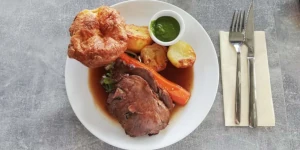
Classic Sunday Roast Beef with Gravy and Roast Potatoes
What a Sunday roast actually is
A Sunday roast is less a single recipe than a way of putting a proper British Sunday dinner on the table. Roast meat sits at the centre, with potatoes, vegetables and gravy around it. When the meat is beef, Yorkshire puddings are the classic partner. The combination of roast beef, potatoes, vegetables, gravy and Yorkshire pudding is strongly associated with English cooking.
There is no single correct list of vegetables. Carrots and parsnips are common, while cabbage, peas, broccoli and cauliflower can all appear depending on the household. Horseradish or English mustard is also a familiar addition to roast beef.
A little history
The Sunday roast developed gradually rather than appearing as one fixed recipe. Roast meat had become part of English Sunday meals by the eighteenth century, and the meal continued to take shape through the nineteenth century as home ovens became more common. The familiar combination of roast meat, potatoes, vegetables and gravy eventually became a regular part of British family cooking.
Yorkshire pudding has an older documented history. A recipe for what was then called dripping pudding appeared in 1737, with Hannah Glasse publishing a recipe called Yorkshire pudding in 1747. The early pudding was cooked in the drippings from roasting meat and was originally a thrifty way of making a filling dish from flour, eggs and milk.
Choosing the beef
You do not need the most expensive joint in the butcher's window. Topside and silverside are practical choices for a traditional roast. A joint with a layer of fat is useful because it helps keep the meat moist while it cooks. Sirloin or rib can also be used when you want a more tender and richer roast.
The trick with the potatoes
Do not skip the short boil. Cooking the potatoes until the outside is beginning to soften gives you something to work with. Drain them well, then shake them around in the saucepan. The rough edges catch the hot fat and become the crispest part of the finished potatoes.
Yorkshire puddings
Yorkshire pudding is made from a simple batter of flour, eggs and milk, but the tin and fat need to be properly hot. Traditionally, the batter was cooked in the dripping from roasting meat. Today, individual puddings in a muffin tin are common, although a large shallow pudding is closer to older English practice.
What to do with the leftovers
Cold roast beef is excellent the next day. Slice it thinly for sandwiches with mustard or horseradish, or chop it with leftover potatoes and vegetables for a simple hash. Keep the leftover gravy too; reheated beef is much better when it has something rich to go with it.
Expert tips:
Use a thermometer for the beef
Cooking time depends heavily on the shape of the joint and how you like your beef. A thermometer gives you a much better indication than a fixed cooking time. Take the beef out before it reaches the final temperature you want because it will continue cooking while it rests.
Do not crowd the potatoes
Give the potatoes plenty of room in the roasting tin. If they are packed tightly together, they release steam and soften instead of browning. A wide tray is much better than a deep, crowded one.
Make the batter ahead
Yorkshire pudding batter can be mixed several hours before dinner and kept chilled. The important part is getting the fat and tin properly hot before the batter goes in. The puddings should sizzle as soon as the batter hits the fat.
Save the roasting juices
Do not wash the roasting tin before making the gravy. The browned bits stuck to the bottom and the beef juices are what give a simple gravy its proper roast flavour.
Storage:
How to store
Let leftover beef cool, then refrigerate it in a covered container. Keep the roast potatoes and vegetables separate if possible. Store leftover gravy in its own covered container and refrigerate promptly.
Shelf life
Keep cooked beef and gravy refrigerated and use within 3 to 4 days. Reheat only the amount you plan to eat and make sure the meat and gravy are piping hot.
Freezing instructions
Sliced roast beef freezes well, especially when packed with a little gravy to prevent it drying out. Cool it completely before freezing and use within about 2 to 3 months for the best quality. Yorkshire puddings can also be frozen, although the roast potatoes are better eaten fresh.
Recipe information:
Roast Beef and Vegetables
Gravy
Yorkshire Puddings
Substitutions for ingredients:
- Topside or silverside beef - Sirloin, rib of beef or another roasting joint can be used. The cooking time will change with the size and shape of the joint, so judge doneness by temperature rather than the clock alone.
- Beef dripping - Vegetable oil, sunflower oil or lard can be used for the potatoes and Yorkshire puddings. Beef dripping gives the most traditional roast flavour.
- Plain flour - For Yorkshire puddings, plain wheat flour is the traditional choice. A gluten-free flour blend can be used, but the result will not have exactly the same texture.
- Beef stock - Use homemade beef stock, a good-quality prepared stock or a stock cube mixed with water. If the stock is already salty, adjust the seasoning only after the gravy has reduced.
Preparation
1. Get the beef ready
2. Roast the beef
3. Prepare the potatoes
4. Roast the vegetables and potatoes
5. Prepare the Yorkshire pudding batter
6. Bake the Yorkshire puddings
7. Rest the beef
8. Make the gravy
9. Serve
Frequently Asked Questions (FAQ):
Is Sunday roast really a traditional British dish?
Yes. The Sunday roast is a long-established British meal rather than one fixed recipe. Roast beef with potatoes, vegetables and gravy is one of its best-known forms, while Yorkshire pudding is the classic accompaniment to roast beef.
Should Yorkshire puddings be served with roast beef?
Roast beef is the most traditional pairing. Yorkshire pudding was historically cooked using the fat and drippings from roasting meat, and the two became closely associated in English cooking.
Can I prepare the Yorkshire pudding batter ahead of time?
Yes. The batter can be made several hours ahead and kept refrigerated. Take it out when you are ready to cook and give it a quick whisk before pouring it into the hot tin.
What vegetables go with a traditional Sunday roast?
Carrots and parsnips are common choices, but there is no fixed list. Cabbage, peas, broccoli, cauliflower and other seasonal vegetables are also traditional choices for a roast dinner.
How do I know when the roast beef is ready?
A meat thermometer is the most reliable option because cooking time varies between joints. For medium-rare beef, aim for an internal temperature around 55°C after resting. If you prefer medium or well-done beef, cook it further according to your preference.
Can I make the gravy without meat drippings?
Yes. You can make gravy with beef stock, flour and a little butter or dripping. It will still work, but the browned bits and juices left from the roast give the gravy a deeper flavour.