
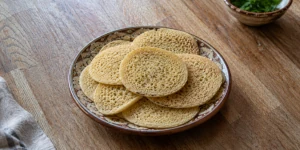
Baghrir: Moroccan Thousand-Hole Semolina Pancakes
Baghrir is one of Morocco's best-known traditional pancakes. Often called the “thousand-hole pancake”, it is immediately recognizable by the hundreds of tiny holes that appear across its surface while it cooks. The pancake is soft, light and slightly spongy, and those small openings are perfect for absorbing the traditional topping of warm melted butter and honey.
Unlike an ordinary European or American pancake, Baghrir is cooked on one side only. A thin yeast batter is poured into a hot pan and left untouched. As it cooks, bubbles rise through the batter and burst on the surface, leaving behind the familiar honeycomb pattern. When the top is dry and the holes have opened, the pancake is ready. It is never flipped.
A Traditional Pancake of Morocco
Baghrir belongs to the wider food traditions of North Africa and is particularly strongly associated with Morocco. Similar semolina pancakes are also prepared in Algeria and Tunisia, where recipes, names and proportions vary from region to region and from one household to another.
The exact historical origin of Baghrir is difficult to document. It is generally understood as part of the long North African tradition of simple grain-based breads and pancakes and is often associated with Amazigh culinary traditions. Like many traditional home dishes, it developed through regional cooking rather than having one clearly documented inventor or birthplace.
There is also no single recipe that can be called the only authentic version. Some households use mostly semolina, while others add a small amount of wheat flour. Some recipes contain only yeast, while many modern Moroccan versions use both yeast and baking powder to make the characteristic holes form more reliably.
Why Baghrir Has So Many Holes
The holes are the defining feature of Baghrir. When the thin batter reaches the hot pan, bubbles begin rising from underneath. Instead of being trapped inside the pancake, they break through the still-wet surface and leave behind dozens or hundreds of small openings.
For this reason, Baghrir must be cooked gently and without turning. The bottom should cook without becoming dark too quickly, while the upper surface gradually dries and fills with holes. A good Baghrir remains pale on top and lightly coloured underneath.
The holes are not merely decorative. They make the pancake especially suitable for butter and honey. The warm topping runs into the openings and soaks into the soft pancake instead of simply sitting on the surface.
Semolina, Flour and a Thin Batter
Fine semolina is the ingredient most closely associated with Baghrir and gives the pancakes their characteristic soft but slightly springy texture. A small amount of wheat flour is commonly added to help create a smoother batter and a more tender pancake.
The batter should be noticeably thinner than ordinary pancake batter. It should pour easily from a ladle and spread naturally after it reaches the pan. If it is too thick, the bubbles have difficulty reaching the surface and the pancakes can become heavy with very few holes.
Many modern Moroccan home recipes use a blender to make the batter completely smooth. This is a convenient modern method, but it is not essential. The ingredients can also be mixed thoroughly by hand as long as the finished batter is smooth and free from lumps.
After mixing, the batter needs time to become slightly bubbly. Depending on the room temperature and the yeast used, this may take around 20 to 30 minutes. It should look lively but still remain thin and easy to pour.
Cooking Baghrir the Traditional Way
A good pan temperature is one of the most important parts of the recipe. The pan needs to be hot enough for bubbles to appear quickly after the batter is poured in, but not so hot that the bottom browns before the top has time to dry.
Pour the batter into the centre of the pan and let it spread naturally. Do not press it down, flatten it with a spoon or move it around after pouring. Once the bubbles begin to appear, leave the pancake alone until the upper surface is dry.
Baghrir is cooked on one side only. Flipping it is unnecessary and changes the delicate porous surface that makes this pancake distinctive.
As each pancake finishes cooking, move it to a clean cloth, tray or plate and allow some of the steam to escape before stacking. Freshly cooked Baghrir can stick together if several hot pancakes are piled directly on top of one another.
Butter and Honey
The most familiar Moroccan way to serve Baghrir is with warm butter and honey. The butter is melted and mixed with honey until the topping becomes fluid enough to run easily into the holes.
Some households use clarified butter, while others use ordinary butter. The amount of honey can also vary depending on how sweet the family prefers the finished pancakes.
Orange blossom water may occasionally be added as a household or regional variation, but it is not necessary for a simple traditional Baghrir. The basic combination of butter and honey remains the classic accompaniment.
Baghrir for Breakfast and Ramadan
Baghrir is commonly eaten for breakfast, with tea, as an afternoon snack or as part of a larger family meal. It is also frequently prepared during Ramadan, when different breads, pancakes and sweets appear on the table for the evening meal.
Its appeal comes from the simplicity of the ingredients and the contrast between the soft semolina pancake and the rich honey-and-butter topping. Baghrir does not need elaborate decoration. When properly cooked, its surface full of tiny holes is already its most recognizable feature.
Baghrir Across the Maghreb
Although Baghrir is strongly associated with Morocco, related pancakes are found throughout the Maghreb. Algeria and Tunisia have closely related preparations, sometimes known by regional names such as ghrayef or similar local variations.
The exact proportions of semolina, flour, water and leavening differ considerably. Some pancakes are thinner, others thicker, and some households use additional ingredients. This is normal for a traditional dish that has been prepared in family kitchens for generations.
The version presented here follows a widely used Moroccan pattern: fine semolina, a small amount of flour, yeast, baking powder, a thin batter, a short resting period and cooking on one side only before serving with warm butter and honey.
What Proper Baghrir Should Be Like
A properly cooked Baghrir should be soft, light and slightly springy rather than crisp. The upper surface should contain many open holes, while the underside should remain only lightly golden.
If the pancake becomes dark before the top dries, the pan is too hot. If very few holes appear, the batter may be too thick, insufficiently rested or affected by an unsuitable pan temperature.
Baghrir is at its best served warm or shortly after cooking, when the butter and honey can easily soak into its characteristic porous surface.
Expert tips:
Use Fine Semolina
Fine semolina is the best choice for Baghrir. Coarse semolina can leave the batter grainy and make it more difficult to achieve the smooth, soft texture associated with traditional Moroccan pancakes.
Keep the Batter Thin
The batter should pour easily and be much thinner than ordinary pancake batter. A thick batter is one of the most common reasons Baghrir turns out heavy or develops only a few holes.
Use Lukewarm, Not Hot Water
The water should be comfortably warm rather than hot. Very hot water can prevent the yeast from working properly, while cold water can make the resting period much longer.
Do Not Flip the Pancakes
Baghrir is cooked from one side only. Leave it untouched until the top is dry and the holes have formed. Flipping is unnecessary and destroys the characteristic porous surface.
Adjust the Heat Between Pancakes
The first pancake is useful for checking the pan temperature. If the bottom becomes dark before the top dries, reduce the heat. If bubbles barely appear, allow the pan to heat a little longer.
Do Not Stack Them Immediately
Freshly cooked Baghrir can stick together because of the steam. Let each pancake cool briefly on a clean cloth or separate them with parchment paper before making a stack.
Storage:
How to store
Allow the Baghrir to cool completely, then place the pancakes in an airtight container. Separate them with pieces of parchment paper if necessary to prevent sticking.
Shelf life
Baghrir is best eaten fresh, preferably while still warm. Leftovers can be kept in the refrigerator for up to 2 days and should be warmed gently before serving.
Freezing instructions
Baghrir freezes well. Allow the pancakes to cool completely, place parchment paper between them and freeze in a well-sealed container or bag. For the best texture, use within about 2 to 3 months and warm gently after thawing.
Reheating
Warm leftover Baghrir briefly in a dry pan over low heat or in a low oven until soft and warm. Add fresh warm butter and honey after reheating rather than before storing.
Recipe information:
For the Baghrir
For Serving
Substitutions for ingredients:
- Fine Semolina - Use another very fine durum wheat semolina if available. Avoid coarse couscous-style semolina because it produces a noticeably rougher batter and a heavier pancake.
- All-purpose flour - Plain wheat flour can be used in the same quantity. The small amount of flour helps the pancakes hold together while keeping semolina as the main ingredient.
- Instant dry yeast - Active dry yeast can be used in a similar quantity, but it should be dissolved or activated according to the instructions on the package. Fresh yeast can also be used in traditional home-style versions.
- Butter - Clarified butter can be used for the traditional honey topping. For a dairy-free version, Baghrir itself can be served with honey alone or another preferred topping.
- Honey - Orange blossom honey or another fragrant good-quality honey works particularly well. Ordinary honey is perfectly suitable for the classic butter-and-honey topping.
- Sugar - The sugar can be reduced slightly if preferred, but a small amount is useful in balancing the flavour and helping the yeast become active.
Prepare the Batter
1. Combine the Dry Ingredients
2. Blend the Batter
3. Let the Batter Rest
Cook the Baghrir
1. Heat the Pan
2. Pour the Batter
3. Cook Without Turning
4. Remove and Repeat
Prepare the Honey Butter
1. Warm the Butter and Honey
2. Serve
Frequently Asked Questions (FAQ):
Why is Baghrir called a thousand-hole pancake?
The name refers to the hundreds of tiny holes that form across the surface while the pancake cooks. The holes give Baghrir its characteristic honeycomb appearance and allow butter and honey to soak into the pancake.
Do you flip Baghrir?
No. Traditional Baghrir is cooked on one side only. The top cooks through as bubbles rise from the batter and leave openings across the surface.
What is Baghrir traditionally served with?
The classic Moroccan accompaniment is a mixture of warm butter and honey. The mixture is spooned over the pancakes or the pancakes are briefly dipped into it so that it fills the holes.
Can I make Baghrir without a blender?
Yes. A blender is a modern convenience rather than an essential part of the recipe. The batter can be mixed by hand, provided it is whisked thoroughly until smooth and free of lumps.
Is Baghrir only eaten in Morocco?
No. Similar semolina pancakes are found throughout the Maghreb, including Algeria and Tunisia. They can have different names and slightly different recipes depending on the region.
Can I add orange blossom water?
Yes, orange blossom water is sometimes used as a regional or household variation, particularly with sweet toppings. It is optional rather than essential for a basic traditional Baghrir.