
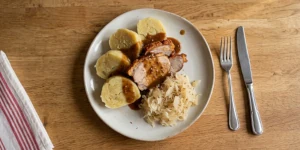
Bramborové knedlíky - Czech Potato Dumplings
Bramborové knedlíky are one of the familiar foundations of traditional Czech cooking: simple potato dumplings made from cooked potatoes, flour, semolina and egg. They are usually shaped into long, thick rolls, boiled whole and then cut into slices. Unlike the lighter yeast-based houskové knedlíky, these potato dumplings have a compact, tender texture and a distinct taste of potato.
A traditional part of Czech cooking
Potato dumplings became established in Czech cooking during the 19th century, as potatoes became an increasingly important part of the everyday diet. Historical culinary sources record recipes for potato dumplings made from cooked potatoes as early as 1805. Over the following generations, the recipe became a familiar part of both household and more formal Czech cooking. Different families and regions developed their own proportions and variations, including dumplings made from cooked potatoes, raw potatoes, or a mixture of both.
The cooked-potato version is particularly practical. Potatoes are boiled, cooled, grated or pressed, then combined with wheat flour, semolina, egg and salt. The dough is worked quickly, shaped into rolls and cooked in salted water. The finished dumplings are cut into thick slices and served hot.
What makes good bramborové knedlíky
The most important thing is the potatoes. They should be floury rather than waxy and, ideally, should be cooked in their skins and allowed to cool completely before the dough is made. Potatoes cooked the previous day are especially convenient because they are firm enough to grate and easier to turn into a workable dough.
The amount of flour cannot be determined perfectly by weight alone because potatoes vary considerably in moisture. Start with the stated amount and add a little more flour only if the dough is too wet to shape. The finished dough should be soft and pliable but firm enough to form into a roll. Adding excessive flour makes the dumplings heavy and dense.
Shaping and boiling the dumplings
Have the large pot of salted water ready before mixing the dough. Once flour and egg are added to the potatoes, work without unnecessary delay. Shape the dough into two or three thick rolls, roughly 5-6 cm in diameter, and place them carefully into gently boiling water.
The water should simmer rather than boil violently. The dumplings need enough room to move freely without being battered by a rolling boil. Depending on their thickness, they usually need around 15-20 minutes to cook through. During cooking, gently loosen them from the bottom of the pot with a wooden spoon if necessary.
How bramborové knedlíky are served
In Czech cooking, these dumplings are primarily a side dish rather than a meal on their own. They are particularly good with roast pork and sauerkraut, smoked meat, goulash and substantial Czech sauces. The soft slices are made for catching gravy, which is one reason potato dumplings have remained such a useful part of Czech home cooking.
Freshly cooked knedlíky are sliced while still hot, traditionally with a knife or, in many Czech kitchens, with a piece of strong thread. Cutting with thread keeps the soft roll from being compressed and produces clean, even slices.
A dish with many Czech variations
There is no single recipe that represents every Czech household. Some versions use more coarse flour, others more semolina; some contain only one egg, while older and regional recipes can differ considerably. There are also related Czech potato dumplings made from raw potatoes, including regional varieties known as chlupaté knedlíky, bosáky and other local names.
For that reason, this recipe should be understood as a traditional Czech home-style version of bramborové knedlíky made from cooked potatoes, rather than as the only authentic formula. The essential character remains the same: cooked potatoes, wheat flour, egg, salt, quick preparation, boiling in salted water and serving the sliced dumplings alongside a substantial Czech dish.
Expert tips:
Use cold potatoes
Potatoes cooked and cooled the day before are ideal. They are firmer, easier to grate and generally require less flour than warm, freshly boiled potatoes.
Do not add too much flour
The exact amount depends on the potatoes. Add the flour gradually and stop as soon as the dough can be shaped. Too much flour produces heavy, dense dumplings instead of soft potato slices.
Work quickly
Once the egg, flour and semolina are mixed with the potatoes, shape the dough and cook it without a long wait. This helps keep the dough manageable and prevents it from becoming unnecessarily sticky.
Keep the water at a gentle boil
A violent rolling boil can damage the outside of the dumplings. Keep the water bubbling gently while the potato rolls cook through.
Slice while hot
Freshly cooked dumplings are easiest to slice while still hot. Cutting them with strong thread is a traditional kitchen trick that produces neat slices without pressing down on the soft roll.
Storage:
How to store
Allow leftover dumplings to cool, then place them in a covered container and refrigerate.
Shelf life
They keep well in the refrigerator for about 3 days. Reheat the slices by steaming them until hot and soft again.
Freezing instructions
Cooked dumplings can be cooled, sliced and frozen in a sealed container or freezer bag. Separate the slices so they do not freeze into one solid block. Thaw and reheat them by steaming.
Recipe information:
Ingredients
Substitutions for ingredients:
- Coarse wheat flour (hrubá mouka) - A mixture of regular wheat flour and coarse semolina can be used when Czech coarse flour is unavailable, although the texture will not be exactly the same.
- Coarse semolina (krupice) - A small amount of fine semolina can be used, but avoid replacing the entire flour component with semolina. The traditional dough relies on a balance of wheat flour and potato.
- Potatoes cooked the day before - If necessary, cook the potatoes on the same day and cool them completely before making the dough. Spread them out after cooking so excess moisture can escape.
Preparation
1. Cook and cool the potatoes
2. Grate the potatoes
3. Make the potato dough
4. Shape the dumpling rolls
5. Boil the dumplings
6. Slice and serve
Frequently Asked Questions (FAQ):
Are bramborové knedlíky traditional Czech food?
Yes. Potato dumplings are firmly established in Czech cuisine. Historical culinary sources document potato dumplings made from cooked potatoes as early as 1805, while many regional versions developed over the 19th and 20th centuries.
Should I use potatoes cooked the day before?
It is strongly recommended for this style. Completely cooled potatoes are firmer and easier to grate, making it easier to produce a dough without adding excessive flour.
Are bramborové knedlíky the same as chlupaté knedlíky?
No. They are related Czech potato dumplings but are not identical. Bramborové knedlíky are commonly made from cooked potatoes, while chlupaté knedlíky and other regional varieties can contain raw grated potatoes. Czech cuisine has many local forms of potato dumplings.
What are bramborové knedlíky served with?
They are traditionally served as a side dish with substantial Czech meals, especially roast pork and sauerkraut, smoked meat, goulash and rich sauces.
Why do Czech cooks slice the dumplings with thread?
A strong piece of thread cuts through the soft cooked roll without pressing it flat. It is a simple traditional technique that produces clean, even slices.
Can the dumplings be made with raw potatoes?
Yes, but that creates a different family of Czech potato dumplings. Czech cuisine includes dumplings made from both cooked and raw potatoes, as well as combinations of the two.