
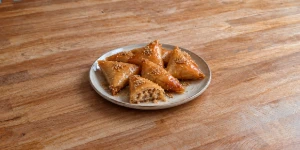
Briouat bil Louz: Moroccan Sweet Almond Triangles
Briouat bil Louz (Sweet Almond Triangles) are Moroccan honey-coated pastries. This version combines fried and blanched almonds for a nutty filling, enclosed in thin pastry and fried until golden.
What is Briouat bil Louz & Its Origins
Briouat bil Louz (often spelled briouate) is a classic Moroccan pastry consisting of a sweet almond paste flavored with orange blossom water, cinnamon, and mastic gum, folded into thin pastry layers (historically warqa, though phyllo is commonly used globally) and shaped into neat triangles. The pastries are deep-fried to a golden crisp and immediately submerged in warm, infused honey. Their precise place and date of origin are not securely established. Today, they are synonymous with celebratory occasions, served widely during Ramadan, Eid, and traditional wedding ceremonies.
What Does It Taste Like?
Each bite of Briouat bil Louz offers a distinct contrast of textures and flavors. The initial crunch of the micro-thin, honey-glazed pastry shell gives way to a dense, marzipan-like filling. The flavor profile is complex: the earthy, nutty base of the almonds is brightened by the floral, citrusy notes of orange blossom water, grounded by warm cinnamon, and deepened by the resinous, balsamic undertones of mastic gum. It is intensely sweet, yet balanced by the natural oils of the almonds.
Popular Variations
While the classic almond triangle is the standard, several regional and modern variations exist:
- Baked Briouats: For a lighter alternative, the pastries can be brushed generously with clarified butter and baked at 350°F (180°C) until golden before dipping in honey.
- Briouat bil Kawkaw: A highly popular budget-friendly variation that replaces the almond filling with roasted, skinned peanuts, offering a more robust, earthy flavor.
- Pistachio or Walnut Filling: Modern pastry chefs often substitute a portion of the almonds with ground pistachios or walnuts to introduce vibrant colors and alternative nutty undertones.
What To Serve With Briouat bil Louz
These pastries are exceptionally rich and sweet, meaning they pair best with beverages that cut through the sugar. The ultimate pairing is Moroccan mint tea (atay), traditionally sweetened; use less sugar if preferred, which utilizes bitter gunpowder green tea and fresh spearmint to cleanse the palate. Alternatively, a strong, dark espresso or a spiced Arabic coffee provides an excellent bitter contrast to the honey glaze.
Expert tips:
Prevent Oil Leaks
Ensure the corners of your triangles are completely sealed during folding. If there are small gaps, the almond paste can expand and leak into the hot frying oil, causing the oil to foam, sputter, and burn.
Maintain Moderate Frying Heat
Do not rush the frying process. If the oil is too hot, the pastry outer layers will brown too quickly while the inner layers remain soft and doughy. Frying at a consistent 340°F (170°C) yields uniform, crisp layers.
The Dual-Almond Advantage
Frying half of the almonds adds a toasted flavor. All-blanched almond fillings are also used; the split is a variation, not a requirement.
Warm Honey, Hot Pastries
Always submerge hot briouats into warm honey. Warm honey flows more easily around the pastry; rewarm gently if it thickens.
Storage:
How to store
Store the cooled briouats in a single layer or separated by sheets of parchment paper in an airtight container.
Shelf life
Keep in a cool, dry place for up to 2 weeks for best quality, or freeze cooked pastries for longer storage. Honey gradually softens the shell; prolonged crispness is not guaranteed.
Freezing instructions
You can freeze uncooked, assembled briouats in a single layer on a tray, then transfer them to a freezer bag for up to 3 months. Fry directly from frozen, adding 2 minutes to the total frying time.
Recipe information:
Almond Paste Filling
Pastry Shell & Assembly
Glaze & Frying
Substitutions for ingredients:
- Phyllo dough - Wheat-based spring roll wrappers (not rice paper, cut into strips) can be used. They yield a slightly thicker, crunchier shell but are highly stable and bubble beautifully when fried.
- Mastic gum - Omit if unavailable. Cardamom or nutmeg changes the flavor and is not a direct traditional replacement.
- Orange blossom water - Rose water can be substituted at a 1:1 ratio, though it will shift the flavor toward Middle Eastern-style profiles.
Prepare the Almond Paste
1. Split and Fry Half the Almonds
2. Grind the Almonds
3. Knead the Filling
Assembly and Folding
1. Prepare the Phyllo Sheets
2. Fold into Triangles
3. Seal the Briouats
Cooking and Glazing
1. Heat the Honey and Oil
2. Fry to Golden Perfection
3. Soak in Honey
4. Drain and Garnish
Frequently Asked Questions (FAQ):
Can I bake Briouat bil Louz instead of frying?
Yes. Arrange the assembled triangles on a parchment-lined baking sheet, brush them generously with clarified butter, and bake in a preheated oven at 350°F (180°C) for 15-20 minutes until golden, then soak immediately in warm honey.
What is the difference between Warqa and Phyllo dough?
Warqa is a traditional Moroccan pastry leaf made by dabbing wet dough onto a hot metal pan, resulting in a flexible, very thin sheet. Phyllo is stretched dough, drier and more brittle, but behaves similarly when brushed with fat.
Why did my frying oil foam up?
Oil foaming is usually caused by egg yolk leaking into the oil from poorly sealed pastries, or moisture escaping from the almond filling. Ensure a perfect, tight seal using minimal egg wash.
How do I keep the pastries crispy for a long time?
Ensure they are fried thoroughly so all internal pastry layers are cooked, drain them well after the honey soak, and store them in an airtight container in a dry, cool place away from humidity.