
Lukanka - Traditional Bulgarian Dry-Cured Sausage
Traditional Bulgarian Lukanka
Lukanka is one of Bulgaria's characteristic dry-cured sausages. It is made from minced meat and fat seasoned with salt and spices, stuffed into casings and slowly dried until firm. During maturation, the sausages are pressed to produce the flattened or slightly oval form strongly associated with lukanka.
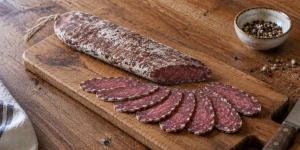
When cut across the sausage, a properly matured lukanka has a dense, compact interior with visible particles of lean meat and fat. It is normally sliced thinly and eaten without further cooking.
What makes Lukanka different
The flattened shape is one of the easiest ways to recognise lukanka. The sausage does not simply remain hanging in a round casing throughout maturation. Pressing during the drying process gives it its characteristic form and contributes to its dense texture.
The flavour is also distinctive. Cumin, known in Bulgarian as kimion, and black or white pepper are particularly characteristic seasonings. Individual recipes and commercial varieties can contain additional ingredients, but a long list of herbs and spices is not necessary to define lukanka.
Beef and pork
Lukanka is commonly made from a combination of beef and pork. The exact proportions are not universal. Different named products and established recipes use different ratios, which means that one beef-to-pork ratio should not be presented as the formula for every Bulgarian lukanka.
The lean meat and fatty pork create the characteristic marbled cross-section. During preparation the meat is kept cold, minced and thoroughly mixed with the curing ingredients and spices before being stuffed into casings.
The characteristic seasoning
Cumin is one of the defining aromas of Bulgarian lukanka. Black or white pepper is another established seasoning. Together they produce a warm, savoury flavour without turning the sausage into a heavily herb-seasoned salami.
Bulgarian summer savory, or chubritsa, is extremely important elsewhere in Bulgarian cooking, but it should not automatically be presented as an essential ingredient in every traditional lukanka. The same applies to nutmeg and other optional spices found in individual recipes.
Stuffing and shaping
After grinding and mixing, the seasoned meat is packed tightly into suitable sausage casings. Traditional and regulated production can use beef casings and other approved natural or artificial casings depending on the particular product specification.
Air pockets are undesirable because the filling should form a dense, continuous mass. Once filled and tied, the sausages are hung so that the drying and maturation process can begin.
Drying and maturation
Lukanka is a raw dry-cured sausage. It is preserved through a controlled combination of curing, drying and maturation rather than through cooking. This makes the production process fundamentally different from preparing a fresh sausage that will later be fried or grilled.
Temperature, humidity, airflow, formulation and curing agents all affect the safety and quality of the finished sausage. Traditional production therefore cannot be reduced safely to instructions such as hanging raw meat in a cool room for a fixed number of days.
Why Lukanka is pressed
During maturation, lukanka is periodically pressed. This creates the characteristic flattened shape and compact structure of the finished sausage.
Pressing is sufficiently important that it appears in descriptions of established Bulgarian production methods. It should therefore be treated as a defining production step rather than merely a decorative way of shaping the finished sausage.
Lukanka Panagyurska
One of the best documented forms is Lukanka Panagyurska. Its official product specification describes a mixture of beef and pork seasoned with salt, curing agents, sugar, pepper and cumin. Starter cultures can also be used within the regulated production process.
This specification is particularly useful when discussing traditional lukanka because it provides a documented formulation and production method rather than relying on modern internet interpretations of Bulgarian charcuterie.
Troyanska Lukanka
Troyanska lukanka is another important Bulgarian traditional product. Its history is connected with the town of Troyan and the development of Bulgarian sausage production in the nineteenth century.
European Commission material records the association of the product with Iliya Taslakov, one of Bulgaria's early sausage producers, who brought meat-grinding machinery into Bulgaria in 1883. Troyanska lukanka is now protected under the European Union's Traditional Speciality Guaranteed system.
Lukanka is not one fixed recipe
Names such as Panagyurska and Troyanska show why lukanka should be described as a Bulgarian sausage tradition rather than a single universal formula. Meat proportions, processing details and some seasonings can differ between recognised types and individual producers.
The common identity comes from the broader method: seasoned minced meat, curing, stuffing, controlled drying and maturation, together with the characteristic pressing that produces the flattened sausage.
How Lukanka is served
Fully matured lukanka is sliced thinly across the sausage. Thin slicing makes the dense cured texture easier to eat and exposes the marbled pattern of meat and fat.
It is commonly served as part of a cold selection of foods and can accompany bread, cheese, pickled vegetables and other Bulgarian dishes. It is also a natural accompaniment to Bulgarian wine or rakia.
Expert tips:
Cumin is a defining seasoning
Cumin and pepper are strongly associated with documented Bulgarian lukanka formulations. Do not bury their flavour beneath a large mixture of unrelated spices.
Keep the meat cold
Keep meat and fat cold while grinding and mixing so that the sausage retains a clear, compact texture rather than becoming greasy or smeared.
Pressing defines the shape
The flattened appearance of lukanka develops during maturation through pressing. It is not simply a round salami flattened immediately before serving.
Do not judge curing by days alone
Dry-cured sausage safety cannot be established simply because a certain number of days have passed. Use a validated process with controlled conditions and measurable endpoints.
Do not improvise curing salts
Different curing products contain different concentrations and combinations of nitrite and nitrate. Use the exact quantity specified for the particular product and validated recipe.
Storage:
Whole Lukanka
Store finished lukanka according to the storage requirements of the validated curing process or the producer's instructions. Refrigeration is the safest default for homemade dry-cured sausage.
After cutting
Wrap the cut surface well and refrigerate the sausage. Slice only as much as needed for serving.
Freezing
Freezing is possible but can change the texture of dry-cured sausage. Refrigerated storage is preferable when the sausage will be consumed within its established safe storage period.
Recipe information:
Meat
Seasoning and Curing
Casings
Substitutions for ingredients:
- Beef-to-pork ratio - Different Bulgarian lukanka traditions use different meat proportions. Choose a documented formulation rather than assuming one ratio represents every type of lukanka.
- Black pepper - White pepper occurs in documented Bulgarian specifications and can be used when appropriate to the particular style.
- Natural casing - A casing specifically approved for dry-cured sausage can be used when required by the selected production method.
- Curing salt - Do not substitute curing salts by name or volume. Products differ in composition and concentration, so use only the curing system specified by a validated formulation.
Prepare the meat
1. Trim and chill
2. Grind the meat
Season and cure
1. Add the seasoning
2. Mix thoroughly
3. Follow the curing formulation
Stuff the Lukanka
1. Prepare the casings
2. Fill the casings
3. Tie and hang
Dry, mature and press
1. Begin controlled maturation
2. Press the Lukanka
3. Continue maturation
Serve the Lukanka
1. Slice thinly
2. Serve
Frequently Asked Questions (FAQ):
What is Lukanka?
Lukanka is a traditional Bulgarian dry-cured sausage made from seasoned minced meat, commonly beef and pork. It is dried, matured and pressed into a characteristic flattened shape.
Why is Lukanka flat?
The sausage is periodically pressed during maturation. Pressing creates the characteristic flattened shape and compact structure associated with lukanka.
What spices are traditionally used in Lukanka?
Cumin and black or white pepper are among the best documented characteristic seasonings. Particular varieties and producers may use additional ingredients.
Does traditional Lukanka contain Chubritsa?
Summer savory appears in some Bulgarian sausage recipes, but it should not be treated as an essential ingredient in every lukanka. Official formulations such as Lukanka Panagyurska prominently specify cumin and pepper.
Is Lukanka made from pork or beef?
Many traditional lukanka formulations combine beef and pork. The proportions vary between established varieties and recipes.
Is Lukanka cooked?
Traditional lukanka is a raw dry-cured sausage. Preservation and development of its texture come from controlled curing, drying and maturation rather than conventional cooking.
What is Lukanka Panagyurska?
Lukanka Panagyurska is a documented Bulgarian traditional dry-cured sausage made from beef and pork and characteristically seasoned with cumin and pepper.
What is Troyanska Lukanka?
Troyanska lukanka is a Bulgarian traditional sausage associated historically with Troyan. It is recognised under the European Union Traditional Speciality Guaranteed quality scheme.
How long does Lukanka take to mature?
The maturation period depends on the particular product specification, sausage dimensions and controlled drying conditions. A fixed number of days alone is not a reliable measure of readiness or safety.
Can Lukanka be made without starter culture?
Traditional and regulated production methods vary, and starter cultures can be part of modern controlled production. For homemade dry-cured sausage, follow a validated formulation rather than removing or adding a culture independently.
Is white mold required on Lukanka?
No. A specific white mold culture should not be presented as a defining requirement of traditional Bulgarian lukanka. Unexpected mold should not be assumed safe based only on its colour.
How is Lukanka served?
Fully matured lukanka is usually sliced thinly and served as a cold cured meat, often with bread, cheese, pickled vegetables, wine or Bulgarian rakia.