
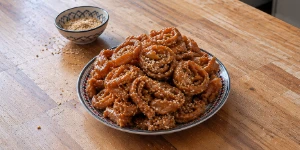
Chebakia: Sesame and Honey Pastries
What is Moroccan Chebakia?
Chebakia is a Moroccan fried pastry made from a richly seasoned dough containing flour, toasted sesame, anise, cinnamon, saffron and orange blossom water. The dough is rolled thin, cut into strips and carefully interlaced into its characteristic flower-like shape before being fried and dipped while hot into warm honey.
The finished pastries are glossy with honey and covered with toasted sesame seeds. They are crisp around the thin edges but become slightly tender and chewy where the folded layers absorb the honey.
Chebakia is especially associated with Ramadan. In Morocco it is commonly served at iftar alongside harira, dates and other foods used to break the fast. It can also be found at other celebrations and is available outside Ramadan, but the holy month remains its strongest culinary association.
Why is it called Chebakia?
The name refers to the pastry's interlaced construction. Moroccan culinary documentation describes the characteristic shape as being formed by cutting several parallel strips into a piece of dough and weaving or turning them through one another.
The exact name varies around Morocco. The WIPO study of Moroccan gastronomic heritage records mkharqa in Rabat, griwech in Fez, el qli in Salé, el hlou in Ouazzane and kwilech in parts of northern Morocco. Recipes and shapes vary as well.
The history is not as simple as one origin story
Chebakia belongs to an old North African and Mediterranean tradition of shaped doughs fried in oil and finished with honey or syrup. Similar techniques were known in medieval Islamic cooking, and Andalusian influence is frequently suggested when discussing Moroccan honey pastries.
It is difficult, however, to identify one place or person as the inventor of modern chebakia. Historical discussions connect its development with several periods and traditions, while the modern folded Moroccan pastry evolved into its own recognizable form over time.
A WIPO study of Moroccan gastronomic heritage links the wider spread of sweet fried pastries such as chebakia with Morocco's important sugar production during the Saadian period. The same study notes that its particularly strong association with Ramadan developed later in the pastry's history. It is therefore safer to describe chebakia as a long-established Moroccan pastry rather than claim one precise medieval origin.
Traditional ingredients
The exact formula changes between households and regions, but the characteristic ingredient family is remarkably consistent: flour, sesame, butter or oil, vinegar, orange blossom water, anise, cinnamon, saffron and honey.
Some recipes also contain almonds, particularly versions associated with Fez. Gum arabic, known in Moroccan cooking as meska horra, is another traditional aromatic used in many recipes. Small amounts of baker's yeast and baking powder can both appear in the dough.
This recipe keeps almonds out because they are not necessary in every Moroccan chebakia, but includes a small optional pinch of gum arabic and a little yeast alongside the baking powder.
Toast and grind the sesame
Toast the sesame gently before grinding it. You want a nutty aroma without burning the seeds. Grind most of the sesame very finely so it can be incorporated into the dough without making rolling and shaping difficult.
The sesame does not need to become completely liquid. A very fine meal with a slight oily character works well. Coarse pieces can tear thin dough when it is rolled and folded.
A firm but workable dough
Chebakia dough should be firmer than an ordinary bread dough because it needs to hold a detailed shape during frying. At the same time, it should remain flexible enough to roll thinly without cracking.
Add warm water gradually rather than pouring in a fixed amount all at once. Flour and ground sesame absorb different amounts of liquid, so use the consistency of the dough as your guide.
Once smooth, cover the dough and let it rest for about 30 minutes. Resting makes the firm dough easier to roll without requiring extra water.
Shaping the flower
Roll the dough approximately 2 to 3 mm thick. Traditional recipes vary, but excessively thin dough becomes difficult to handle while thick dough produces heavy chebakia.
Cut pieces roughly 7 to 8 cm across and make four parallel cuts inside each piece without cutting through the outer edges. This creates five connected strips.
The strips are then threaded between the fingers and turned through one another to form the characteristic woven flower. The exact hand movement is difficult to describe in words and traditionally takes a little practice. What matters is that the strips remain separated and the ends are pinched securely enough to survive frying.
Frying the Chebakia
Fry the shaped pastries in neutral vegetable oil at about 165 to 170°C / 330 to 340°F. Moderate heat allows the folded layers to cook through before the outside becomes excessively dark.
Fry in small batches and turn the pastries so they color evenly. They should reach a deep golden brown rather than remain pale. Very high heat can darken the exterior while leaving the thicker folded sections undercooked.
Warm honey is essential
Keep the honey warm and fluid but do not boil it. Orange blossom water can be stirred into the honey for additional fragrance.
Transfer each batch directly from the frying oil into the warm honey. Leave the pastries submerged for several minutes, turning them if necessary, then lift them out and allow excess honey to drain.
The exact soaking time depends on the thickness of the pastries and the temperature and viscosity of the honey. Around 3 to 4 minutes is a useful starting point. Longer soaking produces a softer, sweeter chebakia.
Sesame and the final texture
Sprinkle toasted sesame over the pastries while the honey is still sticky so the seeds adhere to the surface. Leave the chebakia until completely cool before stacking or storing it.
Fresh chebakia has crisp edges and a honey-soaked interior. It becomes softer with storage as moisture from the honey moves into the fried dough, so it should not be expected to remain uniformly crisp like a dry cookie.
Regional variations
There is no single formula used throughout Morocco. The WIPO study notes almond powder in versions from Fez and barley flour in some Atlas and southern preparations. More economical versions may omit expensive ingredients such as saffron, while honey can sometimes be replaced with syrup.
These differences are part of the tradition rather than signs that one version is necessarily more authentic than another.
What to Serve with Chebakia
Chebakia is famously paired with harira during Ramadan. The sweet, honey-coated pastry is eaten alongside the savory tomato, lentil and chickpea soup at iftar. Morocco's National Tourist Office specifically identifies chebakia as a flagship Ramadan sweet served with Moroccan soup or tea.
It is also very good with Moroccan mint tea. Because the pastry is already intensely sweet, it does not need an additional sauce or garnish beyond its honey and sesame coating.
Expert tips:
Grind the sesame finely
Large sesame fragments can tear thin dough during rolling and folding. Grind the toasted seeds until very fine and slightly oily rather than leaving coarse pieces.
Keep the dough firm but flexible
Too much water makes the shapes difficult to handle, but excessively dry dough cracks when it is folded. Add water gradually and stop when the dough rolls without breaking.
Use moderate frying heat
Oil that is too hot browns the thin edges before the folded center cooks. Around 165 to 170°C gives the pastry more time to cook evenly.
Keep the honey warm, not boiling
Warm honey flows easily around the folds and coats the hot pastry. There is no benefit to boiling it, and very hot honey is harder and more dangerous to handle.
Expect the texture to change
Chebakia is crisp immediately after frying but becomes somewhat softer and chewier after absorbing honey. A honey-soaked pastry should not remain completely dry and brittle.
Storage:
How to store
Once completely cool, store chebakia in an airtight container in a cool, dry place. Separate layers with baking parchment if the pastries are especially sticky.
Shelf life
For the best texture and flavor, eat homemade chebakia within about 2 to 3 weeks. Humidity gradually softens the pastries and can make the honey coating sticky.
Freezing
Chebakia can be frozen, although the honey coating may become stickier after thawing. Pack completely cooled pastries in an airtight container and freeze for up to about 2 months. Thaw them in the closed container at room temperature.
Recipe information:
Chebakia Dough
Frying and Honey Coating
Substitutions for ingredients:
- Orange Blossom Water - It can be omitted if unavailable, although its floral aroma is characteristic of many Moroccan chebakia recipes. Rose water gives a noticeably different flavor and is not a direct traditional replacement.
- White Vinegar - Use the same amount of mild apple cider vinegar if necessary. Vinegar is a common ingredient in chebakia dough, but it should not be described as the single ingredient responsible for crispness.
- Saffron - Omit it if necessary. A tiny pinch of turmeric can add yellow color but does not reproduce the aroma of saffron.
- Gum Arabic - Simply omit it if unavailable. Meska horra is traditional in many Moroccan pastry recipes but is not present in every household version.
- Honey - Some Moroccan commercial and economical versions use sugar syrup, but honey gives the characteristic flavor of this recipe.
Dough Preparation
1. Toast and grind the sesame
2. Steep the saffron
3. Combine the dry ingredients
4. Add the fats and aromatics
5. Knead the dough
6. Rest the dough
Shaping and Folding
1. Roll the dough
2. Cut the pieces
3. Shape the Chebakia
4. Keep the pastries covered
Frying and Honey Coating
1. Warm the honey
2. Heat the frying oil
3. Fry the Chebakia
4. Dip in warm honey
5. Drain and decorate
6. Cool completely
Frequently Asked Questions (FAQ):
What is Chebakia?
Chebakia is a Moroccan pastry made from a spiced sesame dough that is cut and interlaced into a flower-like shape, deep-fried, dipped in warm honey and sprinkled with toasted sesame.
Is Chebakia traditionally eaten during Ramadan?
Yes. Chebakia is one of Morocco's best-known Ramadan sweets and is commonly eaten at iftar alongside harira. It can also be found at other times of year.
Where does the name Chebakia come from?
Moroccan gastronomic documentation links the name with the interlaced shape created by weaving the cut strips of dough together.
Does authentic Chebakia contain almonds?
Not always. Recipes vary regionally. Almond powder is particularly associated with some versions from Fez, while many chebakia recipes rely mainly on sesame.
Does Chebakia contain yeast?
Many Moroccan recipes use a very small amount of baker's yeast together with baking powder. Other household formulas vary, so the dough is not intended to rise like bread.
Can I bake Chebakia instead of frying it?
Baking produces a different pastry. Traditional chebakia is fried and then dipped in honey, and this recipe has not been tested as a baked conversion.
How long should Chebakia stay in the honey?
There is no universal exact time. About 3 to 4 minutes in warm honey works as a starting point for this recipe. Thicker pastries or cooler honey may need slightly longer.
Why does Chebakia soften after storage?
The fried dough gradually absorbs moisture from the honey. Some softening is normal and part of the texture of stored chebakia.
What is the difference between Chebakia and Mkharka?
The terminology varies by region. A WIPO study of Moroccan gastronomic heritage records mkharqa as a name used in Rabat, while other regional names include griwech, el qli and kwilech.