
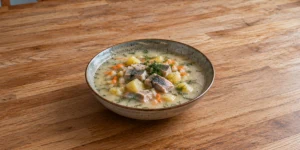
Jūšia - Traditional Lithuanian Herring Soup
What is Jūšia?
Jūšia is an old Lithuanian word documented with the specific meaning of herring soup. It is closely related to the older word jūšė, which Lithuanian linguistic sources record more broadly as fish soup, thin soup or, in some usages, soup containing groats.
This distinction matters. A recipe based specifically on herring is better described as jūšia, while jūšė historically had a wider meaning and should not automatically be treated as the name of one fixed herring recipe.
An Old Lithuanian Soup Name
The words belong to an old layer of Lithuanian culinary vocabulary. Historical dictionaries and linguistic studies record jūšė with several meanings connected with broth and soup, including fish soup. The form jūšia is recorded specifically as silkių sriuba, or herring soup.
This means that there was probably no single standardized national formula corresponding to the word. The historical evidence identifies the type of dish more clearly than it identifies an exact list of ingredients.
Why This Recipe Uses Herring
Salted herring is used here because it matches the documented meaning of jūšia. Herring also has a long-established place in Lithuanian food culture and became especially important in fasting and Christmas Eve meals.
The fish should be plain salted herring rather than a sweet pickled product. If it is strongly salted, it should be soaked briefly before cooking so that the broth does not become excessively salty.
A Simple Traditional-Style Reconstruction
No reliable historical source located for this recipe gives one canonical set of proportions for jūšia. For that reason, the recipe below should be understood as a cautious reconstruction based on the documented meaning of the dish rather than as a verbatim historical recipe.
The preparation is deliberately simple: herring, onion, water and black pepper form the soup, while boiled potatoes are served alongside. These ingredients keep the focus on the fish and avoid adding elements that cannot be established as essential to jūšia.
Why There Are No Mushrooms in This Version
Dried forest mushrooms are an important part of Lithuanian cooking and are sometimes paired with herring in other dishes. However, the linguistic sources defining jūšia as herring soup do not identify mushrooms as a defining ingredient.
For the same reason, this version does not add vinegar or sauerkraut brine. Sourness may occur in individual household recipes, but it should not be presented as a universal feature of historical jūšia without a specific source.
Preparing the Herring
Salted herring varies considerably in salinity. Taste a small piece before cooking. If it is very salty, soak the fillets in cold water for 30 to 60 minutes and taste again.
Do not soak the fish longer than necessary. The aim is to remove excessive salt, not to remove the characteristic herring flavor.
Cooking the Soup
The onion is first simmered gently in water to create a simple base. Pieces of herring are added only near the end because cured herring does not require prolonged cooking.
Keep the liquid at a gentle simmer after adding the fish. Strong boiling can cause the herring to break apart and can make its texture unnecessarily dry.
Serving Jūšia
Serve the soup warm with boiled potatoes on the side. Potatoes provide a mild accompaniment to the salty fish and onion broth and are a familiar partner for herring in Lithuanian cooking.
The soup should remain simple and relatively light. It is not intended to resemble a creamy modern fish soup or a heavily vegetable-based chowder.
Jūšia and Jūšė
The two names should not be used as though they were perfectly interchangeable. Historical linguistic evidence gives jūšė a broader range of meanings, including fish soup and thin soup, while jūšia is specifically recorded as herring soup.
For a recipe built around salted herring, Jūšia is therefore the more precise title.
Expert tips:
Taste the Herring Before Cooking
Salt levels vary greatly between herring products. Taste the fish first and soak it only as long as necessary.
Do Not Salt the Water First
The herring can release enough salt to season the entire soup. Adjust the salt only after the fish has cooked in the broth.
Add the Herring Near the End
Salted herring does not need prolonged cooking. A few minutes at a gentle simmer are sufficient to heat the fish and flavor the broth.
Avoid a Strong Boil
Vigorous boiling can break the herring into small pieces and make its texture dry.
Keep the Recipe Simple
The historical evidence identifies jūšia as herring soup but does not establish mushrooms, vinegar, cream or a large mixture of vegetables as required ingredients.
Storage:
How to Store
Cool leftover soup promptly and refrigerate it in a covered container. Keep boiled potatoes separately.
Shelf Life
For the best quality, eat refrigerated jūšia within 2 days.
Reheating
Reheat gently over low heat until hot. Avoid boiling the soup for several minutes because the herring can become dry and begin to fall apart.
Freezing
Freezing is not recommended because cooked herring can lose its texture after thawing.
Recipe information:
Jūšia
For Serving
Substitutions for ingredients:
- Salted Herring - Use plain lightly salted herring fillets. Avoid sweet or strongly vinegar-pickled herring because the marinade changes the character of the broth.
- Whole Black Peppercorns - Use freshly ground black pepper added near the end of cooking.
- Boiled Potatoes - Serve the soup with dark rye bread if potatoes are unavailable.
Prepare the Jūšia
1. Check the Herring
2. Prepare the Fish
3. Prepare the Onion
4. Prepare the Broth
5. Add the Chopped Onion
6. Add the Herring
7. Season the Soup
8. Prepare the Potatoes
9. Serve
Frequently Asked Questions (FAQ):
What is Jūšia?
Jūšia is an old Lithuanian term documented specifically with the meaning of herring soup.
What is the difference between Jūšia and Jūšė?
Historical linguistic sources use jūšė more broadly for fish soup, thin soup and related preparations, while jūšia is specifically recorded as herring soup.
Is Jūšia a modern Lithuanian dish?
The name belongs to older Lithuanian culinary vocabulary and is not as widely used today as modern general terms for fish soup.
Is there one authentic Jūšia recipe?
The surviving linguistic sources define the dish as herring soup but do not establish one standardized historical recipe with fixed proportions. This version is therefore a cautious traditional-style reconstruction.
Does Jūšia traditionally contain mushrooms?
The available historical definitions do not identify mushrooms as an essential ingredient. Mushrooms may occur in other Lithuanian herring dishes or household variations.
Does Jūšia need vinegar?
No evidence located for the historical definition of jūšia makes vinegar or a sour flavor essential.
Should the herring be fried before adding it?
There is no need to fry it in this version. The soaked salted herring is added directly to the gently simmering broth near the end of cooking.
Can I use pickled herring?
Plain salted herring is preferable. Sweet or strongly vinegar-pickled herring would noticeably change the flavor of the soup.
What should I serve with Jūšia?
Boiled potatoes are a practical accompaniment and pair naturally with salted herring and onion.
Is Jūšia specifically from Lithuania Minor?
The available linguistic evidence confirms the Lithuanian word and its meaning but is not strong enough to present this particular herring soup recipe as belonging exclusively to Lithuania Minor.
Is Jūšia the same as Samogitian Cibulynė?
No. They are different names and should not be treated as the same dish. Jūšia is documented as herring soup, while cibulynė belongs to a separate Samogitian culinary tradition.