
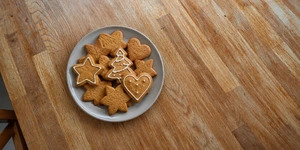
Kalėdiniai Meduoliai (Traditional Lithuanian Christmas Honey Cookies)
Traditional Lithuanian Christmas Honey Cookies
Kalėdiniai meduoliai are Lithuanian Christmas honey cookies made with flour, honey, butter, sugar and aromatic spices. The dough is rolled out, cut into festive shapes and baked until lightly golden. These fragrant cookies are especially popular during the Christmas season, when families prepare homemade treats and decorate them with colourful or white icing.
The Tradition of Meduoliai in Lithuania
Honey and spice cakes have a long history in Lithuania, particularly in the Vilnius region. Traditional meduoliai were made in different shapes and sizes, sometimes decorated with icing, names or festive messages. They were associated not only with Christmas but also with church celebrations, markets and other special occasions.
Among the best-known examples are the decorated honey hearts traditionally sold at Vilnius fairs, including the famous Kaziukas Fair. These decorated sweets reflect the broader Lithuanian tradition of preparing honey-based baked goods for celebrations.
Today, kalėdiniai meduoliai are commonly prepared as Christmas cookies shaped into stars, hearts, trees and other festive designs. Baking and decorating them has also become a popular family activity during Advent.
Honey, Butter and Christmas Spices
Honey gives Lithuanian meduoliai their characteristic flavour, colour and aroma. Butter provides richness, while brown sugar contributes sweetness and helps develop the warm colour of the baked cookies. Cinnamon, ginger, cloves, nutmeg and cardamom create the familiar Christmas spice mixture.
The precise combination of spices varies between households. Some Lithuanian recipes use ready-made meduolių prieskoniai, while others combine individual spices. Cocoa powder and citrus zest also appear in contemporary Lithuanian preparations, but they are not essential ingredients.
Resting the Honey Dough
After the honey, butter and sugar are gently heated together, the mixture is combined with flour, spices and an egg to make a soft dough. The dough is refrigerated overnight before rolling and cutting. Chilling allows the butter to firm up and the flour to absorb moisture, making the dough easier to handle.
Traditional and contemporary Lithuanian recipes vary in how long the dough is rested. Some are refrigerated overnight, while others mature for several days. This version uses an overnight rest of approximately 12 hours.
Shaping and Decorating the Cookies
The chilled dough is rolled into a thin sheet and cut into festive shapes. Stars, hearts and Christmas trees are popular choices, although other shapes can also be used. The cookies are baked briefly in a moderately hot oven until their edges are set and lightly browned.
Once cooled, the cookies may be decorated with a simple sugar icing. This recipe uses powdered sugar, lemon juice and water to make an egg-free glaze. Traditional and contemporary Lithuanian versions may also use other types of icing, including royal icing made with egg white.
Serving Lithuanian Christmas Cookies
Kalėdiniai meduoliai are enjoyed throughout the Christmas season, often with tea or coffee. They can be served plain or decorated and are also suitable for giving as homemade Christmas gifts.
This particular recipe contains butter and egg, so it is not suitable for a strictly traditional dairy-free and egg-free Kūčios supper. However, meduoliai are widely associated with Lithuanian winter celebrations and can be enjoyed during Advent, on Christmas Day and throughout the festive season.
Expert tips:
Use natural honey
Natural honey provides the characteristic flavour of Lithuanian meduoliai. Mild floral honey produces a lighter taste, while buckwheat or forest honey gives a stronger aroma and darker colour.
Do not overheat the honey mixture
Heat the honey, butter and sugar gently until combined. Allow the mixture to cool before adding it to the egg to prevent the egg from cooking prematurely.
Avoid adding too much flour
Freshly mixed honey dough may feel soft and sticky. Refrigeration makes it firmer and easier to roll. Adding excessive flour before chilling can produce dry, hard cookies.
Chill the dough overnight
An overnight rest helps the dough become more manageable and allows the spices to develop their flavour. Keep the dough wrapped or covered to prevent drying.
Roll the dough evenly
Aim for approximately 4 mm thickness. Thinner cookies may bake faster and become crisper, while thicker cookies may remain softer in the centre. Try to keep the thickness consistent within each batch.
Bake similar shapes together
Small cookies usually bake faster than large ones. Arrange similarly sized shapes on the same tray to obtain more even baking results.
Bake two test cookies first
Ovens and cookie cutters vary. Bake two test cookies before shaping the entire batch to check spreading, thickness and baking time. Adjust the remaining dough or baking time if necessary.
Do not overbake
Honey cookies can darken quickly. Remove them when the edges are lightly browned and the tops are set. They will continue to firm up as they cool.
Cool completely before decorating
Icing applied to warm cookies may melt or run off the surface. Allow the cookies to cool fully before adding the glaze.
Storage:
Room temperature storage
Allow the cookies to cool completely and ensure any icing has dried before storing. Place them in a clean, dry, airtight container, with baking parchment between decorated layers if needed. Store in a cool, dry place away from direct sunlight.
Shelf life
For best quality, consume the cookies within 1-2 weeks when stored in a cool, dry place in an airtight container. This is a conservative quality recommendation rather than a laboratory-tested shelf life. Discard cookies showing signs of mould, unusual moisture or spoilage.
Freezing the dough
Wrap the prepared dough tightly and freeze for up to 1 month for best quality. Thaw overnight in the refrigerator before rolling and cutting. Keep the dough covered during thawing to prevent drying.
Freezing baked cookies
Plain, completely cooled cookies can be frozen in airtight freezer-safe containers for up to 2 months for best quality. Thaw in the closed container at room temperature to reduce condensation on the cookies. Decorate after thawing.
Recipe information:
Honey cookie dough
Optional lemon icing
Substitutions for ingredients:
- Individual ground spices - Use approximately 2-3 teaspoons of ready-made Lithuanian gingerbread spice mix (meduolių prieskoniai), adjusting to the strength of the mixture. Commercial blends vary in composition and intensity, so this is an approximate substitution rather than an exact equivalent.
- Light brown sugar - White granulated sugar can be used, but the cookies may have a lighter colour and slightly different flavour. Brown sugar is recommended for this version.
- Orange zest - Use finely grated lemon zest or omit the citrus zest entirely. Both approaches appear in Lithuanian Christmas baking variations.
- Natural honey - Different varieties of natural honey can be used. Buckwheat and forest honey provide a stronger flavour and darker colour than mild floral honey. Honey is recommended for the characteristic flavour of this version.
- Lemon icing - Leave the cookies undecorated or use another simple sugar glaze. Traditional and contemporary Lithuanian meduoliai may also be decorated with royal icing or coloured sugar decorations.
Preparation
1. Heat the honey, butter and sugar
2. Combine the dry ingredients
3. Prepare the honey dough
4. Chill the dough overnight
5. Prepare the oven and dough
6. Roll out the dough
7. Cut the Christmas shapes
8. Bake the honey cookies
9. Cool the cookies
10. Prepare the optional lemon icing
11. Decorate and allow the icing to set
Frequently Asked Questions (FAQ):
What are kalėdiniai meduoliai?
Kalėdiniai meduoliai are Lithuanian Christmas honey and spice cookies. They are typically made with flour, honey or sugar, aromatic spices and other ingredients depending on the recipe. The dough is often rolled out, cut into festive shapes and decorated with icing.
Are meduoliai traditional in Lithuania?
Yes. Honey and spice cakes have a long history in Lithuanian baking, especially in the Vilnius region. Decorated meduoliai were traditionally associated with markets, religious celebrations and other special occasions. Christmas-shaped cookies are a familiar modern continuation of this baking tradition.
Are Lithuanian meduoliai the same as gingerbread?
Meduoliai belong to the broader family of European gingerbread and honey-spice baked goods. Lithuanian recipes often include honey and a mixture of spices such as cinnamon, ginger, cloves and nutmeg, although exact ingredients and textures vary.
Do Lithuanian Christmas cookies always contain honey?
No. Honey is characteristic of many traditional meduoliai, but Lithuanian recipes also include versions made with sugar or other sweeteners. This recipe uses natural honey to create a rich, aromatic dough.
Why does the dough need to rest overnight?
Refrigerating the dough allows the butter to firm up and the flour to absorb moisture. This makes the dough easier to roll and cut into shapes. It also gives the spices time to develop their aroma.
Can I prepare the dough several days in advance?
Some Lithuanian recipes rest honey dough for several days. However, this particular recipe has not been tested with extended refrigeration. For the stated method, refrigerate the dough overnight or freeze it if longer storage is needed.
Can I use a ready-made Lithuanian gingerbread spice mix?
Yes. Meduolių prieskoniai is a ready-made spice mixture used for Lithuanian honey and spice baking. Replace the individual spices with approximately 2-3 teaspoons, adjusting the amount to the strength of the blend.
Should Lithuanian Christmas cookies be soft or crisp?
Both textures occur in Lithuanian meduoliai. Thin cookies baked for longer tend to be crisper, while thicker cookies may remain softer inside. The final texture depends on the recipe, dough thickness, baking time and storage conditions.
Can I decorate the cookies with icing?
Yes. Decorated honey cookies are part of Lithuanian festive baking traditions. This recipe uses a simple lemon sugar icing, but other types of glaze and colourful decorations can also be used.
Are kalėdiniai meduoliai served during Kūčios?
Meduoliai are associated with the Lithuanian Christmas season, including Advent and Christmas celebrations. This particular recipe contains butter and egg, so it is not suitable for a strictly traditional meatless, dairy-free and egg-free Kūčios supper. It can be enjoyed on Christmas Day and throughout the festive season.
What is the difference between meduoliai and meduolis?
Meduolis is the singular Lithuanian term for a honey or spice baked good, while meduoliai is its plural form. The broader category includes small shaped cookies as well as larger cakes or sheet-style baked goods.
Can I freeze Lithuanian honey cookie dough?
Yes. Wrap the dough tightly and freeze for up to 1 month for best quality. Thaw overnight in the refrigerator before rolling and baking.
How long do homemade meduoliai last?
Store completely cooled cookies in an airtight container in a cool, dry place. For best quality, this recipe recommends consuming them within 1-2 weeks. Their exact shelf life has not been established through testing.