
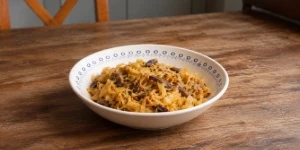
Kapusta z grzybami (Polish Sauerkraut with Wild Mushrooms)
What is Kapusta z Grzybami?
Kapusta z grzybami is a traditional Polish dish of fermented cabbage slowly cooked with dried forest mushrooms, onion and simple spices. It is particularly associated with Christmas Eve, when the meatless combination of preserved cabbage and mushrooms fits naturally into the traditional Wigilia menu.
The dish is usually thick rather than soupy. The sauerkraut should become tender while retaining its characteristic acidity, and the dried mushrooms should give the cabbage a deep forest aroma.
There is no single national recipe. Some versions are very simple and contain only cabbage, mushrooms, onion and oil. Others include butter, flour, cream, caraway, bay leaf, allspice or linseed oil. Regional and family traditions differ considerably.
Kapusta z Grzybami on the Polish Christmas Eve table
The connection with Polish Christmas Eve is well documented. In 2025 the Ministry of Culture and National Heritage added the traditions of Polish Christmas Eve to the National List of Intangible Cultural Heritage. The official description specifically names cabbage with peas or mushrooms among the dishes served at Wigilia.
The combination is found in many parts of Poland rather than belonging to one single region. Official ethnographic material from Podlasie records boiled cabbage with mushrooms among traditional Christmas Eve foods, while Pomeranian sources also mention cabbage with mushrooms on the Kashubian Christmas table.
For that reason, this general recipe is classified as Polish rather than exclusively Podkarpackie. Podkarpackie nevertheless has its own strong Christmas traditions combining fermented cabbage and dried forest mushrooms.
An old Polish combination of cabbage and mushrooms
The combination of sour cabbage and dried mushrooms is documented in Polish cookery well before the modern period. In the 1871 edition of Lucyna Ćwierczakiewiczowa's 365 obiadów za 5 złotych, sour cabbage is stewed with onion and then combined with boiled chopped mushrooms as a filling for pierogi.
The same cookbook also describes a meatless cabbage soup in which a large quantity of dried mushrooms is cooked with sour cabbage and the finished soup is thickened with butter, flour and onion.
These recipes are not identical to modern Christmas kapusta z grzybami, but they clearly document the established nineteenth-century Polish pairing of fermented cabbage, dried mushrooms and onion.
A direct early twentieth-century recipe
A particularly close historical precedent appears in the 1913 edition of Wincenta Zawadzka's Kucharka litewska under the title Kapusta kwaśna z grzybami i śmietaną.
Zawadzka instructs the cook to prepare a mushroom broth, pour it over sour cabbage, add finely chopped cooked porcini mushrooms and simmer everything together. The dish is then enriched with sour cream and finally with flour browned in butter.
The modern Christmas version in this recipe is leaner and omits both cream and flour, but the historical recipe confirms that sour cabbage cooked directly with dried mushroom stock and chopped mushrooms was already an established dish more than a century ago.
A traditional Mazovian version
The Ministry of Agriculture has registered Kapusta z olejem lnianym i grzybami from Mazowieckie on Poland's List of Traditional Products.
The official description presents a dense dish made from fermented cabbage, dried mushrooms, vegetables, spices and linseed oil. It also records the older Christmas custom of serving cabbage with mushrooms dressed with oil.
This is particularly important because it confirms that a completely meatless and dairy-free form of kapusta z grzybami is not simply a modern vegan adaptation. Vegetable oils, including linseed oil, belong to older Polish fasting traditions.
Podkarpackie traditions
Although this exact recipe should not be labelled exclusively Podkarpackie, the region has several documented Christmas dishes built around the same ingredients.
Kwas wigilijny from the village of Cygany combines fermented cabbage, dried mushrooms and millet and is documented as a traditional Podkarpackie Christmas Eve dish. The mushrooms are soaked, cooked and added together with part of their cooking liquid.
Another local dish, kwas z gąsek zielonych, combines cabbage, mushrooms and millet. These examples show how strongly fermented cabbage and forest mushrooms were linked in regional cooking.
Choosing the Sauerkraut
Use naturally fermented cabbage made primarily from cabbage and salt. Polish food-quality authorities explain that the terms kapusta kiszona and kapusta kwaszona can both correctly describe cabbage produced by natural lactic fermentation.
The important distinction is not between the words kiszona and kwaszona, but between naturally fermented cabbage and vegetables acidified by adding vinegar or another food acid. The latter is technically a marinated product rather than the same traditional fermentation.
Pasteurization is a separate issue. Pasteurized sauerkraut can still have been produced through genuine lactic fermentation; pasteurization simply changes its microbiological state and can also affect texture and fresh fermented aroma. Check the ingredient list rather than assuming that every shelf-stable jar is vinegar-pickled.
Should Sauerkraut be rinsed?
Always taste it first. Mild, pleasantly sour sauerkraut usually needs no rinsing at all.
If the cabbage is extremely sour or salty, rinse it briefly in cold water and drain it. Avoid repeated washing because that removes much of the characteristic fermented flavor.
Long strands can be chopped into shorter pieces before cooking, which makes the finished dish easier to serve and eat.
Why dried forest mushrooms matter
Dried porcini and bay boletes give the dish much more concentrated mushroom flavor than cultivated mushrooms. Their aroma is particularly suitable for a winter dish based on fermented cabbage.
Historically, drying allowed mushrooms gathered during the autumn season to be stored for Christmas and the rest of winter.
Use commercially sold mushrooms or mushrooms that were positively identified before drying. Never use a recipe or photograph as a guide for identifying wild species.
Soaking and cooking dried mushrooms
Rinse the dried mushrooms briefly, cover them with cool water and soak for about 2 hours. If they need to soak overnight, keep them covered in the refrigerator.
Lift the mushrooms from the liquid rather than pouring everything together. Fine sand and forest debris often collect at the bottom of the bowl.
Filter the soaking water through a very fine sieve, cloth or coffee filter, then simmer the mushrooms in the filtered liquid until tender.
Use the mushroom cooking liquid
The mushroom liquid is valuable because it contains much of the aroma extracted during soaking and cooking. Traditional regional recipes also use mushroom cooking liquid together with fermented cabbage.
Add it gradually to the sauerkraut. The dish needs enough moisture to simmer without burning but should not end as a soup.
Cooking the Sauerkraut
Cook the cabbage slowly with the mushrooms, bay leaves, allspice and black pepper. About one hour is usually enough for modern commercial sauerkraut, although firmer cabbage can require longer.
Keep the pot covered during most of the cooking so the cabbage softens without losing liquid too quickly. Toward the end, uncover it and allow excess moisture to evaporate.
Onion and fat
Fried onion is one of the most characteristic additions to cabbage and mushrooms. Cook it until soft and golden rather than aggressively dark or deeply caramelized.
Rapeseed oil is suitable for a straightforward meatless version. Butter can be used in a richer household version and is well documented in historical Polish cabbage recipes.
Cold-pressed linseed oil has particularly strong traditional associations with fasting and Christmas foods. Rather than frying onion heavily in it, add a small spoonful to the finished cabbage shortly before serving if you want its distinctive nutty flavor.
Does Kapusta z Grzybami need flour?
No. Some historical and regional recipes use a zasmażka, a roux made from flour and fat, to bind the liquid. Zawadzka's 1913 version is one example.
Other versions simply cook the cabbage uncovered near the end until the mushroom liquid reduces naturally. This recipe uses the second method and therefore remains gluten-free.
Caraway and other spices
Bay leaf, allspice and black pepper are familiar additions to Polish braised cabbage. Caraway is also used in cabbage dishes but is not essential to every kapusta z grzybami recipe.
Use caraway sparingly or leave it out completely if you want the dried mushroom aroma to dominate.
Does Kapusta z Grzybami taste better the next day?
The dish reheats very well, and resting overnight allows the mushroom aroma to become more evenly distributed through the cabbage. This makes it particularly convenient for Christmas Eve, when several dishes are prepared in advance.
It is not necessary to cook and reheat the cabbage repeatedly for several days. Prepare it a day in advance, refrigerate it promptly and reheat only the amount needed.
How to serve Kapusta z Grzybami
Serve it hot as one of the Christmas Eve dishes alongside fried carp, pierogi, barszcz and other meatless foods.
Outside Christmas it works as a side dish with boiled potatoes and can also be used as a starting point for fillings for pierogi, paszteciki and kulebiak.
Expert tips:
Use naturally fermented Sauerkraut
Look for cabbage produced by lactic fermentation. The words kiszona and kwaszona can both correctly describe fermented cabbage in Poland; the important distinction is whether the product was fermented or simply acidified with added food acids.
Pasteurized does not automatically mean fake Sauerkraut
Pasteurized sauerkraut may still have been genuinely fermented. Pasteurization affects live microorganisms and can change texture and aroma, but it is different from producing cabbage simply by adding vinegar.
Taste before rinsing
Good sauerkraut does not need to be washed automatically. Rinse only an excessively sour or salty batch, because repeated washing removes much of its characteristic flavor.
Use dried forest mushrooms
Porcini and bay boletes give the dish the deep mushroom aroma associated with Polish Christmas cooking. Cultivated mushrooms can add bulk but do not reproduce the same flavor.
Filter the mushroom liquid
The soaking and cooking liquid contains valuable flavor but may also contain fine sand. Filter it carefully before adding it to the cabbage.
Do not make the dish watery
Add mushroom liquid gradually. The finished kapusta z grzybami should be moist and tender but dense enough to hold on a spoon.
A roux is optional
Historical versions sometimes use flour browned in butter to bind the cabbage. This recipe instead reduces the liquid naturally, which keeps it gluten-free.
Linseed oil belongs to the tradition
Official regional records document cabbage with mushrooms dressed with linseed oil. Add cold-pressed linseed oil after cooking to preserve its characteristic flavor.
Storage:
Refrigeration
Cool the cooked cabbage promptly and refrigerate it in a covered container at 4°C / 40°F or colder. Do not leave a large pot sitting at room temperature for several hours.
Shelf life
For conservative home storage, eat refrigerated kapusta z grzybami within 3 to 4 days.
Making it ahead
The dish can be prepared one day before serving. Reheat it gently with a small splash of water if it has become too dry in the refrigerator.
Freezing
Kapusta z grzybami freezes well. Cool it completely, portion it into freezer-safe containers and freeze for about 2 to 3 months for best quality. Thaw in the refrigerator before reheating.
Recipe information:
Sauerkraut with Mushrooms
Optional Traditional Finish
Substitutions for ingredients:
- Dried Porcini or Bay Boletes - Use a commercially sold mixture of edible dried Polish forest mushrooms. Fresh cultivated mushrooms can supplement the filling but should not fully replace the dried mushrooms if you want the characteristic traditional aroma.
- Rapeseed Oil - Butter can be used for a richer vegetarian version. Historical Polish recipes frequently combine sour cabbage, mushrooms and butter.
- Rapeseed Oil - For a stronger traditional fasting character, finish the cooked cabbage with cold-pressed linseed oil.
- Caraway - Leave it out completely. Caraway is used in Polish cabbage dishes but is not required for kapusta z grzybami.
- Sauerkraut - Fresh white cabbage can be cooked with mushrooms, but it produces a different, much milder dish and should not be presented as identical to traditional kapusta z grzybami based on fermented cabbage.
Prepare the Mushrooms
1. Rinse the dried mushrooms
2. Soak
3. Filter the soaking liquid
4. Cook the mushrooms
5. Cut the mushrooms
Prepare the Sauerkraut
1. Taste the cabbage
2. Chop if necessary
3. Start cooking
4. Add mushroom liquid
5. Simmer
Prepare the Onion
1. Fry the onion
2. Add to the cabbage
Finish the Dish
1. Reduce uncovered
2. Season
3. Add optional linseed oil
4. Rest
Frequently Asked Questions (FAQ):
Is Kapusta z Grzybami a traditional Polish Christmas Eve dish?
Yes. The Polish Ministry of Culture lists cabbage with mushrooms among the dishes traditionally served during Christmas Eve supper.
How old is the combination of cabbage and mushrooms in Polish cooking?
It is clearly documented in nineteenth-century Polish cookery. Lucyna Ćwierczakiewiczowa combined sour cabbage with boiled mushrooms in an 1871 pierogi filling and also used dried mushrooms with sour cabbage in meatless kapuśniak.
Is there an old recipe specifically for cabbage with mushrooms?
Yes. The 1913 edition of Kucharka litewska contains a recipe titled Kapusta kwaśna z grzybami i śmietaną, made from sour cabbage, dried mushrooms, mushroom broth, cream, butter and flour.
Is Kapusta z Grzybami specifically from Podkarpackie?
No. It is a broader Polish Christmas tradition. Podkarpackie has several related regional dishes combining fermented cabbage and dried mushrooms, but similar cabbage-and-mushroom traditions are documented in Mazowsze, Podlasie, Pomorze and elsewhere.
Is there an officially registered regional Kapusta z Grzybami?
Yes. Kapusta z olejem lnianym i grzybami from Mazowieckie is registered on Poland's List of Traditional Products and documents fermented cabbage, dried mushrooms and linseed oil as a traditional holiday combination.
What mushrooms are traditionally used?
Dried edible forest mushrooms are characteristic, especially porcini and bay boletes. A mixture of dried forest mushrooms is also suitable.
Can Shiitake replace Polish forest mushrooms?
They can technically be cooked with sauerkraut, but they have a different flavor profile and are not a good authenticity-focused substitute. A commercial mixture of European dried forest mushrooms is preferable.
Should I use the mushroom soaking water?
Yes, provided it is carefully filtered. It contains a great deal of mushroom aroma and traditional regional recipes also use mushroom cooking liquid with fermented cabbage.
Should Sauerkraut be rinsed before cooking?
Only if it is excessively sour or salty. Taste it first. Repeated washing removes much of the fermented flavor.
Is Kiszona different from Kwaszona?
Not necessarily. Polish food-quality authorities state that both names can be used for cabbage produced by natural lactic fermentation. The important difference is between fermented cabbage and a product acidified directly with added food acids.
Does pasteurized Sauerkraut contain vinegar?
Not necessarily. Pasteurization and acidification are different processes. A product can be naturally fermented and then pasteurized, so check the ingredients and production description rather than judging it only by whether it is shelf-stable.
Does Kapusta z Grzybami need a flour roux?
No. Some historical and regional versions use a roux, but the dish can also be thickened simply by reducing the cooking liquid.
Is linseed oil traditional with cabbage and mushrooms?
Yes. The Ministry of Agriculture documents a traditional Mazovian cabbage-and-mushroom dish dressed with linseed oil, and vegetable oils were important fats in meatless Christmas cooking.
What is the difference between Kapusta z Grzybami and Bigos?
Kapusta z grzybami is a meatless dish centered on fermented cabbage and dried mushrooms. Bigos is a separate family of long-cooked cabbage dishes typically containing meat and often combining sauerkraut with fresh cabbage, but its exact ingredients vary widely and tomato, sausage or dried plums are not mandatory in every version.
Can Kapusta z Grzybami be made ahead?
Yes. It reheats very well and can conveniently be prepared the day before Christmas Eve. Cool it promptly, refrigerate and reheat only as much as needed.
How long can Kapusta z Grzybami be refrigerated?
For conservative home storage, keep it refrigerated at 4°C / 40°F or colder and eat it within about 3 to 4 days.
Can Kapusta z Grzybami be frozen?
Yes. It freezes well for about 2 to 3 months for best quality. Thaw it in the refrigerator and reheat gently with a little water if necessary.
Is this recipe vegan?
Yes. This version uses rapeseed oil instead of butter and contains no meat, dairy or eggs. Butter can be used as a vegetarian household variation.