
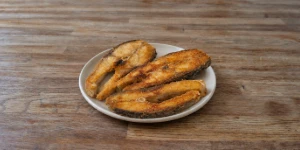
Karp smażony - Traditional Polish Fried Carp
What is Karp Smażony?
Karp smażony is Polish fried carp, most commonly prepared from cross-cut steaks known as dzwonka. The fish is seasoned, coated in flour or a light breading and fried until golden while the meat remains moist inside.
Today it is one of the dishes most strongly associated with Polish Christmas Eve, or Wigilia. Fried carp is often served with potatoes, sauerkraut, vegetable salad or other traditional meatless Christmas dishes.
This recipe uses a flour, egg and breadcrumb coating, one of the familiar modern Polish ways of preparing fried Christmas carp. Older Polish recipes also document simpler coatings based on flour mixed with breadcrumbs, so there has never been only one acceptable breading.
Carp in Polish cuisine before the twentieth century
Carp has a much longer history in Polish cooking than its modern association with Christmas might suggest. Carp farming on Polish lands has medieval roots, encouraged by the development of monastery and estate fish ponds. Freshwater fish were particularly important because the Christian calendar included numerous periods when meat was avoided.
By the seventeenth century carp was firmly established in elite Polish cookery. Stanisław Czerniecki included several preparations for carp in his Compendium ferculorum of 1682, the first surviving printed Polish cookbook. Even older sixteenth-century culinary material contains methods that could be applied to carp and other freshwater fish.
Historic Polish cuisine prepared carp in many ways: boiled in seasoned sauces, cooked with wine or beer, served in sweet-and-sour sauces, jellied and eventually increasingly often fried. The simple fried carp familiar today is therefore only one branch of a much larger Polish carp tradition.
Was Christmas carp invented during the communist era?
No. The often repeated claim that carp appeared on Polish Christmas Eve tables only after the Second World War is too simple. Historical sources show that carp was already eaten for Christmas long before communist Poland.
The Polish culinary canon compiled by the National Institute of Rural Culture and Heritage notes nineteenth-century descriptions of carp served in a Polish-style sauce on Christmas Eve. A 1915 cookbook distributed with Gazeta Grudziądzka likewise included Karp w polskim sosie na Wiliją.
Nineteenth-century cook Lucyna Ćwierczakiewiczowa also included carp in her proposed Christmas Eve menu, although her version was carp in grey sauce rather than the modern breaded fried fish. This demonstrates that carp belonged to the Christmas repertoire before the twentieth-century political changes.
What changed after World War II?
Although carp already had a Christmas tradition, it was not always the dominant Polish Christmas fish. Pike, pike-perch, tench, herring and other freshwater and marine fish were also important and could be preferred in wealthier households.
After the Second World War, the centrally planned economy greatly expanded carp production because the species was comparatively practical to raise in ponds. The campaign commonly summarized by the slogan Karp na każdym wigilijnym stole, associated with 1947, helped make affordable carp widely available.
This did not invent the Polish tradition of eating carp at Christmas. It transformed an older tradition into something much closer to a nationwide standard. The distinction is important: pre-war Christmas carp is historically documented, while post-war production and distribution explain why it became so dominant.
Fried carp in older Polish cookbooks
Older Polish recipes also document fried carp directly. Maria Disslowa's early twentieth-century fish cookbook instructs the cook to split a large carp, cut it into relatively small steaks, salt the pieces, dry them carefully and coat them in a mixture of flour and breadcrumbs before frying them in plenty of fat.
Disslowa also recommends finishing thick pieces briefly in the oven because carp steaks can brown on the outside before the flesh near the bones is fully cooked.
This is remarkably close to the basic technique still used today: cut the carp into steaks, season it, dry the surface, coat it lightly and fry it until brown. Modern households differ mainly in the exact breading and frying fat.
Regional traditions of fried carp
Fried carp is not specific to Małopolska, so this recipe is best treated as a Polish national preparation rather than assigned to one voivodeship.
There are, however, important regional carp traditions. The Ministry of Agriculture lists Złotopotocki karp smażony from Silesia as a traditional product. It is prepared as a 3-5 cm carp steak with a golden-brown exterior and soft, juicy flesh.
Another officially registered dish from Wielkopolska combines a fried breaded carp steak with traditional grey sauce. In Silesian Christmas traditions, breaded carp fried in clarified butter is also documented alongside carp in aspic and Jewish-style preparations.
Małopolska has an especially important carp-farming tradition around Zator and the so-called Carp Valley, but that regional connection should not be used to claim that ordinary fried carp belongs exclusively to Małopolska.
Choosing carp for frying
Use a fresh, properly handled carp without a strong unpleasant odor. A fish that already has a pronounced earthy or musty off-flavor is not automatically improved simply by adding stronger seasoning.
A carp weighing around 1.5 kg is convenient for four generous portions. Ask the fishmonger to gut and scale it and, if desired, cut it into steaks approximately 3 to 4 cm thick.
Carp contains numerous intermuscular bones, so eat the finished fish carefully. This is particularly important when serving it to children.
Does carp need to be soaked in milk?
No. Soaking carp in milk is an optional household technique rather than a necessary stage in cooking the fish. Polish home recipes often combine milk with sliced onion and leave the carp refrigerated for several hours or overnight before frying.
The practice is commonly said to reduce a strong fishy or earthy aroma. It may change or mellow the perceived flavor, and it remains a legitimate Polish household variation, but there is not good evidence that a short milk soak actually removes the compounds responsible for true muddy off-flavors from the flesh.
Research on aquaculture identifies geosmin and 2-methylisoborneol, known as 2-MIB, as important causes of earthy and musty off-flavors in fish, including common carp. These compounds can accumulate in fish tissue from the water. Commercial quality control therefore focuses on raising or holding fish in suitable water and, when necessary, depurating live fish in clean water before harvest.
For a good-quality fresh carp, milk soaking is therefore optional. In this recipe it is retained because it is a well-known Polish home-cooking practice and can produce a mild, pleasant preparation, not because the milk should be treated as a guaranteed method of removing geosmin.
Preparing carp steaks
If starting with a whole prepared carp, remove any remaining scales and cut the fish crosswise into steaks about 3 to 4 cm thick. Thick steaks are traditional and help prevent the meat from drying during frying.
If using the optional milk treatment, place the pieces in cold milk with sliced onion and refrigerate them. Never leave raw fish soaking at room temperature.
After soaking, discard the milk and onion. Do not reuse the raw-fish marinade. Pat the carp very thoroughly dry before seasoning and breading.
Seasoning and breading
Carp does not require a complicated spice mixture. Salt and freshly ground black pepper are enough for a straightforward Polish fried version.
This recipe uses three-stage breading: first flour, then beaten egg, then breadcrumbs. It creates a crisp, golden exterior and is common in contemporary Polish Christmas cooking.
Other traditional techniques are equally valid. Carp can be coated only in flour or in a mixture of flour and fine breadcrumbs. Historical recipes demonstrate that the exact coating has varied over time.
Frying the carp
Heat a layer of rapeseed oil in a heavy frying pan over medium heat. The oil needs to be hot enough to brown the coating without making it absorb excessive fat, but not so hot that the breadcrumbs burn before the thick carp steak cooks near the bone.
Fry the pieces in batches for approximately 4 to 6 minutes per side, depending on thickness. Avoid overcrowding the pan because the temperature will fall sharply.
The finished fish should be golden outside and opaque and flaky inside. For an additional safety check, fish can be cooked to an internal temperature of approximately 63°C / 145°F at the thickest part.
How to serve Polish Fried Carp
For Christmas Eve, serve the carp hot with traditional accompaniments such as sauerkraut, potatoes or Polish vegetable salad. Lemon wedges are also common with fried fish.
Some families prepare the carp shortly before the Christmas Eve meal, while others fry it earlier and reheat it gently. Freshly fried carp has the crispest coating, so frying as close to serving time as practical gives the best texture.
Fried carp can of course be eaten outside Christmas. Historically, carp was a much more general freshwater fish in Polish cuisine than its modern once-a-year reputation suggests.
Expert tips:
Milk soaking is optional
Milk and onion are used in many Polish household recipes to mellow the aroma of carp, but a milk soak should not be presented as a scientifically proven way to remove geosmin or other true earthy off-flavor compounds.
Start with good-quality carp
A properly raised, fresh carp should have a mild characteristic aroma rather than a strong muddy smell. Cooking techniques cannot completely compensate for poor raw fish quality.
Dry the fish thoroughly
A dry surface helps the flour adhere, reduces dangerous oil splattering and makes the finished coating crisper.
Three-stage breading is not the only traditional method
Flour, egg and breadcrumbs are common today, but older Polish recipes also coat carp in flour mixed with breadcrumbs or simply in flour.
Control the frying temperature
Carp steaks are relatively thick. Excessively high heat burns the coating before the meat near the backbone is done, while oil that is too cool produces greasy breading.
Watch for bones
Carp contains many intermuscular bones. Serve and eat it carefully, particularly when children are at the table.
Storage:
Raw Carp
Keep raw carp refrigerated and separated from ready-to-eat foods. Fresh raw fish should generally be cooked or frozen within 1 to 2 days.
Cooked Carp
Cool leftover fried carp promptly and refrigerate it in a covered container. Properly refrigerated cooked fish can generally be stored for 3 to 4 days.
Reheating
Reheat fried carp in a hot oven or air fryer rather than a microwave if you want to restore some crispness to the breading.
Freezing
Cooked fried carp can be frozen, but the breading becomes softer after thawing. For better texture, freeze raw prepared carp and bread and fry it after thawing in the refrigerator.
Recipe information:
Carp
Breading and Frying
Substitutions for ingredients:
- Milk and Onion Soak - Omit it completely when using fresh, mild-tasting carp. The soaking step is a household variation rather than a requirement for authentic fried carp.
- Rapeseed Oil - Clarified butter can be used for a richer flavor and is documented in Polish regional Christmas cooking. A mixture of oil and clarified butter also works well.
- Flour, Egg and Breadcrumb Coating - For a simpler historically documented version, mix plain flour and fine breadcrumbs and coat the seasoned, dried fish directly before frying.
- Carp - Pike-perch, tench or another freshwater fish can be fried by a similar method, but the resulting dish is no longer karp smażony and has its own place in Polish fish traditions.
Prepare the Carp
1. Check and portion the fish
2. Optional milk and onion soak
3. Discard the marinade
4. Dry and season
Bread the Carp
1. Prepare the breading
2. Coat in flour
3. Coat in egg and breadcrumbs
Fry the Carp
1. Heat the oil
2. Fry in batches
3. Turn and finish cooking
4. Drain
5. Serve
Frequently Asked Questions (FAQ):
Is fried carp a traditional Polish Christmas Eve dish?
Yes. Fried carp is now one of the most recognizable Polish Christmas Eve dishes. Carp itself was eaten for Christmas before the communist era, while post-war mass production and distribution made it much more widespread.
Was Christmas carp invented in communist Poland?
No. Historical sources document carp at Polish Christmas Eve meals in the nineteenth century and earlier traditions of Christmas carp existed before World War II. The post-war campaign and expansion of pond farming made carp inexpensive and widely available, turning an older tradition into a near-national standard.
How old is carp in Polish cuisine?
Carp farming in Polish lands has medieval roots, while seventeenth-century Polish cookbooks already contain numerous recipes for the fish. Stanisław Czerniecki included several carp preparations in Compendium ferculorum in 1682.
Was carp always the main Polish Christmas fish?
No. Older Christmas menus also featured pike, pike-perch, tench, herring and other fish. Carp became exceptionally dominant only in the twentieth century, especially after World War II.
Is fried carp itself historically documented in Poland?
Yes. Early twentieth-century Polish cookbooks contain recipes specifically for fried carp, including steaks salted, dried, coated with flour and breadcrumbs and fried in fat.
Do I have to soak carp in milk?
No. Milk soaking is an optional Polish household technique. A fresh, good-quality carp can be seasoned, breaded and fried without soaking.
Does milk remove the muddy taste from carp?
It may mellow the perceived aroma and is widely used in Polish home cooking, but there is no good evidence that a short milk soak removes the compounds responsible for true earthy off-flavors from carp flesh. Geosmin and 2-MIB are important causes of such flavors, and commercial fish quality relies primarily on good farming conditions and depuration before harvest.
What causes the earthy taste sometimes found in carp?
Aquaculture research identifies compounds including geosmin and 2-methylisoborneol as major causes of earthy or musty off-flavors in freshwater fish. Their concentration depends strongly on the water environment and fish production conditions.
Should carp be coated in flour, egg and breadcrumbs?
It can be. This is a common modern Polish preparation. Historical and regional recipes also document flour alone or mixtures of flour and breadcrumbs, so there is no single mandatory coating.
How thick should carp steaks be?
Pieces about 3 to 4 cm thick are practical. Official documentation for Złotopotocki karp smażony describes traditional steaks about 3 to 5 cm wide.
How do I know when fried carp is cooked?
The flesh should be opaque and separate easily near the thickest part without remaining translucent. For an objective check, cook fish to about 63°C / 145°F in the thickest part.
Why does carp have so many bones?
Common carp naturally has numerous fine intermuscular bones in addition to the main skeleton. Cutting the fish into steaks does not remove them, so the cooked fish should always be eaten carefully.
Can fried carp be reheated?
Yes. A hot oven or air fryer preserves the crust better than microwaving. Avoid reheating for too long because carp can dry out.