
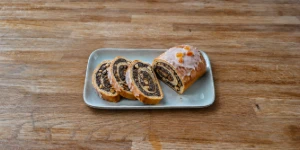
Makowiec zawijany (Traditional Polish Poppy Seed Roll)
What is Makowiec Zawijany?
Makowiec zawijany is a traditional Polish yeast cake rolled around a thick filling made from prepared poppy seeds, honey or sugar, butter, eggs and dried fruit or nuts. When sliced, the cake reveals the characteristic dark spiral of poppy-seed filling inside pale, soft yeast dough.
Makowiec is particularly associated with Christmas in Poland, although regional traditions also connect poppy-seed rolls with Easter, weddings and other important celebrations.
The Polish Ministry of Culture lists makowiec among the foods most commonly associated with Christmas Eve in Poland. Regional entries on the Ministry of Agriculture's List of Traditional Products document related poppy-seed rolls in several parts of the country, including Podkarpackie, Małopolska and Lubelskie.
Makowiec is a Polish national tradition, not exclusively a Wielkopolska cake
Makowiec is certainly traditional in Wielkopolska. Official ethnographic material on the region notes that makowiec and strucla are served there at Christmas and that makowiec became widespread on Wielkopolska Christmas tables.
However, a general recipe for rolled makowiec should not be assigned exclusively to Wielkopolska. Closely related traditional rolls are documented across Poland.
Podkarpackie has both makowiec sędziszowski and strucla makowa brzozowska. Małopolska has kościelecka strucla makowa, while Lubelskie has makowiec lubartowski. Their recipes differ, but all belong to the broader Polish tradition of yeast pastry filled with poppy seeds.
A documented Polish Poppy Seed Roll from 1908
Lucyna Ćwierczakiewiczowa included Strucle z makiem in her 1908 book Baby, placki i mazurki. Her method is recognizably related to modern makowiec zawijany.
The poppy seeds were softened and ground, then mixed with sugar or honey, bitter almonds and cinnamon. The filling was spread thickly over rolled yeast dough, sprinkled with raisins and rolled into a long strucla.
The roll was left to rise, brushed with egg and baked longer than a plain yeast cake because of the heavy, moist poppy filling. Ćwierczakiewiczowa then covered the hot baked roll with a clear icing.
This provides strong evidence that the basic form of today's rolled makowiec - yeast dough, ground sweetened poppy filling, dried fruit, rolling, proofing and icing - was already firmly established in Polish cookery at the beginning of the twentieth century.
Egg whites in the Poppy Seed filling are also historically documented
A Polish baking book from the 1920s gives another useful detail. Its recipe for strucle z makiem uses approximately 400 g of poppy seeds and adds whole eggs or egg whites specifically so that the poppy mass sets during baking and does not flow out of the roll.
This is very close to the technique used in the present recipe. Beaten egg whites make the filling somewhat lighter, but their more important practical role is binding the moist poppy mixture as it cooks.
Makowiec at Christmas and Easter
Christmas is the holiday most strongly associated with makowiec today. Official regional sources describe poppy-seed rolls as traditional Christmas cakes in several parts of Poland.
The tradition is not limited to Christmas. The officially registered Kościelecka strucla makowa from Małopolska was baked both for Christmas and Easter. Makowiec sędziszowski from Podkarpackie was likewise associated with Christmas, Easter and other important family occasions.
Poppy seeds also carried symbolic meaning in older folk culture. Regional ethnographic records connect the abundance of tiny seeds with ideas of prosperity, fertility, luck and protection. These were traditional beliefs rather than properties of the food itself.
Traditional Blue Poppy Seeds
Blue poppy seeds are particularly appropriate for this cake. The official description of Strucla makowa brzozowska specifically records the use of mak niebieski, prepared by scalding and grinding it several times.
Use culinary poppy seeds intended for household consumption. Polish sanitary authorities advise consumers to buy food-grade poppy seeds from reliable sellers in properly labelled packaging.
This is relevant because culinary poppy seeds can become contaminated with naturally occurring opium alkaloids from other parts of the plant during harvesting. Properly marketed food-grade seeds are subject to legal limits and controls.
Why the Poppy Seeds must be prepared and ground
Whole poppy seeds have a hard outer coat. For the characteristic creamy makowiec filling, they need to be softened and then crushed or ground.
Older Polish recipes used a makutra, a ridged earthenware bowl in which the softened seeds were laboriously ground. Later recipes commonly use a meat grinder. Official documentation of the Brzozów regional strucla says the prepared poppy seeds were traditionally ground two or three times.
For this recipe, simmer the poppy seeds gently, drain them extremely well and pass them twice through the fine plate of a meat grinder. A dedicated poppy-seed grinder also works very well.
Do not leave excess water in the Poppy Seed filling
After cooking, the poppy seeds need to be drained thoroughly. Excess water produces a loose filling that can soak the yeast dough and contribute to a gummy layer around the spiral.
Let the seeds drain in a very fine sieve lined with cheesecloth. Press or squeeze away excess water before grinding.
The finished filling should be moist and spreadable but thick enough to remain on the dough rather than flowing from it.
Honey, Nuts and Candied Orange Peel
Honey is strongly documented in regional Polish makowiec traditions. The registered Brzozów strucla combines poppy seeds with honey and dried fruit or nuts.
Walnuts are a particularly natural addition. Hazelnuts and almonds also occur in Polish poppy-seed fillings. Raisins and candied citrus peel provide sweetness and small contrasts in texture.
The filling does not need an enormous quantity of sugar. Honey, raisins and candied peel already contribute sweetness, so the balance can be adjusted to taste.
Preparing the Yeast Dough
The dough is an enriched yeast dough made from wheat flour, milk, yeast, egg yolks, sugar and butter. It should be soft and elastic but strong enough to support a heavy layer of poppy filling.
When using fresh yeast, prepare a small starter with lukewarm milk, a little sugar and flour. The milk should feel warm rather than hot; excessive heat can damage the yeast.
Instant yeast can instead be mixed directly into the flour according to the manufacturer's instructions.
Why the Butter is added near the end
Begin developing the dough before gradually adding the melted and cooled butter. Fat coats flour proteins and can slow gluten development when added too early in a rich dough.
Adding the butter after the other ingredients have begun forming a dough makes it easier to achieve a smooth, elastic structure.
Knead until the dough becomes cohesive, supple and relatively smooth. It may remain slightly tacky, but it should not behave like a wet batter.
First fermentation
Cover the dough and let it rise in a comfortably warm place until approximately doubled in volume. Depending on room temperature and yeast activity, this usually takes about 60 to 90 minutes.
Use the appearance and volume of the dough rather than treating exactly one hour as mandatory.
Rolling and filling Makowiec
Divide the risen dough into two equal portions and roll each into a rectangle approximately 30 × 40 cm and about 4 to 5 mm thick.
Spread half of the filling over each rectangle, leaving approximately 2 cm of clean dough around the edges. The filling should form a substantial layer; traditional makowiec is valued for a generous ratio of poppy filling to pastry.
Fold the short side edges slightly inward and roll the dough into a log. Keep the roll neat and reasonably snug but do not compress it so hard that the dough has no room to expand.
Why Makowiec is wrapped in Baking Paper
Wrapping the shaped roll in baking paper is a widely used modern Polish technique for makowiec zawijany. The paper supports the soft roll during proofing and baking and helps it retain an even cylindrical shape.
It is not necessary to present the paper sleeve as an ancient requirement. Older recipes baked strucle directly on baking sheets or in pans.
Wrap each roll with approximately 1 to 2 cm of space between the dough and paper. The sleeve should support the cake without tightly constricting it.
Do not skip the second rise
After shaping and wrapping, let the rolls rest for approximately 20 to 30 minutes before baking. This short second proof allows the yeast dough to expand again after rolling.
Putting a freshly rolled makowiec directly into a hot oven increases the risk of irregular expansion and tearing.
Why Makowiec can crack
Cracking does not have one single cause and a small crack does not mean the cake has failed. Makowiec contains a heavy, moist filling surrounded by expanding yeast dough, making some movement during baking inevitable.
Common causes of major splitting include very wet filling, excessive filling, insufficient second proofing, an extremely tight roll or unsupported baking.
A paper sleeve or narrow baking tin helps control expansion, but it cannot guarantee a completely crack-free surface.
Baking
Bake the rolls at approximately 180°C / 355°F for about 35 to 40 minutes. The exact time depends on their thickness and the oven.
The exterior should be golden brown and the yeast dough fully baked around the moist filling. If the surface colors too rapidly, reduce the heat slightly rather than removing the cake while the inner dough is still raw.
Let the makowiec cool before applying icing. Unwrap the paper once the structure has begun to set so that trapped steam does not unnecessarily soften the outside.
Icing and decoration
A simple icing made from powdered sugar and lemon juice or hot water is a characteristic finish. Candied orange peel or chopped nuts can be scattered over the wet icing.
Older recipes also document glazed poppy-seed strucle, so the white icing is not merely a recent decorative invention.
How to serve Makowiec
Makowiec is best sliced only after it has cooled completely and the filling has stabilized. A serrated knife makes clean slices without crushing the roll.
Serve it with coffee or tea as part of a Christmas or Easter cake table. It can also be baked independently of the holidays, as Polish bakeries commonly sell makowiec throughout the year.
Expert tips:
Drain the poppy seeds very thoroughly
Excess water is one of the easiest ways to produce a loose filling and a gummy layer of dough around the spiral.
Grinding two or three times is traditional
Regional Polish documentation describes prepared poppy seeds being ground repeatedly. The goal is a moist, cohesive mass rather than a filling of loose whole seeds.
Egg whites mainly bind the filling
Whipped whites make the mixture somewhat lighter, but historical Polish recipes also use eggs or whites specifically to help the poppy filling set and remain inside the roll.
Do not skip the second proof
Give the shaped rolls about 20 to 30 minutes to rise before baking. This helps the yeast dough expand more evenly in the oven.
Baking paper supports rather than guarantees
The paper sleeve helps the roll retain its cylindrical shape and limits excessive spreading, but even a correctly wrapped makowiec can develop small cracks.
Do not wrap the paper too tightly
Leave approximately 1 to 2 cm around the raw roll. The dough needs room to expand during the final proof and baking.
Small cracks are not a failed Makowiec
A heavy moist filling and expanding yeast dough make slight cracking common. Focus on fully baked dough and a moist, cohesive spiral rather than a perfectly smooth exterior.
Use food-grade Poppy Seeds
Buy poppy seeds intended for direct household food use from a reliable, properly labelled source. Polish sanitary authorities specifically advise this for Christmas baking.
Storage:
Room-temperature storage
Once completely cool and the icing has set, wrap the makowiec well or keep it in a closed cake tin. In a cool room, it is best eaten within about 2 to 3 days.
Refrigeration
For longer storage, keep the tightly wrapped roll in the refrigerator for up to about 5 days. Refrigeration can firm yeast crumb, so bring slices toward room temperature before serving.
Freezing
Makowiec freezes well. For best results, freeze it without icing, tightly wrapped, for about 2 to 3 months. Thaw while wrapped and add fresh icing after thawing.
Recipe information:
Yeast Dough
Poppy Seed Filling
Icing
Substitutions for ingredients:
- Fresh Baker's Yeast - Use about 7 g instant yeast. Mix it directly into the flour unless the manufacturer specifies another method.
- Blue Poppy Seeds - Use packaged ground poppy seeds intended for baking if available. Adjust the preparation according to the package because pre-ground poppy does not require meat-grinder processing.
- Walnuts - Hazelnuts or almonds are traditional-compatible alternatives and appear in Polish poppy-seed fillings.
- Raisins - Omit them or replace them with finely chopped dried plums or pears. Regional Polish strucle document several kinds of dried fruit.
- Almond Extract - Omit it completely or use vanilla. Almond aroma is common in modern makowiec but is not required.
- Sugar Icing - Use a light dusting of powdered sugar or leave the roll unglazed. Icing is traditional but not mandatory for every regional form.
Prepare the Poppy Seeds
1. Rinse the poppy seeds
2. Cook until softened
3. Drain thoroughly
4. Grind
Prepare the Yeast Dough
1. Prepare the fresh-yeast starter
2. Whisk the yolks
3. Mix the dough
4. Knead and add the butter
5. First rise
Prepare the Poppy Seed Filling
1. Combine the filling
2. Check the consistency
3. Whip the egg whites
4. Fold into the filling
Shape the Makowiec
1. Divide the dough
2. Roll into rectangles
3. Spread the filling
4. Roll
Wrap, Proof and Bake
1. Wrap in baking paper
2. Second rise
3. Bake
4. Cool
Ice and Decorate
1. Prepare the icing
2. Glaze the cooled Makowiec
3. Let the icing set
Frequently Asked Questions (FAQ):
Is Makowiec Zawijany a traditional Polish cake?
Yes. Rolled yeast cakes filled with ground poppy seeds are well documented in Polish cooking, including Lucyna Ćwierczakiewiczowa's recipe for strucle z makiem published in 1908.
Is Makowiec traditionally eaten at Christmas?
Yes. The Polish Ministry of Culture lists makowiec among foods commonly associated with Christmas Eve, and several regional traditional-product records describe poppy-seed rolls as Christmas cakes.
Is Makowiec also an Easter cake?
Yes. Some regional traditions, including the officially documented Kościelecka strucla makowa and Makowiec sędziszowski, associate poppy-seed rolls with both Christmas and Easter.
Is Makowiec Zawijany specifically from Wielkopolska?
No. Makowiec is traditional in Wielkopolska, but rolled poppy-seed cakes are documented throughout Poland. General makowiec zawijany is better classified as a Polish national preparation rather than assigned exclusively to one region.
How old is the rolled Poppy Seed Cake tradition?
A clearly recognizable rolled poppy-seed strucla is documented in Polish cookbooks by at least the early twentieth century. Ćwierczakiewiczowa's 1908 recipe already describes ground sweetened poppy seeds spread on yeast dough, rolled, proofed, baked and glazed.
Why is Poppy Seed associated with Polish Christmas?
Poppy was an important ingredient in Polish festive and fasting foods. Regional folk traditions also attached symbolic ideas of prosperity, fertility, luck and protection to the abundance of poppy seeds.
What kind of Poppy Seed should I use?
Food-grade blue poppy seed is a strongly documented Polish choice for makowiec. Buy seeds intended for household food use from a reliable seller in properly labelled packaging.
Do the Poppy Seeds have to be ground?
For a traditional smooth filling, yes. Softened poppy seeds were historically ground in a makutra and later through meat grinders, often two or three times.
Can I use pre-ground Poppy Seeds?
Yes. Packaged ground poppy intended for baking is convenient. Follow its preparation instructions because it does not need the same grinding process as whole seeds.
Why are Egg Whites added to the filling?
They help the poppy mixture set during baking and reduce the risk of the filling flowing out. Whipped whites also make the filling somewhat lighter.
Why is Makowiec wrapped in Baking Paper?
The paper sleeve supports the soft roll, helps preserve its shape and controls expansion. Older recipes did not require this technique, so it is best understood as a useful modern method rather than an ancient rule.
How much space should be left inside the Baking Paper?
About 1 to 2 cm around the roll is enough. The paper should support the makowiec while still leaving room for the yeast dough to expand.
Why does Makowiec crack?
Cracking can result from wet or excessive filling, insufficient proofing, very tight rolling or rapid oven expansion. Small cracks are common and do not necessarily mean the cake was prepared incorrectly.
Does Makowiec need a second rise after rolling?
Yes. Allow about 20 to 30 minutes after shaping before baking so the yeast dough can recover and expand.
Can I use ready-made Masa Makowa?
Yes, but products vary greatly in the proportion of poppy seeds, sugar and water. Choose a thick filling with a high poppy-seed content and avoid adding extra liquid. Adjust the amount of egg white according to its consistency rather than automatically adding four whites.
How should Makowiec be stored?
Keep it tightly wrapped. It is best within about 2 to 3 days at cool room temperature or up to about 5 days refrigerated. Let chilled slices warm slightly before serving for a softer crumb.
Can Makowiec be frozen?
Yes. Freeze the cooled roll preferably before icing, tightly wrapped, for about 2 to 3 months. Thaw it while wrapped and glaze it afterward.