
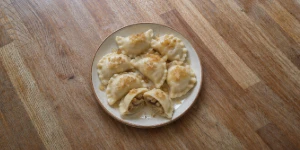
Pierogi z kapustą i grzybami (Polish Cabbage and Mushroom Pierogi)
What are Pierogi z Kapustą i Grzybami?
Pierogi z kapustą i grzybami are Polish boiled dumplings filled with sauerkraut, mushrooms and onion. The filling is savory, slightly sour and strongly aromatic from dried forest mushrooms, while the thin wheat dough remains soft and delicate after boiling.
They are eaten throughout Poland and are particularly strongly associated with Christmas Eve, when meatless dishes traditionally dominate the table. The Polish Ministry of Culture lists pierogi with cabbage and mushrooms among characteristic Polish Christmas Eve foods.
Although today they are closely connected with Christmas, they are not exclusively a holiday dish. Regional records show that they were also prepared during periods of fasting and could be eaten at other times of the year.
A documented Polish tradition
Pierogi filled with cabbage and mushrooms have substantial historical documentation in Polish cooking. Lucyna Ćwierczakiewiczowa included both mushroom pierogi and pierogi combining sour cabbage with cooked mushrooms in her nineteenth-century cookbook 365 obiadów za 5 złotych.
Her 1871 recipe for pierogi with mushrooms describes dried mushrooms cooked until tender, finely chopped and combined with fried onion. Elsewhere in the same book she describes sour cabbage cooked with onion and mixed with boiled chopped mushrooms. Her historical versions could also contain eggs, fish or substantial amounts of butter, so they should not be treated as identical to the modern Christmas Eve recipe.
What they demonstrate clearly is that both mushroom pierogi and cabbage-and-mushroom fillings were already well established in nineteenth-century Polish cookery. The modern combination of fermented cabbage, dried forest mushrooms and onion belongs to that longer tradition but has continued to evolve in Polish households.
Pierogi on the Polish Christmas Eve table
Today pierogi z kapustą i grzybami are one of the best-known dishes of Polish Wigilia, the Christmas Eve supper. The Ministry of Culture includes them among characteristic Polish Christmas Eve foods alongside dishes such as mushroom soup, carp and poppy-seed preparations.
The ingredients also fit the traditional character of the meal particularly well. Fermented cabbage was an important winter food, while dried mushrooms preserved the autumn forest harvest for use during the coldest months of the year.
The combination therefore joins products of the field and forest, a symbolism explicitly recorded in regional Polish traditions. On Kujawy, for example, traditional accounts associate Christmas Eve foods made from cultivated crops and forest products with hopes for prosperity and a good harvest in the following year.
Regional traditions
This dish belongs to Polish cooking as a whole, but several regional forms are officially documented. The Ministry of Agriculture lists pierogi z kapustą i grzybami pilzneński from the Podkarpackie region as a traditional product. The documented Pilzno version has a soft pale dough and a filling of cabbage, mushrooms and onion.
The same national list contains kujawskie pierogi z kapustą i grzybami. The Kujawy version is described as a soft half-moon-shaped dumpling with a dense filling of sauerkraut and mushrooms and a characteristic mushroom-and-cabbage aroma.
There is also a documented Lubuskie version made with forest mushrooms. These regional examples show that the dish cannot be assigned exclusively to one part of Poland. The details of the filling, mushroom species, fat and seasoning depend on local and family practice.
Why use dried forest mushrooms?
Dried wild mushrooms give the filling a much stronger aroma than cultivated button mushrooms. Porcini, bay boletes and mixtures of edible Polish forest mushrooms are common choices.
Drying concentrates their flavor and also made mushrooms easy to store through winter, which is one reason they became so useful in Christmas Eve cooking.
Use commercially sold dried mushrooms or mushrooms that have been positively identified before drying. A recipe should never be used as a guide for identifying wild species.
Preparing the mushrooms
Dried mushrooms need time to rehydrate. Cover them with cool water and leave them for at least 4 hours, or preferably overnight. After soaking, lift them from the bowl rather than pouring everything directly into the pot, because a little sand or forest debris can settle at the bottom.
Strain the soaking liquid through a very fine sieve or filter and cook the mushrooms gently in it until tender. Part of this intensely flavored liquid can then be used while cooking the sauerkraut.
Preparing the sauerkraut
Use naturally fermented sauerkraut made primarily from cabbage and salt. Polish food-quality authorities note that kapusta kiszona and kapusta kwaszona can both refer to cabbage produced through natural lactic fermentation; cabbage simply acidified by adding vinegar is a different product.
Taste the sauerkraut before rinsing it. Good fermented cabbage does not automatically need washing. If it is extremely sour or salty, rinse it briefly once and squeeze gently. Excessive rinsing removes much of the characteristic flavor.
Simmer the cabbage until tender, then drain it well. A wet filling is one of the most common causes of pierogi that are difficult to seal.
The cabbage and mushroom filling
The cooked sauerkraut and mushrooms should be chopped quite finely. Onion is fried separately until soft and lightly golden, then combined with the cabbage and mushrooms.
Continue frying the mixture for several minutes so excess moisture evaporates. The finished filling should be moist enough to remain tender but dry enough to hold together on a spoon without releasing liquid.
Black pepper is the most important seasoning. Taste before adding salt because both sauerkraut and mushroom cooking liquid may already contribute significant saltiness.
Traditional pierogi dough
Modern Polish pierogi dough can be made very simply from wheat flour, hot water, salt and a small amount of oil. Eggs are not required for this style of dough.
Hot water hydrates the flour quickly and partially changes the starch structure, helping create a soft, pliable dough. The dough should then rest covered for about 30 minutes. During this time the flour hydrates more evenly and the gluten relaxes, making rolling easier.
The exact amount of water depends on the flour. Add most of it first and use the remainder only if necessary. The finished dough should be smooth and soft without sticking heavily to the table.
Rolling and shaping
Work with part of the dough at a time and keep the remainder covered so its surface does not dry out. Roll it to approximately 2 mm thick and cut circles about 7 to 8 cm across.
Place about one heaped teaspoon of completely cooled filling in the center. Fold the circle in half and press the edges together firmly.
Keep flour and filling away from the sealing edge. A flour-coated or greasy edge will not bond properly and may open during boiling.
How to cook Pierogi
Bring a large pot of salted water to a gentle boil. Cook the pierogi in batches so they have enough space to move freely.
Stir carefully after adding them to prevent sticking to the bottom. Once they rise to the surface, continue cooking for approximately 2 to 3 minutes, depending on the thickness of the dough.
Remove them with a slotted spoon and drain well. They can be served immediately or lightly coated with oil so they do not stick together.
How to serve them
For Christmas Eve, the simplest serving is often the most appropriate: hot pierogi with fried onion and a little oil. Outside the traditional meatless meal, butter can also be used.
Leftover boiled pierogi are particularly good the following day when lightly fried in a pan until golden on both sides.
Expert tips:
Do not rinse good Sauerkraut automatically
Taste it first. Rinsing is useful when the cabbage is excessively sour or salty, but washing naturally fermented sauerkraut too thoroughly removes much of the flavor that defines the filling.
Use dried forest mushrooms
Porcini, bay boletes and other edible dried forest mushrooms give the filling a much deeper aroma than cultivated button mushrooms. A mixture works very well.
Keep the mushroom liquid
After careful filtering, a little mushroom soaking or cooking liquid can be used when simmering the sauerkraut. It intensifies the forest-mushroom flavor without requiring more mushrooms.
The filling must be fairly dry
After combining the cabbage, mushrooms and onion, fry the mixture until no free liquid collects in the pan. Wet filling makes sealing difficult and can cause the pierogi to open.
Hot water makes a softer dough
Using hot water helps hydrate the flour and produces a soft, pliable pierogi dough. The dough should still be comfortable enough to knead by hand.
Rest the dough
The 30-minute rest is important. It allows moisture to distribute through the flour and lets the gluten relax, so the dough rolls out with less resistance.
Keep the edges clean
Do not let flour, oil or filling cover the sealing edges. Clean dough pressed directly against clean dough gives the strongest seal.
Storage:
Cooked Pierogi
Cool cooked pierogi promptly, toss them very lightly with oil to prevent sticking and refrigerate in a covered container for up to 3 to 4 days.
Uncooked Pierogi
Freshly shaped raw pierogi should be cooked promptly or frozen. Do not leave filled raw pierogi at room temperature for extended periods because the filling gradually softens the dough.
Freezing raw Pierogi
Arrange uncooked pierogi in a single layer on a tray so they do not touch. Freeze until firm, then transfer them to a freezer bag or container. Cook directly from frozen, allowing a little additional time after they rise to the surface.
Freezing cooked Pierogi
Cooked pierogi can also be frozen, but raw frozen pierogi generally retain a better texture after cooking.
Reheating
Reheat boiled pierogi gently in a frying pan with a little oil or butter until hot. Pan-frying also gives leftover pierogi a lightly crisp exterior.
Recipe information:
Pierogi Dough
Sauerkraut and Mushroom Filling
For Serving
Substitutions for ingredients:
- Dried Wild Mushrooms - Cultivated mushrooms can be used when dried forest mushrooms are unavailable, but the filling will have a much milder flavor. Dried porcini are the best widely available substitute for a Polish forest-mushroom mixture.
- Rapeseed Oil - Butter can be used outside a strictly meatless or vegan Christmas Eve version. Historical Polish recipes frequently used butter with cabbage, mushrooms and pierogi.
- Sauerkraut - Fresh white cabbage can be used in a different traditional cabbage-pierogi filling, but it produces a substantially milder dish. It should not be presented as identical to the classic sauerkraut-and-mushroom version.
- Hot Water Dough - Some historical and household pierogi doughs contain egg, but egg is not necessary for the soft water-based dough used in this recipe.
Prepare the Mushrooms
1. Soak the dried mushrooms
2. Strain the soaking liquid
3. Cook the mushrooms
Prepare the Filling
1. Taste the sauerkraut
2. Cook the sauerkraut
3. Drain and chop
4. Fry the onion
5. Finish the filling
6. Cool completely
Prepare the Dough
1. Combine the ingredients
2. Knead the dough
3. Rest the dough
Shape the Pierogi
1. Roll the dough
2. Cut circles
3. Fill the pierogi
4. Seal
Cook and Serve
1. Boil the water
2. Cook in batches
3. Cook after they float
4. Drain
5. Serve
Frequently Asked Questions (FAQ):
Are Pierogi z Kapustą i Grzybami a traditional Polish Christmas Eve dish?
Yes. Pierogi with cabbage and mushrooms are strongly associated with Polish Wigilia and are listed by the Polish Ministry of Culture among characteristic Christmas Eve dishes.
How old are Pierogi with cabbage and mushrooms?
The exact origin of the modern recipe is difficult to date, but nineteenth-century Polish cookbooks already document pierogi with mushrooms and fillings combining sour cabbage with cooked mushrooms. Lucyna Ćwierczakiewiczowa included such preparations in her 1871 cookbook.
Did nineteenth-century Pierogi z Kapustą i Grzybami look exactly like the modern Christmas version?
Not necessarily. Historical recipes could also include eggs, fish or butter and sometimes used different doughs. They document the older cabbage-and-mushroom tradition but should not be treated as an identical modern Wigilia recipe.
Are Pierogi z Kapustą i Grzybami specific to Podkarpackie?
No. They are eaten throughout Poland. Podkarpackie has an officially registered traditional Pilzno version, while other regional versions are documented in Kujawy, Lubuskie and elsewhere.
What mushrooms are traditionally used?
Dried edible forest mushrooms are characteristic of many Christmas Eve versions. Porcini and bay boletes are especially suitable, either alone or as part of a mixed dried forest-mushroom blend.
How long should dried mushrooms be soaked?
At least about 4 hours is useful, while soaking overnight is convenient and allows larger dried pieces to rehydrate fully.
Should Sauerkraut be rinsed?
Only if it is excessively sour or salty. Taste it first. Good naturally fermented sauerkraut can be used without rinsing so that the filling retains its characteristic flavor.
Is Kapusta Kiszona different from Kapusta Kwaszona?
Polish food-quality authorities note that the terms can both refer to cabbage produced by natural lactic fermentation. Cabbage acidified simply by adding vinegar or another acid is not the same traditional fermented product.
Should Pierogi dough contain egg?
It does not have to. Polish pierogi dough exists in many forms, including historical versions containing egg, but a simple modern dough made from wheat flour, hot water, salt and a little oil is traditional in home cooking and produces soft pierogi.
Should I use boiling water for Pierogi dough?
Very hot water works well, but it does not have to be aggressively boiling when it reaches the flour. Add it gradually so the dough becomes soft and hydrated while remaining manageable once it cools enough to knead.
Why should Pierogi dough rest?
Resting allows the flour to hydrate evenly and the gluten structure to relax. This makes the dough easier to roll thinly and reduces its tendency to spring back.
How long should Pierogi be boiled?
Cook them in batches in gently boiling salted water. Once they rise to the surface, approximately another 2 to 3 minutes is usually enough for thin freshly made pierogi.
Can Pierogi z Kapustą i Grzybami be frozen?
Yes. Freezing the shaped uncooked pierogi individually on a tray before transferring them to a bag is one of the most convenient methods and helps prevent them from sticking together.
Are these Pierogi vegan?
This recipe is vegan because the dough contains no egg or dairy and the filling is cooked with vegetable oil. Versions served with butter are vegetarian but no longer vegan.