
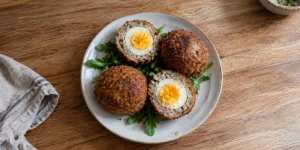
Scotch Eggs: Sausage-Wrapped Boiled Eggs
What to know about making Scotch eggs at home
A Scotch egg is a boiled egg wrapped in sausage meat, coated in breadcrumbs and fried. It is one of those very British foods that works just as well cold in a packed lunch as it does warm with mustard. The homemade version is worth the small amount of work because you can choose how soft you want the yolk and use decent sausage meat instead of the bland versions often found in shops.
The dish is strongly associated with England rather than Scotland. Fortnum & Mason says it created the Scotch egg in London in 1738 as a portable meal for travellers leaving Piccadilly. That is a well-known origin story, although the history is not completely settled. Earlier printed recipes for a dish called a Scotch egg appeared around the beginning of the 19th century, and food historians have also suggested links with meat-wrapped egg dishes such as Indian nargisi kofta.
The basic idea has hardly changed: a cooked egg surrounded by seasoned meat and finished with a crisp coating. Fortnum & Mason describes its early version as a small egg surrounded by forcemeat, dipped in egg wash and breadcrumbs, then deep-fried. Modern Scotch eggs usually use hen eggs and pork sausage meat.
Getting the sausage meat to stick
This is the fiddly part. Keep a bowl of cold water nearby and wet your hands before shaping the meat. Do not flour your hands. Flatten each portion of sausage meat into a thin, even disc and wrap it around the egg without leaving gaps. Any cracks can open during frying.
How to serve Scotch eggs
Scotch eggs are commonly eaten cold, which makes them particularly useful for picnics and packed lunches. They are also good slightly warm with English mustard, brown sauce or a simple green salad. The Oxford Advanced Learner's Dictionary defines a Scotch egg as a boiled egg covered with sausage meat and breadcrumbs, fried and eaten cold.
Expert tips:
Keep your hands damp
Wet your hands with cold water before shaping each portion of sausage meat. It stops the meat sticking to your fingers and makes it much easier to seal the layer around the egg.
Keep the sausage layer even
The sausage should be thin enough to leave room for the egg but thick enough to cover it completely. Pay particular attention to the ends, where thin spots can split during frying.
Watch the oil temperature
The oil should be hot enough to brown the breadcrumbs steadily without burning them. If the coating darkens very quickly, lower the heat before cooking the remaining Scotch eggs.
For a softer yolk
Start with eggs that are cooked only until the white has set. They will continue cooking slightly while the sausage layer fries, so avoid boiling them until the yolk is completely firm.
Storage:
How to store
Cool the Scotch eggs completely before placing them in a covered container. Keep them refrigerated rather than leaving cooked eggs and sausage at room temperature.
Shelf life
Eat refrigerated Scotch eggs within 3 days for the best quality.
Freezing instructions
Freezing is not recommended for this recipe. The cooked egg white can become rubbery and watery after thawing, which changes the texture of the finished Scotch egg.
Recipe information:
Ingredients
Substitutions for ingredients:
- Pork sausage meat - Use good-quality pork sausages and squeeze the meat out of the casings. Minced beef or turkey can also be used, but they need additional seasoning because they are usually less seasoned than sausage meat.
- Dried breadcrumbs - Panko gives a particularly crisp coating, while ordinary dry breadcrumbs work well for a more traditional finish.
- Dried thyme - Sage or marjoram works well with pork and can be used in the same small quantity.
Preparation
1. Boil the eggs
2. Peel the eggs
3. Prepare the coating
4. Wrap the eggs in sausage meat
5. Breadcrumb the Scotch eggs
6. Fry until golden
Frequently Asked Questions (FAQ):
Where did Scotch eggs originate?
The dish is generally associated with England. Fortnum & Mason claims to have created the Scotch egg in London in 1738 as a portable food for travellers, but the full history is disputed. The name appears in printed sources by the early 19th century, and other theories suggest older influences.
Can I make Scotch eggs with soft-boiled eggs?
Yes. A shorter initial boiling time gives you a softer centre. The eggs are easier to handle once thoroughly chilled, although very soft eggs need to be peeled and wrapped carefully.
Are Scotch eggs eaten hot or cold?
Both are common. They can be served warm shortly after frying, but Scotch eggs are also traditionally associated with cold eating, especially as picnic and portable food.
Can Scotch eggs be cooked in an air fryer?
Yes, although the crust will be different from deep-fried Scotch eggs. Lightly coat the breaded eggs with oil and cook them in a preheated air fryer until the sausage is fully cooked and the coating is crisp and browned.
What sauce goes well with Scotch eggs?
English mustard and brown sauce are simple choices. They also work well with a sharp pickle, chutney or a dressed green salad.