
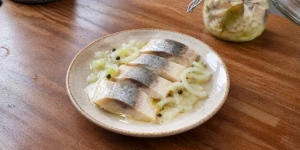
Śledzie w oleju z cebulką (Polish Herring in Oil with Onion)
What are Śledzie w Oleju z Cebulką?
Śledzie w oleju z cebulką are Polish salt-cured herring fillets served cold with sliced onion, vegetable oil and simple spices. The fish is first soaked to reduce excess salt, then cut into bite-sized pieces and left with onion, oil, bay leaf, allspice and pepper so the flavors can combine.
The dish is simple, inexpensive and strongly rooted in Polish cold-fish traditions. Today it is particularly associated with Christmas Eve, but herring has historically also been eaten on Fridays, during Lent and on other fasting days.
Poland's official tourism material lists herring served in oil with onion among the characteristic dishes of the Polish Christmas Eve table. At the same time, regional records from Pomorze show that herring with onion and oil also belonged to everyday and Friday meals, not only to Christmas.
Why Herring became so important in Polish cuisine
For centuries, salting made sea herring transportable far beyond the Baltic coast. Unlike fresh fish, heavily salted herring could be stored and carried inland, making it an important food even in parts of Poland far from the sea.
Its availability and relatively low price made herring particularly important during periods when meat was avoided for religious reasons. Polish regional traditions repeatedly associate it with Fridays, Lent, Advent and Christmas Eve.
On the Baltic coast and in Kashubia the connection was even stronger. The Polish Ministry of Agriculture notes that herring occupied a dominant place in traditional Pomeranian coastal cuisine. Large quantities were salted and packed into barrels or stoneware vessels for winter use, then prepared in many ways with vinegar, cream, oil, onions and other additions.
A strong Pomeranian tradition
The Ministry of Agriculture has registered Śledzie marynowane w oleju from Pomorskie on Poland's List of Traditional Products. The official description calls herring marinated in oil one of the most popular traditional Pomeranian snacks.
The same source records a characteristic Friday meal consisting of herring with onion dressed with cream or oil and served with potatoes boiled in their skins. It also notes that young fatty herring from spring catches was especially valued.
This makes Pomorze a well-supported regional association for this recipe. However, herring with oil and onion is not exclusive to Pomorze. Variants are now eaten throughout Poland, especially at Christmas.
Śledzie on the Polish Christmas Eve table
Herring remains one of the most recognizable foods of Polish Wigilia. Unlike carp, which became particularly dominant in the twentieth century, salted herring had long been accessible even to less affluent households.
Official Polish tourism material describes herring as an obligatory part of the Christmas Eve table and specifically mentions versions served in oil with onion.
Historical and ethnographic sources also show herring appearing regularly in Polish fasting traditions. Its connection with Christmas therefore belongs to a much wider tradition of eating preserved fish on meatless days.
Nineteenth-century herring with onion and oil
The flavor combination used in modern śledzie w oleju has clear nineteenth-century precedents. In the 1871 edition of 365 obiadów za 5 złotych, Lucyna Ćwierczakiewiczowa describes salted herring that is first soaked thoroughly and then prepared with sliced onion, pepper and allspice.
One of her versions combines the herring with a generous amount of olive oil, lemon juice, onion and lemon slices. She instructs the cook to keep the dish in a cool place and notes that it is ready to eat the following day.
This is not exactly the same recipe as today's simple herring submerged in rapeseed oil, but it documents the established Polish practice of combining soaked salted herring with onion, oil and acidity more than 150 years ago.
An early twentieth-century version
Kucharka litewska by Wincenta Zawadzka, in its 1913 edition, also gives two methods for preserving herring. The fish is soaked in either water or milk. One version is layered with apple and onion and covered with spiced vinegar, then dressed with oil when served.
The alternative is even closer to the modern dish: the soaked herring is covered directly with oil and served with vinegar. The cookbook states that such herring could historically be kept for weeks in a cold place.
That historical storage instruction should not be transferred directly to a modern home recipe. The old recipe does not define refrigerator temperature, final salt concentration, acidity or modern microbiological controls. This recipe therefore uses a much shorter refrigerated storage period.
Use salt-cured herring, not automatically Matjes
The terms herring and matjes are often used loosely in shops, but they are not technically interchangeable. For this traditional Polish recipe, ordinary salt-cured herring fillets in brine are the most predictable choice.
True maatjes or matjes is a specific product made from fatty herring caught before the development of visible roe or milt and matured enzymatically in a mild brine. European Union documentation describes traditional maatjes herring as tender, fatty and only mildly salty.
That matters because true matjes normally does not need the same long desalting as strongly salted Polish-style herring fillets. If using genuine matjes, taste it first and follow the instructions on the package rather than soaking it automatically for several hours.
Soaking salted herring
Traditional salted herring could be extremely salty and historical Polish recipes sometimes soaked whole fish for 24 to 36 hours. Modern prepared fillets are usually much less heavily cured, so such long soaking can remove too much flavor and soften the flesh unnecessarily.
For modern salt-cured fillets, begin with about 1 to 2 hours in cold water in the refrigerator. Change the water once and taste a small piece. Continue soaking only if the fish is still excessively salty.
The exact time must therefore be adjusted to the product rather than treated as a fixed rule.
Can herring be soaked in milk?
Yes. Soaking salted herring in milk is an old documented technique rather than a recent internet trick. Wincenta Zawadzka's Kucharka litewska explicitly allows herring to be soaked in either milk or water.
Milk produces a somewhat milder flavor, but it is not required. Water is simpler and keeps this recipe naturally dairy-free.
Raw or scalded onion?
Raw onion is entirely traditional and gives the dish its characteristic sharp flavor. It does not have to be blanched before going into the jar.
If the onion is particularly strong, briefly pour boiling water over the slices and immediately cool and dry them. This softens their pungency without cooking them completely. Another option is to use a milder onion variety.
Whether raw or briefly scalded, the onion should be drained and dried well before it is combined with the oil.
Why rapeseed oil?
Rapeseed oil is particularly appropriate for a Polish version and is explicitly documented in traditional regional herring preparations. A mild refined rapeseed oil keeps the flavor centered on the fish and onion.
Cold-pressed rapeseed oil can also be used if you like its more pronounced nutty flavor. Sunflower oil is another common neutral choice.
Olive oil is not wrong historically - older Polish cookbooks use oliwa in herring recipes - but many olive oils become cloudy or partially solid at refrigerator temperature. This is a normal physical change and does not mean the oil has spoiled.
Bay leaf, allspice and pepper
Bay leaf, allspice and black pepper are familiar Polish seasonings for herring. They should remain restrained because the fish and onion should dominate the dish.
Historical recipes also document vinegar and lemon. In a basic modern śledzie w oleju recipe, acidity is optional. A small amount of lemon juice or mild vinegar can brighten the flavor, but it should not turn the dish into strongly pickled herring.
Layering the Herring
After soaking, dry the fillets and cut them into pieces about 2 to 3 cm wide. Layer them in a clean container with thinly sliced onion and the spices.
Pour over enough oil to coat the fish and onions thoroughly and largely cover them. Gently tap the container to release trapped air and refrigerate it immediately.
The oil carries the onion and spice aromas and protects the surface from drying, but it should not be treated as a home-canning method or as a guarantee of long preservation.
Why the Herring should rest before serving
The dish tastes noticeably better after resting. About 24 hours in the refrigerator allows the aroma of onion, bay leaf and allspice to move into the oil and fish.
Historical recipes make the same observation. Ćwierczakiewiczowa noted that her prepared herring was good to use the following day.
Food safety and storage in oil
Keep the prepared herring continuously refrigerated at 4°C / 40°F or colder. Do not treat a jar covered with oil as shelf-stable food.
Fresh onion is a moist, low-acid vegetable, and covering low-acid vegetables with oil does not by itself make them safely preserved. A small splash of vinegar or lemon added for flavor is not a validated preservation process.
For a conservative home recipe, prepare only as much as you can eat within about 3 to 4 days. If the original herring package specifies a shorter period after opening, follow the package instructions instead.
Keep the dish refrigerated until close to serving time and return leftovers promptly to the refrigerator.
How to serve Śledzie w Oleju
Serve the herring cold or let it stand for only a few minutes so the oil becomes fully fluid. Rye bread is a natural accompaniment, particularly when the herring is served as an appetizer.
For a larger meal, serve it with hot potatoes boiled in their skins. This pairing has particularly strong roots in Pomeranian and Kashubian cooking.
At Christmas Eve, herring in oil can be served alongside other cold herring dishes, pierogi, barszcz, mushroom dishes and carp.
Expert tips:
Do not automatically buy Matjes
True matjes is a mildly salted, enzymatically matured herring product and is not the same as strongly salt-cured herring fillets. For this recipe, ordinary salted herring in brine is the easier and more traditional choice.
Adjust soaking by taste
Modern herring fillets vary greatly in salt content. Two hours is only a starting point. Mild fillets may need less soaking, while strongly salted ones need longer.
Historical herring needed much longer soaking
Nineteenth-century recipes sometimes soak salted whole herring for 24 to 36 hours. Do not apply those times automatically to modern prepared fillets, which are usually much less heavily salted.
Milk is an old alternative
Soaking in milk is historically documented in Polish and former Polish-Lithuanian cookery. It gives a milder flavor, but water is sufficient and keeps this version dairy-free.
Raw onion is traditional
There is no need to scald onion for authenticity. Brief scalding is simply a useful option when the onion is unusually sharp.
Rapeseed oil suits the Polish version
Traditional regional Polish sources explicitly document rapeseed oil with herring. Refined rapeseed oil gives a clean flavor, while cold-pressed oil makes the dish more aromatic.
Cloudy oil is not automatically spoiled
Some oils, especially olive oil and certain less-refined oils, become cloudy or partially solid in a cold refrigerator. They usually become clear and fluid again as they warm slightly.
Oil coverage is not canning
Keeping the fish coated with oil improves texture and limits surface drying, but a jar of herring and fresh onion in oil is not shelf-stable. It must remain refrigerated.
Storage:
Refrigeration
Keep the herring continuously refrigerated at 4°C / 40°F or colder in a clean, covered container.
Shelf life
For a conservative homemade version containing fresh onion, prepare only enough to eat within about 3 to 4 days. If the original herring packaging gives a shorter period after opening, follow that instruction.
Oil does not make it shelf-stable
Do not store the jar at room temperature. Covering moist fish and fresh onion with oil is not a validated home-preservation process, and a small amount of lemon juice or vinegar does not change that.
Serving
Remove only the amount needed for serving and return the remainder to the refrigerator promptly. Do not leave the herring at room temperature for more than about 2 hours.
Freezing
Freezing the assembled dish is not recommended for quality because the onion and herring texture can deteriorate after thawing. If necessary, freeze the herring separately according to the product instructions.
Leftover oil
Discard the remaining oil after the herring has been eaten. Do not use it to start another batch or treat it as preserved cooking oil.
Recipe information:
Herring in Oil
Substitutions for ingredients:
- Salt-Cured Herring Fillets - True matjes can be used, but it is milder, fattier and softer than ordinary salted herring. Do not automatically soak matjes for 2 hours; taste it first and follow the package instructions.
- Cold Water for Soaking - Cold milk can be used for a milder flavor. Soaking herring in either water or milk is documented in early twentieth-century cookery.
- Yellow or White Onion - Red onion or shallot gives a milder, slightly sweeter flavor. This is a modern variation rather than a requirement for the traditional version.
- Rapeseed Oil - Sunflower oil is a neutral alternative. Olive oil can also be used, but it has a stronger flavor and commonly becomes cloudy or semi-solid when chilled.
- Lemon Juice - Use a small amount of mild wine vinegar or omit the acidic ingredient entirely for a simpler oil-and-onion version.
Prepare the Herring
1. Taste the herring
2. Soak in cold water
3. Dry the fillets
4. Cut into pieces
Prepare the Onion
1. Slice the onions
2. Use raw or briefly scald
3. Dry the onion
Assemble the Herring
1. Start the layers
2. Continue layering
3. Add optional acidity
4. Add the oil
5. Refrigerate
6. Rest before serving
Frequently Asked Questions (FAQ):
Are Śledzie w Oleju traditional in Poland?
Yes. Herring preserved and served with oil has a long history in Polish cooking. Nineteenth- and early twentieth-century cookbooks document soaked salted herring combined with onion, oil, vinegar or lemon.
Are Śledzie w Oleju a traditional Polish Christmas Eve dish?
Yes. Herring is strongly associated with Polish Wigilia, and official Polish tourism material specifically mentions herring served in oil with onion among typical Christmas Eve foods.
Why was herring so important in Poland?
Salting made herring inexpensive, transportable and available far from the Baltic coast. It also fitted Christian fasting traditions, making it common on Fridays, during Lent and on Christmas Eve.
Are herring in oil particularly associated with Pomorze?
Yes. The Ministry of Agriculture records Śledzie marynowane w oleju as a traditional product of Pomorskie and describes herring with onion and oil as part of traditional Pomeranian meals. The dish is nevertheless eaten throughout Poland.
Did nineteenth-century Poles eat herring with oil and onion?
Yes. Lucyna Ćwierczakiewiczowa documented soaked herring prepared with onion, oil, spices and either vinegar or lemon in 1871 and noted that the dish was ready to eat the following day.
What is the difference between salted herring and Matjes?
Salted herring is a broad category of herring preserved with salt or brine. True matjes is made from fatty herring caught before visible development of roe or milt and traditionally undergoes mild salting and enzymatic maturation, giving it a softer texture and milder saltiness.
Should Matjes be soaked before making this recipe?
Usually not for as long as strongly salted herring. True matjes is already mildly salted. Taste it first and follow the manufacturer's instructions.
How long should salted herring be soaked?
For modern prepared fillets, about 1 to 2 hours is a useful starting point, but the correct time depends on salt concentration. Taste during soaking and continue only if necessary.
Can herring be soaked in milk?
Yes. This is a historically documented method. Kucharka litewska from 1913 instructs cooks to soak herring in milk or water before preparing it with onion, vinegar or oil.
Should the onion be raw?
Raw onion is traditional and can be used directly. If it is particularly pungent, briefly scalding it is an optional way to soften the flavor.
Why should the herring rest for 24 hours?
Resting allows the onion, spices and oil to combine with the fish. Historical Polish herring recipes likewise note that prepared herring improves by the following day.
How long can homemade herring in oil be refrigerated?
For this home recipe with fresh onion, a conservative limit is about 3 to 4 days at 4°C / 40°F or colder. Follow a shorter storage period if specified on the original herring package.
Does covering herring with oil preserve it for weeks?
Not safely by itself. Historical recipes sometimes describe longer cold storage, but their salt, acid and temperature conditions were not standardized. A homemade jar of fish and fresh onion covered with oil should remain refrigerated and should not be treated as shelf-stable.
Can I reuse the herring oil?
It is better to discard it after the fish is eaten. The oil has been in prolonged contact with fish, onion and moisture and should not be reused to preserve another batch.
What is traditionally served with Śledzie w Oleju?
Rye bread is a common accompaniment. In Pomeranian traditions herring with onion and oil or cream is also served with potatoes boiled in their skins.