
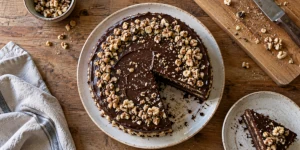
Torta Garash - Bulgarian Chocolate Walnut Cake
Traditional Bulgarian Torta Garash
Torta Garash is one of Bulgaria's best-known cakes. It combines thin walnut and egg-white layers with a rich dark chocolate cream and chocolate coating. The cake contains little besides walnuts, eggs, sugar, butter, milk and chocolate, which gives it a dense texture and an intense walnut and chocolate flavour.
Unlike an ordinary sponge cake, traditional Garash does not depend on wheat flour for its structure. Finely ground walnuts form the body of the thin layers, while egg whites bind them together. The result is a compact cake that is considerably richer than its relatively thin slices suggest.
The origin of Torta Garash
The history of the cake is closely connected with Ruse, Bulgaria's major Danube port. During the late nineteenth century the city was an important point of contact between Bulgaria and Central Europe, and its hotels, restaurants and confectioneries reflected those connections.
The cake is attributed to Kosta Garash, an Austro-Hungarian confectioner who came to Ruse during the 1880s. Bulgarian historical accounts connect him with the prestigious Islyah Hane hotel, where he worked for a clientele that included members of the Bulgarian elite and visiting dignitaries.
The year 1885 is commonly associated with Garash's arrival in Ruse and with the beginnings of the cake. Modern celebrations in Ruse marked the cake's 140th anniversary in 2025. Earlier sources are less precise, however, and often describe its creation simply as taking place in the late nineteenth century.
Kosta Garash
Kosta Garash came from the Austro-Hungarian world and had been trained in Viennese confectionery. His professional background helps explain the Central European character of the cake, but Garash was created in Bulgaria and became firmly established in Bulgarian pastry tradition.
Historical accounts from Ruse describe walnut layers prepared with eggs and sugar, while butter and dark chocolate were used for the filling and coating. Walnuts were readily available around the Danube and became one of the defining ingredients of the cake.
Garash later moved to Sofia, where he worked at another prominent hotel and confectionery. His name nevertheless remained permanently attached to the cake he had created in Ruse.
Was Garash inspired by Sachertorte?
Bulgarian accounts frequently connect Garash with the Central European confectionery tradition and sometimes specifically with Sachertorte. The comparison is understandable because both are rich chocolate cakes associated with nineteenth-century hotel confectionery.
The cakes themselves are very different. Sachertorte is based on a chocolate cake layer and apricot filling, while Garash relies on walnuts, egg whites and chocolate cream. It is therefore safer to describe Sachertorte as a possible influence rather than to treat Garash as a direct Bulgarian version of the Viennese cake.
The walnut layers
The characteristic layers are made primarily from ground walnuts, egg whites and sugar. They should be thin and relatively flexible rather than tall and sponge-like.
The walnuts should be ground finely but not processed until they release enough oil to form a paste. Their natural fat contributes heavily to the richness and texture of the finished cake.
The egg whites provide structure. They are beaten with sugar and combined carefully with the walnuts before the mixture is divided into thin layers for baking.
Five thin layers
Garash is traditionally associated with several thin walnut layers, commonly five. Keeping them approximately equal in thickness gives the finished cake its distinctive striped cross-section.
Because the layers are thin, they bake quickly. They should be watched closely because the walnuts and sugar can darken rapidly around the edges.
The chocolate cream
Chocolate is the second defining flavour of Garash. Historical descriptions mention dark chocolate and butter, while accounts of the preserved traditional recipe also mention whole milk.
The cream should be rich and smooth but firm enough to hold the thin walnut layers together. It is spread sparingly between them because the cake already contains a considerable amount of fat from both the walnuts and chocolate.
A modern heavy-cream ganache produces a good chocolate cake, but it should not automatically be presented as the historical Garash filling. A butter, chocolate and milk-based cream is closer to the documented character of the cake.
Assembling the cake
The first walnut layer is placed on a flat serving plate and covered with a thin layer of chocolate cream. The process is repeated until all five walnut layers have been stacked.
The remaining chocolate cream can be used to cover the top and sides before the cake is chilled. Once firm, the surface is finished with a thin dark chocolate coating.
The characteristic green decoration
Garash is frequently recognised by the contrast between its dark chocolate surface and a green decoration around the top. Modern versions commonly use finely chopped pistachios or green-coloured nuts or coconut.
The green detail has become strongly associated with the visual identity of the cake, but the chocolate and walnut structure is more fundamental to its historical character than any single modern garnish.
Resting the cake
Garash benefits from several hours of refrigeration after assembly. The chocolate cream firms, the thin layers settle and the cake becomes easier to cut cleanly.
It does not need to become soft like a soaked sponge cake. The finished texture should remain dense and distinctly nutty, with thin layers held together by chocolate cream.
How Torta Garash is served
Because the cake is extremely rich, relatively small slices are appropriate. Remove it from the refrigerator shortly before serving so that the chocolate and butter soften slightly without allowing the cake to become warm.
A clean sharp knife produces the best slices. Warming the blade briefly and wiping it between cuts helps expose the alternating dark chocolate and walnut layers.
Garash in modern Bulgaria
Garash has long outgrown its beginnings in a nineteenth-century hotel. It became part of Bulgarian confectionery culture and continues to appear in pastry shops, restaurants and home kitchens.
Ruse has particularly embraced its connection with the dessert. The city now holds a Garash Cake Festival celebrating both the cake and its local history. The continuing association with Ruse makes the dessert an unusual example of a Bulgarian national favourite whose place of origin can be identified relatively clearly.
Expert tips:
Do not turn the walnuts into paste
Grind the walnuts finely but stop before their oils turn them into walnut butter. A paste will make the thin layers heavier.
Make the layers thin
Garash is characterised by several thin walnut layers rather than two or three thick cake layers.
Watch the layers closely
Thin walnut layers bake quickly. Check them after the first few minutes because the edges can darken before the centre is ready.
Cool the chocolate before adding butter
Adding warm chocolate mixture to softened butter can produce a loose or greasy cream. Let the chocolate mixture return close to room temperature first.
Use dark chocolate
Chocolate is one of the dominant flavours of Garash. Dark chocolate provides the characteristic contrast with the sweet walnut layers.
Rest before slicing
Several hours in the refrigerator allow the layers and chocolate cream to settle into the dense structure associated with Garash.
Serve small portions
Walnuts, butter and dark chocolate make Garash an exceptionally rich cake. Thin slices are usually sufficient.
Storage:
How to store
Keep Torta Garash covered in the refrigerator so that the chocolate cream remains firm and the cake does not absorb other food aromas.
Shelf life
For best quality, eat the refrigerated cake within 4 to 5 days.
Before serving
Remove the cake from the refrigerator about 15 to 20 minutes before serving so that the chocolate and butter soften slightly.
Freezing
Garash can be frozen, although refrigeration gives the best texture. Wrap individual portions well and freeze for up to 2 months. Thaw overnight in the refrigerator.
Recipe information:
Walnut Layers
Chocolate Cream
Chocolate Coating
Decoration
Substitutions for ingredients:
- Walnuts - Walnuts are a defining ingredient of traditional Garash and should not be replaced when authenticity is the goal. Almonds or hazelnuts produce a different nut-and-chocolate cake.
- Dark chocolate - Use another good-quality dark cooking chocolate with a similar cocoa content. Milk chocolate will produce a considerably sweeter and less characteristic result.
- Pistachios - Finely chopped green-coloured almonds or another traditional-style green garnish can be used. The garnish does not affect the structure of the cake.
- Whole milk - Whole milk is preferable because it contributes to the richness of the chocolate cream. Lower-fat milk can be used but may produce a slightly lighter filling.
Prepare the walnut layers
1. Prepare the oven
2. Grind the walnuts
3. Whip the egg whites
4. Add the walnuts
5. Divide the mixture
6. Bake
7. Cool
Prepare the chocolate cream
1. Heat the milk and sugar
2. Add the chocolate
3. Cool the chocolate
4. Add the butter
Assemble the Garash cake
1. Layer the cake
2. Cover the cake
3. Chill
Glaze and finish
1. Prepare the coating
2. Coat the cake
3. Decorate
4. Rest
Frequently Asked Questions (FAQ):
What is Torta Garash?
Torta Garash is a traditional Bulgarian cake made from thin walnut and egg-white layers joined with rich chocolate cream and covered with chocolate.
Where was Torta Garash created?
The cake is associated with Ruse, a Bulgarian city on the Danube, where Austro-Hungarian confectioner Kosta Garash worked in the late nineteenth century.
Who created Torta Garash?
The cake is attributed to Kosta Garash, an Austro-Hungarian confectioner trained in the Central European pastry tradition who worked in Ruse.
When was Torta Garash created?
The cake dates from the late nineteenth century. The year 1885 is commonly associated with its beginnings in Ruse, although historical accounts do not all give the same precise date.
Is Torta Garash naturally gluten-free?
The traditional flourless form is based on walnuts, egg whites and sugar rather than wheat flour. When preparing it for someone with coeliac disease, all chocolate and other packaged ingredients must still be checked for gluten and cross-contamination.
Does authentic Garash contain walnuts?
Yes. Walnuts are one of the defining ingredients of Garash and are used to make its characteristic thin layers.
How many layers does Torta Garash have?
Garash is commonly prepared with five thin walnut layers separated by chocolate cream.
Are the layers of Garash meringue?
They contain whipped egg whites, sugar and walnuts, but describing Garash simply as a meringue cake can be misleading. The ground walnuts form a substantial part of the thin cake layers and give them their characteristic dense nutty texture.
Is Garash based on Sachertorte?
Bulgarian accounts sometimes describe Sachertorte and the Viennese confectionery tradition as influences on Kosta Garash. The cakes are nevertheless structurally different, so Garash should be treated as its own Bulgarian dessert.
Why does Garash have green decoration?
A green garnish contrasting with the dark chocolate surface has become a recognisable feature of many Garash cakes. Pistachios or green-coloured nuts are commonly used in modern versions.
Should Garash be made with heavy cream ganache?
Heavy-cream ganache is a modern and convenient interpretation. Historical descriptions of Garash instead emphasise dark chocolate, butter and, in accounts of the preserved traditional recipe, whole milk.
Can Torta Garash be made in advance?
Yes. Garash benefits from several hours of refrigeration after assembly and can conveniently be prepared the day before serving.
How should Torta Garash be served?
Serve it in relatively thin slices because the combination of walnuts, butter and chocolate makes the cake very rich. Let it stand briefly outside the refrigerator before cutting.