
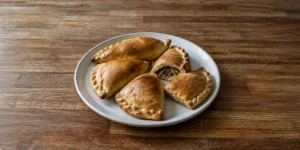
Kibinai - Traditional Karaim Meat Pastries from Trakai
Kibinai are one of the foods most closely associated with Trakai, but their story begins with the Karaim community rather than with ordinary Lithuanian village cooking. The Karaims brought their own culinary traditions to Lithuania centuries ago, and kibinai became one of the best-known dishes connected with their community.
Today you can find kibinai almost everywhere in Lithuania, especially in Trakai. They are sold in restaurants, small bakeries and roadside cafes, with fillings ranging from pork and chicken to mushrooms and cheese. However, the older Karaim tradition is centered on a simple meat filling, especially lamb or beef, mixed with onion, salt and black pepper.
A good kibinas is not a puff pastry turnover and it should not be filled with a smooth meat paste. The pastry is sturdy enough to hold the filling, but tender and rich from butter, eggs and sour cream. Inside, the meat remains in small pieces and releases its juices while baking. The characteristic crescent shape and carefully folded edge help keep those juices inside.
Kibinai and the Karaim tradition of Trakai
The Karaim community has been associated with Trakai for centuries and remains one of the most distinctive parts of the town’s cultural heritage. Kibinai became closely connected with this history and eventually spread far beyond the Karaim community, becoming one of Lithuania’s best-known regional foods.
This is why it is more accurate to describe kibinai as traditional Karaim pastries from Trakai that became an important part of Lithuanian regional cuisine. Modern Lithuanian versions can have many different fillings, but the meat-filled kibinas remains the classic form most strongly associated with Karaim culinary tradition.
The meat should be chopped, not turned into paste
For traditional-style kibinai, the filling is best made from meat cut into very small pieces with a knife. This is one of the details that gives the finished pastry its characteristic texture. The filling should remain loose rather than becoming a dense meatball inside the dough.
Lamb and beef are the most traditional choices. Pork is now extremely common in Lithuania and is widely used in modern Trakai-style kibinai, but it is better understood as a local adaptation rather than the oldest Karaim filling.
Choose meat with a little natural fat and chop it into small cubes. Mix it with finely chopped onion, salt and plenty of black pepper. A small amount of cold water can be added to the filling if the meat is very lean. During baking, the onion and meat create the savoury juices that make a freshly baked kibinas so satisfying.
The dough for kibinai
The dough should be rich but easy to roll. Butter is worked into the flour first, then eggs and sour cream bring everything together. Do not knead it like bread for a long time. Once the dough is smooth and holds together, let it rest in the refrigerator before rolling.
Chilling the dough makes it easier to work with and helps the pastries keep their shape. If the dough becomes very soft and sticky while you are forming the kibinai, put it back in the refrigerator for a few minutes instead of adding large amounts of extra flour.
The traditional braided edge
The curved edge of a kibinas is not simply pressed flat. After the two sides are sealed, the edge is folded and pinched repeatedly to create the familiar decorative braid. Apart from giving the pastry its characteristic appearance, a good seal also helps keep the meat juices inside.
Do not worry if the first few kibinai look uneven. The important part is making sure the seam is firmly closed before you begin folding the decorative edge. With practice, the braid becomes faster and more regular.
How kibinai are traditionally served
Kibinai are best eaten hot or warm, when the pastry is still crisp and the filling remains juicy. In Trakai they are often served with a clear broth, which makes a simple and filling meal.
They are also good on their own as a substantial snack or light lunch. One large kibinas can be surprisingly filling, especially when it is fresh from the oven.
Expert tips:
Choose hand-chopped meat for the traditional texture
Finely chopped meat gives the filling a looser and juicier texture than very finely ground meat. Cut the meat into small, even pieces so it cooks evenly inside the pastry.
Do not make the filling too wet
A small amount of water can help create juices inside the kibinai, but too much liquid makes sealing difficult and can cause the pastry to split during baking.
Seal before you braid
First press the two edges firmly together along the entire crescent. Only then start folding the decorative braid. The braid cannot rescue a seam that was not properly sealed in the first place.
Keep the dough cool
If the pastry becomes soft while you work, chill it briefly. Cool dough is easier to roll, fill and shape without sticking to the table.
Storage:
How to store
Let the baked kibinai cool completely before storing them in a covered container. Do not seal them while still hot, because trapped steam will soften the pastry.
Shelf life
Keep leftover kibinai in the refrigerator for up to 3 days. Reheat them in an oven rather than a microwave if you want the pastry to become crisp again.
How to reheat
Warm refrigerated kibinai in an oven at about 180C until hot throughout. A short time in a hot oven restores the crisp exterior much better than reheating in a microwave.
Freezing instructions
Freeze fully baked and cooled kibinai individually until firm, then transfer them to a freezer container. Reheat directly from frozen in the oven at around 180C until the filling is hot throughout.
Recipe information:
For the dough
For the traditional-style meat filling
For brushing
Substitutions for ingredients:
- Lamb - Beef is the closest traditional alternative. Choose a cut that is not completely lean and chop it finely by hand.
- Beef or lamb - Pork can be used for the widely popular Lithuanian-style version, although it is better considered a later local adaptation rather than the oldest Karaim filling.
- Sour cream - Use another thick, full-fat fermented dairy product if necessary, but sour cream gives the dough the flavour and texture most commonly associated with this style of kibinai.
- Butter - Good-quality margarine is sometimes used in regional recipes, but butter gives the pastry a richer flavour.
- Freshly chopped onion - Do not replace the onion completely. It is one of the central ingredients of the classic meat filling and contributes both flavour and moisture.
How to make traditional Kibinai
1. Make the pastry
2. Add the eggs and sour cream
3. Rest the dough
4. Prepare the meat filling
5. Divide and roll the dough
6. Fill the kibinai
7. Make the braided edge
8. Bake until deeply golden
Frequently Asked Questions (FAQ):
Are kibinai originally Lithuanian?
Kibinai are most closely connected with the Karaim community and with Trakai. Over time they became one of the best-known foods in Lithuania and are now an important part of the country’s regional culinary identity.
What meat is most traditional for kibinai?
Traditional Karaim-style kibinai are most strongly associated with lamb or beef. Pork fillings became very popular later in Lithuania and are now common in many modern versions.
Should the meat be ground or chopped?
For a traditional-style result, chop the meat finely with a knife. Small pieces of meat and onion create a looser and juicier filling than very finely ground meat.
Can I prepare kibinai in advance?
Yes. You can prepare and bake them in advance, then reheat them in the oven before serving. They are especially good when warmed until the pastry becomes crisp again.
What should kibinai be served with?
Kibinai are often eaten on their own, but in Trakai they are traditionally and commonly served with a clear broth.