
Lithuanian Christmas Traditions
Kūčios, Family Customs and the Christmas Season
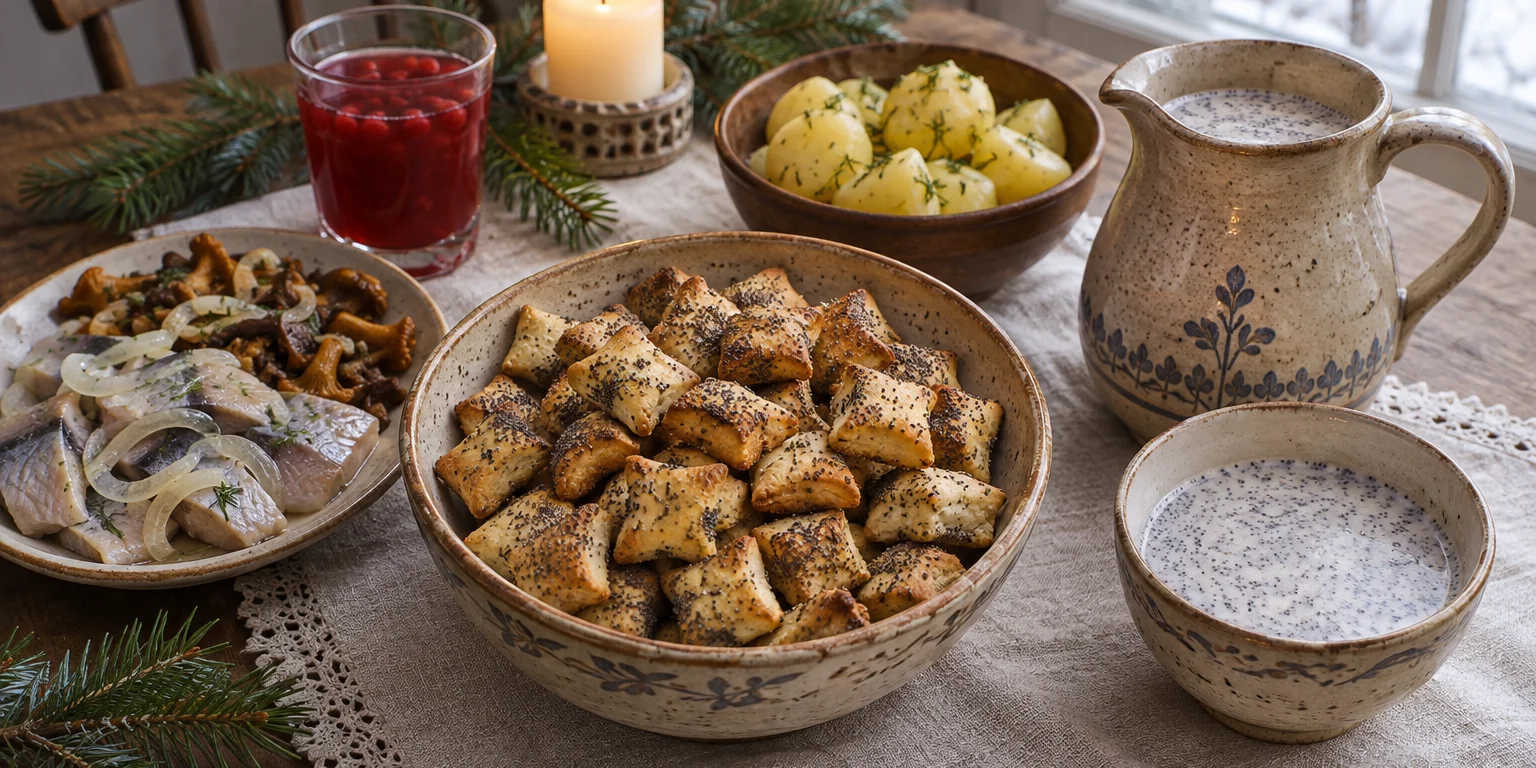
The little poppy-seed biscuits on a Lithuanian Christmas Eve table are not necessarily there to be eaten dry. Drop a handful into a bowl of poppy-seed milk, let them soften, and eat them with a spoon. Kūčiukai and aguonpienis belong together, though there will usually be someone at the table who prefers the biscuits straight from the dish.
They are among the most recognisable foods of Kūčios, the Christmas Eve supper. But Lithuanian Christmas traditions extend well beyond that meal: the preparations before it, the relatives remembered during it, the stories told afterwards, and the visits that continue through the holiday season. Some customs remain part of ordinary family life. Others survive in local celebrations, songs or a grandparent's account of how things used to be.
Getting the house ready for Christmas
Traditionally, the work began before anyone sat down to eat. The house had to be cleaned, unfinished tasks dealt with and, if possible, quarrels settled. Accounts of older rural life also describe washing or going to the bathhouse before the evening gathering. Preparing for Kūčios meant putting both the household and its relationships in order.
Advent gave these preparations their rhythm. In Catholic practice it was a restrained season, with fasting and limits on entertainment. That did not mean four weeks without music. Lithuania has a substantial repertoire of Advent and Christmas songs, particularly well documented in the south and east. Their birds, trees, young people and recurring refrains belong to a folk tradition that cannot be reduced to familiar church carols. Seasonal singing games gave people a way to gather during the long evenings.
Today, a Christmas tree may seem as inseparable from the holiday as the supper itself. Its place in Lithuanian homes is more recent than many of the meal's customs. Museum historian Justina Minelgaitė-Plentienė describes tree decorating becoming more widespread towards the end of the 1930s. There was even resistance to it as an imported fashion.
Straw ornaments are one way of decorating it now. Light, geometric pieces can hang alongside glass baubles or decorations made by children; the National Museum of Lithuania continues to teach their making. A handmade straw ornament has a place in the season without every decoration needing an ancient explanation.
Sitting down to Kūčios
December 24 is the day to come home. The traditional signal for supper is the first evening star, although work, travel and young children naturally affect when a family actually sits down.
Hay may be placed beneath a white tablecloth. In Christian explanations, it recalls the manger where Jesus was laid. It also has a practical role later in the evening, when a strand pulled from under the cloth can become part of a fortune-telling game.
In Catholic households, the meal commonly begins with prayer and the sharing of a thin Christmas wafer, a kalėdaitis. People break pieces from one another's wafers and exchange wishes. The gesture makes time for each person at the table before the dishes start moving around it.
An extra place can remember someone who has died or a family member who cannot be there. Older accounts also describe inviting a person who would otherwise spend the evening alone. These meanings overlap, but they are not identical in every household. An empty plate may carry a very particular family memory.
The custom of leaving food on the table overnight is connected with the belief that departed relatives return on Kūčios night. It is one of the clearest expressions of remembrance surrounding the supper. Today, a family can preserve that remembrance without leaving perishable food unrefrigerated.
What Lithuanians eat on Christmas Eve
Twelve dishes are a genuine Kūčios tradition, but there is no single traditional list of twelve. The number is often explained through the apostles or the months of the year. Ethnologist Libertas Klimka also describes older accounts of nine dishes, and occasional tables with thirteen. It would be misleading to turn one modern menu into a rule for the whole country.
The food follows a clearer pattern than the counting. In the customary fasting meal, meat, dairy products and eggs are left out. Fish is allowed, alongside grains, pulses, vegetables, mushrooms, fruit, nuts and poppy seeds. Families differ in how strictly they keep these restrictions today. A herring salad made with ordinary egg mayonnaise, for example, does not fit the older fasting pattern simply because its main ingredient is fish.
Kūčiukai are small pieces of yeast dough scattered with poppy seeds and baked until dry enough to keep their shape. They also go by local names, including šližikai. Older regional versions were not always the tiny, evenly cut pieces sold in bags today.
Their companion, aguonpienis, gets its milky appearance from soaked poppy seeds that are ground and mixed with water, then sweetened. There is no dairy milk involved. Pour it over the biscuits shortly before eating if you want some firmness left; give them longer if you prefer them thoroughly softened.
Kūčia is a separate preparation of cooked grain with additions such as honey and poppy seeds. Its name is easy to confuse with kūčiukai, but the dish is quite different. Grain, pulses and seeds recur throughout the meal, reflecting foods that could be stored through winter.
Herring might arrive with onions, mushrooms or another dressing known in the family. There may be another fish dish too, but carp does not define the Lithuanian table. Mushroom-filled dumplings, beetroot dishes, cabbage, peas and beans all have a place in descriptions of Kūčios. Which ones appear depends on where a family comes from and what it likes to cook.
Then there is kisielius. Cranberry versions bring tartness to the end of the meal and may be served as a thick drink or a spoonable dessert. Older oat kisielius is a different preparation, traditionally involving fermentation, with a sourness that a starch-thickened berry drink does not have. Sharing a name does not make them interchangeable.
The custom is to taste the dishes. It does not require twelve large portions, nor twelve elaborate recipes. A bowl of peas can belong on this table just as comfortably as a platter that took an afternoon to prepare.
Regional flavours that still matter
A Samogitian family may recognise Christmas Eve in a bowl of cibulynė. This cold, sharp onion and herring soup is associated with Žemaitija in western Lithuania and is often eaten with hot potatoes. In some traditional preparations, the herring is roasted before it goes into the soup. The contrast between cold broth and warm potato is part of the way it is served.
Toasted, crushed hemp seeds also belong to the region's food traditions. Mixed with salt, they make a seasoning for potatoes. Singer and ethnologist Loreta Sungailienė has described both cibulynė and hemp salt on her own family's Christmas Eve table. It is a useful reminder that regional cooking continues through particular households, rather than through an official holiday menu. Our cibulynė recipe is one way to bring that regional dish to the table.
In Dzūkija, in the south, mushrooms and buckwheat feature in accounts of the supper. Buckwheat flatbreads give this tradition a different character from a table built mainly around wheat-flour dumplings. The region also has a rich record of seasonal songs, so its contribution to Christmas is not confined to food.
Descriptions from Aukštaitija include cooked wheat with honey and saldė, a sweet-sour preparation associated with sprouted rye flour. In Sūduva, also called Suvalkija, peas and beans appear prominently. Museum accounts from that region recall larger, scored pieces of kūčiukai dough as well as the small biscuits familiar today. Even a food found across Lithuania has not always looked the same everywhere.
Lithuania Minor needs a little more explanation. Its historic Lutheran communities and close ties with German-speaking culture produced Christmas customs that do not fit neatly into a Catholic fasting supper. Ethnologists describe festive goose, poppy-seed baking and ginger biscuits in this regional tradition, without the same requirement for twelve meatless dishes. These should not be presented as exceptions to a supposedly universal Lithuanian rule; they belong to a different local history.
Families move, marry and borrow recipes. A present-day table can contain several of these traditions at once, and a grandmother's version may matter more to the cook than the boundary on an ethnographic map.
The stories told after supper
Kūčios is a night with an unusually large collection of predictions and warnings attached to it. A strand of hay drawn from beneath the tablecloth might be read as a sign of a long life. Counting an even or odd handful of kūčiukai could become a prediction about marriage. Other customs concerned dreams, future partners and the direction from which a suitor might come.
These are recorded folk beliefs, not instructions everyone follows. In a modern gathering, drawing straws or counting biscuits may simply give children and adults something to laugh about after the meal.
Some of the stories were less light-hearted. Animals were said to speak at midnight, and water to turn into wine. Yet listening at the stable was not necessarily a good idea: tales could warn of misfortune for anyone who overheard the animals. The night offered knowledge, but the stories placed limits on how much a person should try to find out.
For practising Catholics, the evening also leads to Bernelių mišios, the Christmas night Mass. Churchgoing, family games and older beliefs have coexisted in accounts of the holiday. They need not all carry the same meaning for the people recalling them.
Christmas Day brings different food and visitors
With Kalėdos, Christmas, the fasting supper gives way to richer cooking. Meat returns. Historical accounts describe pork and sausages, while roast poultry also has a place in festive meals. A Christmas goose appears, for example, in an American consul's account of life in interwar Kaunas. There has never been a need for every Lithuanian household to serve the same roast.
The distinction matters when putting together Lithuanian Christmas recipes. Meat aspic and cakes containing eggs or butter can belong to the wider holiday table without being dishes for a traditional Kūčios supper. Our Lithuanian Christmas recipes are grouped by occasion, so you can choose dishes for Kūčios or for Christmas Day.
Children today know the gift-bringing Kalėdų Senelis. Older folklore also records Senis Kalėda, a visiting Christmas figure with a staff, a bag and, in some descriptions, a fur coat worn inside out. His visits involved greetings, wishes and exchanges with the household. It is better to recognise those older accounts than to assume the modern gift-giver has remained unchanged for centuries.
Visiting became particularly important after Christmas Day. Groups brought good wishes to neighbours and received food or other gifts in return. The words often concerned the things a rural household depended on: a good harvest, healthy animals and prosperity in the coming year.
The celebrations beyond December 25
Older Christmas-season customs could be noisy and communal. Nineteenth-century descriptions from Samogitia record people dragging a log, the blukas, through a settlement and eventually burning it. Where such a custom is demonstrated or revived today, it should be understood as a particular heritage practice, not something happening outside every Lithuanian home.
Gražiškiai, in Suvalkija, has its own seasonal tradition of šyvio šokdinimas, involving a costumed horse and accompanying visitors. Local customs like this give the days after Christmas a character that disappears if the whole season is described only through dinner on December 24.
The festive cycle extends to January 6, Trys Karaliai, or Three Kings. Epiphany marks its closing in the Christian calendar, while the visiting traditions recorded by folklorists help explain why Christmas was a stretch of time rather than a single evening.
For a first attempt at the food, kūčiukai and poppy-seed milk make a manageable place to start. Keep the cooled biscuits dry in an airtight container and the prepared milk in the refrigerator, combining them when you are ready to serve. After a full Kūčios supper, refrigerate fish and other perishable dishes within two hours. A place set in remembrance can remain on the table after the food has been put away.