
Slovak Christmas Traditions
Štedrý večer, Regional Dishes and the Christmas Season
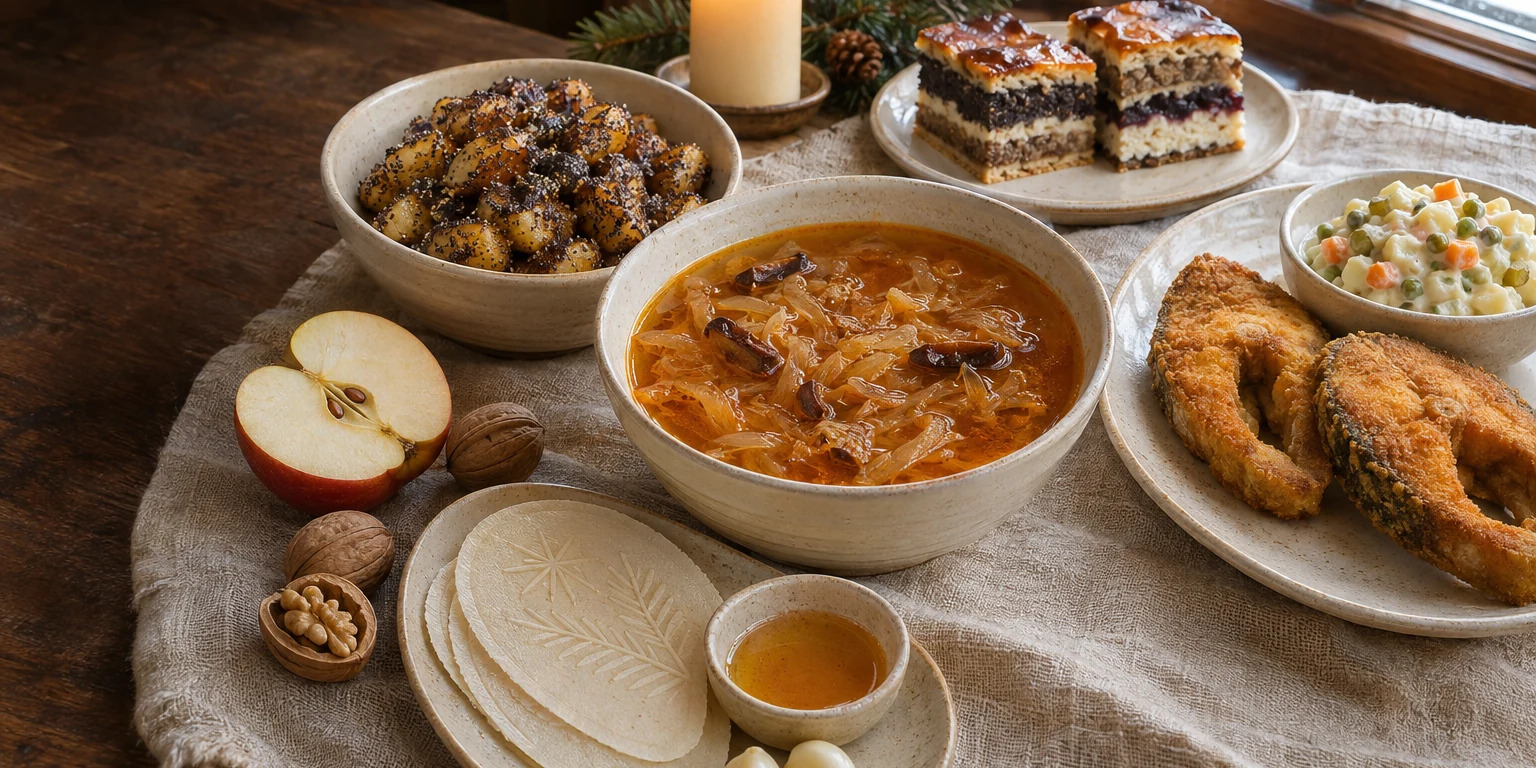
A bowl of kapustnica can tell you quite a lot about a Slovak family's Christmas. There may be dried mushrooms in the sauerkraut soup, perhaps smoked meat or sausage, or a deliberate decision to leave the meat out. Someone will remember the version made by a grandmother, and someone else will insist that the little pieces of Christmas bread should come with poppy seeds.
Those differences are part of Vianoce, Christmas in Slovakia. The best-known meal is the supper on Štedrý večer, Christmas Eve, but the season also includes Advent visits, baking, carols, gifts and the richer cooking that follows the fast. Local names and religious traditions matter as much as national favourites.
Advent, Mikuláš and Lucia
Advent has traditionally been a quieter part of the year. Older customs restricted weddings and dancing; the celebrations around St Catherine's Day, November 25, marked a boundary before that restraint. Today's Advent wreath, with another candle lit on each of four Sundays, brings a more familiar rhythm to the preparations.
For children, Mikuláš, St Nicholas, brings an early reward. Shoes are cleaned and put out on the evening before December 6, ready for sweets or small gifts the following morning. In visiting groups, Mikuláš may be accompanied by an angel and a devil. This visit has its own place in the calendar, separate from the presents opened at Christmas.
December 13 belongs to Lucia. Folk accounts connect the day with protection from witches, predictions about marriage and visitors dressed in white. One recorded game used folded slips bearing possible husbands' names, with slips discarded over the following days and the last one opened on Christmas Eve. Such practices survive through local events, recollections and playful revivals rather than as a routine in every home.
The Christmas tree also has a history. Ethnologists describe its arrival from German-speaking culture during the nineteenth century and its gradual spread through Slovak homes. Earlier decorations included greenery and hanging structures made from straw. The tree, the Advent wreath and much older food customs became neighbours in the same room over time.
Christmas Eve and the fast
Štedrý deň means December 24, the whole day; Štedrý večer names its evening. Cooking, baking and preparing the house lead towards the family supper. The traditional signal to begin is the first star, followed in practising Christian households by prayer.
Fasting explains much of the food, although there has never been one rule followed identically across Slovakia. In older Roman Catholic practice, the meal excluded meat but allowed fish. Lutheran families could eat meat at the Christmas Eve supper. Present-day households preserve, combine or change these patterns, so sausage in a Christmas soup does not by itself make a family recipe an error.
Eastern Christian traditions need their own explanation. The Orthodox Church in Slovakia describes a stricter Christmas Eve fast without meat, dairy or eggs, and, in its account of strict observance, without fish as well. Communities following the Julian church calendar keep Christmas Eve on January 6 and Christmas Day on January 7 in the present civil calendar. This does not describe every eastern Slovak household or every Eastern Christian parish.
Children were once promised a glimpse of a golden pig if they managed the Christmas Eve fast. It is a piece of seasonal folklore, rather than a reason to impose an adult fasting practice on a child.
Setting the Christmas table
Older descriptions make the table almost a small representation of the household's hopes. Grain, pulses, poppy seeds and coins could be placed on the cloth, with farm tools underneath. A chain around the table legs belonged to this world of protective customs. Fish scales later joined the objects associated with prosperity.
Some of those gestures remain recognisable today, particularly putting coins beneath the cloth or keeping a carp scale. Others are mostly encountered in museums or family stories. Their meanings concerned a secure harvest, sufficient food and keeping the household together; they should not be presented as things every Slovak family still does.
An additional plate can express hospitality towards a traveller or someone alone. Historical accounts also describe a place or a first spoonful set aside for departed ancestors. Those are related ways of making room for someone absent, but they need not mean the same thing to every family.
There is no fixed Slovak list of twelve Christmas Eve dishes. Ethnographic accounts commonly describe seven or nine courses, while twelve is documented in some local traditions, including Goral communities in the Pieniny area. The number, the order and what counted as a course varied. A smaller family supper belongs to the holiday too.
Wafers, honey and garlic
The opening taste of supper is often a Christmas wafer, oblátka, with honey and sometimes garlic. Crisp, thin wafers are baked between patterned iron plates; flat shapes and rolled tubes both occur. Honey lends sweetness, while garlic carries a traditional association with health and protection.
The wafers once connected the meal with the village school and church. Teachers, known as rechtori, baked them, and pupils helped collect grain or distribute the finished wafers with seasonal wishes. Later, other village bakers took on the work. Buying wafers today continues a custom that once involved a much wider exchange within the community.
The Slovak wafer is usually described through eating it with honey and garlic. It should not automatically be given the same household ritual as the Polish sharing of opłatek. Eastern Christian accounts also record small leavened ritual breads, prosfory or proskury, rather than assuming one wafer tradition for every confession.
Kapustnica and other Christmas soups
Kapustnica is a sauerkraut soup, and one of the most recognisable Slovak Christmas dishes. Dried mushrooms give many versions their aroma. Richer recipes may contain smoked pork and sausage, while meatless preparations belong to fasting tables. The family recipe determines the balance of sour cabbage, mushrooms, seasoning and any additions.
It is useful to distinguish a fasting kapustnica from a festive meat version before choosing a recipe. A soup cooked with smoked meat cannot be made meatless simply by lifting the sausage out of the bowl. Nor is Czech zelňačka or Polish kwaśnica another name for every Slovak kapustnica, even though the dishes share ingredients and a wider Central European setting.
Other Christmas soups use lentils, peas, beans, dried mushrooms or dried fruit. Accounts of older meals also mention sour cereal soup, kyseľ. These are alternatives within a large repertoire, rather than extra courses that every household must cook alongside kapustnica.
Local writing from Zemplín describes Christmas mushrooms cooked with sauerkraut liquid, with dumplings or other dough preparations beside them. Reports from northern Spiš record pea soup with mushrooms, sour bean dishes and slifčanka, a preparation of cooked dried plums, sometimes served with potatoes. The familiar cabbage soup is only one way to begin the meal.
Fish and potato salad
Vyprážaný kapor, fried carp, with zemiakový šalát, potato salad, is a familiar modern Christmas Eve pairing. Other fish also appear. Potato salad often contains mayonnaise, although family recipes and dressings differ.
The pairing is newer than the wafer, pulses and ceremonial bread. The Centre for Traditional Folk Culture describes the spread of fish pieces fried in oil and served with potatoes or potato salad during the second half of the twentieth century. Fish had a place at fasting meals before this particular combination became widespread.
Our available fried carp recipe is a Polish version using flour, egg and breadcrumbs. It offers a closely related preparation for this shared Christmas fish tradition; it is labelled with its actual origin. A Slovak potato salad remains a separate dish to prepare alongside it.
Opekance, poppy-seed noodles and pirohy
Opekance are small baked pieces of dough softened before eating, commonly with hot water or milk, then dressed with ground poppy seeds and honey or sugar. Regional names include bobaľky, pupáky and pupáčky. They may be cut from longer baked pieces or shaped as small pieces before baking.
The names describe a family of preparations with local differences. Some households use curd cheese or bryndza; Zemplín accounts also record versions with sauerkraut. The choice of liquid, fat and topping matters when a family follows a particular fast. Milk, butter and cheese are not suitable for every form of observance.
They are substantial Christmas food, although some families serve sweet poppy-seed opekance at the end of supper as a dessert. The important step is the softening of the baked dough. Their role cannot be reproduced simply by putting an unrelated sweet bun on the table.
Rezance s makom, noodles with poppy seeds, and filled boiled pirohy also appear in Christmas accounts. Fillings differ locally, from plum preserves to savoury preparations. These dishes explain why poppy seeds and dough recur so often across the table, without requiring every family to serve all of them.
Christmas baking: four fillings and a ceremonial loaf
Štedrák and filled baking
Štedrák gives abundance a visible form. A well-documented version has five thin layers of yeast dough enclosing four fillings: walnut, poppy seed, plum preserves and curd cheese. Each slice shows the different layers. It is a Christmas cake with its own construction, rather than a general name for a poppy-seed roll.
Poppy-seed makovník and walnut orechovník belong to the wider repertoire of filled festive baking. Honey cookies, medovníky, jam-filled linecké biscuits, vanilla crescents and honey slices also appear in contemporary Christmas baking. The tray differs from one household to another, and older accounts should not be read as proof that every present-day biscuit has always been baked in every village.
Vianočka and kračun
Western Slovak accounts describe vianočka, a braided Christmas loaf, alongside filled buns and štedrák. The related Czech vánočka recipe already on this site is a Bohemian version of that neighbouring bread tradition. It contains milk, butter and eggs, which matters when choosing when to serve it.
In eastern Slovakia, kračun or kračunik names ceremonial Christmas bread or cake. Recorded forms changed from one place and period to another. Grain, seeds, garlic and honey could carry hopes for health and a good harvest. Some loaves were shared before supper; others remained on the table until New Year or Three Kings.
A single modern recipe cannot stand for every historical kračun. Its ceremonial role, and the idea that the household should have bread throughout the coming year, matter as much as one particular shape.
Regional Christmas tables
Western Slovakia and Bratislava
Dialect records from western Slovakia give names and places to Christmas baking: braided vianočka, filled Christmas buns and štedrák. On Záhorie, a ceremonial cake called vrtáň was baked for carol singers and shepherds. Baking reached beyond the people sitting down to supper.
Bratislava contributes its own city pastry, bratislavské rožky, with poppy-seed or walnut filling. The rolls can be found at the city's Christmas market, although they are enjoyed throughout the year. They fit an Advent baking selection without being described as a compulsory Christmas Eve course.
Northern Spiš and the Pieniny area
Goral, Rusyn and Carpathian German histories meet within a relatively small area. A documented supper in Veľký Lipník begins with bread and garlic and includes sweet bobaľky, pea soup with mushrooms and a dried-plum dish. Nearby communities have their own combinations.
Other recorded foods include sour beans, poppy-seed noodles, pirohy with plum preserves and zočurka s juhom, potatoes with dried mushrooms and sauerkraut liquid. Festive baking includes a round kuch and gruľovník with potato filling. These are local examples, rather than a menu for the whole region.
The northeast and Zemplín
At the Museum of Ukrainian Culture in Svidník, Christmas programmes have included mačanka, bobaľky and slyvčanka, retaining dishes associated with northeastern Slovakia. Mačanka or máčanka can be a thick sour preparation using sauerkraut liquid, dried mushrooms and garlic, eaten with bread. Versions with smoked meat and dairy also exist, so its name alone does not establish that it is a fasting dish.
Writing on Zemplín cooking records Christmas bobaľky with several toppings and mushrooms as an important part of the supper. The same dish name can travel between households while the preparation changes. Marriage, migration and shared kitchens continually reshape regional traditions.
Apples, presents, carols and midnight
Apples and walnuts bring another kind of conversation to the table. A healthy interior in a cut apple or cracked nut was read as a favourable sign for the year ahead. Other recorded predictions involved candle flames or twelve salted onion layers used as a weather calendar. These are historical beliefs and, in some homes, seasonal games, not predictions with any factual authority.
Older stories say that animals can speak at midnight and water can turn to wine. Accounts also describe crumbs or bread left for visiting souls. Such stories help explain the attention paid to the meal's smallest remains; they are not instructions to leave perishable dishes out overnight.
Children today expect Ježiško, the Baby Jesus, to bring the Christmas presents. Gifts are commonly opened on Christmas Eve. Ethnographic accounts distinguish this modern family gift-giving, which spread with the Christmas tree, from older gifts of wishes, songs and food.
Carols, koledy, can fill the rest of the evening. Visiting singers and nativity plays, betlehemské hry, carry the story of the Nativity beyond the household. For practising Roman Catholics, polnočná omša, Midnight Mass, is a central part of the night.
Another living custom is the Bethlehem Peace Light, brought into communities by Slovak scouts since 1990. It belongs to the present-day Christmas season alongside traditions recorded much earlier.
From Christmas Day to Three Kings
The first and second Christmas holidays, December 25 and 26, allow a different kind of cooking from a fasting supper. Historical accounts describe meat broth, meat with cabbage or grains, and foods from the winter pig slaughter: sausages, jaternice, pork aspic called huspenina, and pressed meat preparations. Some Roman Catholic families formerly began eating meat after returning from Midnight Mass.
December 26, St Stephen's Day or Štefan, also belongs to visiting, greetings and entertainment. The štefanská zábava, the St Stephen's dance, marked a return to dancing after Advent restrictions. Older local customs included gifts of festive bread to workers and carol singers.
New Year's meals could bring back Christmas soups, opekance and richer meat dishes. Folk interpretations associated lentils with money and pork with good fortune. Warnings against eating poultry, lest luck fly away, belong to that same symbolic language, rather than a universal rule for modern holiday cooking.
Traja králi, Three Kings on January 6, is another traditional marker of the season. Visiting groups and the blessing of homes retain its place in local celebrations. This date should be read alongside the different calendar used by communities whose Christmas celebrations are only then beginning.
Christmas market food
A Christmas market offers a broader menu than a family's fasting supper. Bratislava's market stalls sell foods such as lokše, sausages, kapustnica, filled pastries and chimney cakes, with mulled drinks and mead. A market meal and a ritual supper have different purposes, even when some dishes appear in both settings.
Lokše here usually means thin potato flatbreads with sweet or savoury toppings. In some dialect records, including Turiec, the same word is used for opekance. The name needs its local context: a potato flatbread and softened pieces of baked Christmas dough are different preparations.
Trdelník is a popular market sweet, baked around a cylinder. Our recipe is a home oven version. Bryndzové halušky also appear at Christmas markets; the version on this site contains bacon. Their presence at a stall does not make them a required course at a fasting Christmas Eve supper.
Among winter drinks, hriate or hriatô is warmed spirit with honey or sugar and fat, traditionally butter or lard in recorded versions. It is distinct from medovina, mead, which is also sold warm at markets. Non-alcoholic dried-fruit drinks belong to the older Christmas repertoire as well.
Our Slovak Christmas recipe collection brings together the relevant dishes currently available on this site, with their origins and occasions explained. The traditions described here extend beyond that selection, from a bowl of meatless kapustnica to a ceremonial loaf remembered in one village.